

Outsourcing administrative functions delivers measurable financial impact, with businesses achieving cost reductions of 25-60% through labor arbitrage and eliminating recruitment overhead. Beyond immediate savings, outsourcing unlocks access to specialized multilingual talent capable of delivering 24/7 customer support across global markets. For telecom, SaaS, and e-commerce companies managing complex international operations, this approach transforms administrative burden into competitive advantage. This guide explains how outsourcing administrative services drives scalable growth, enhances customer experience through multilingual capabilities, and enables your team to focus on core business priorities while maintaining operational excellence and cost efficiency.
Table of Contents
- Key takeaways
- How outsourcing reduces costs and boosts efficiency
- Enhancing customer experience with multilingual, 24/7 support
- Navigating challenges and optimizing outsourced administrative services
- Applying outsourcing strategies for scalable growth in telecom, SaaS, and e-commerce
- Partner with CallTech for expert multilingual outsourcing
- Frequently asked questions about outsourcing administrative services
Key Takeaways
| Point | Details |
|---|---|
| Cost savings range | Outsourcing admin reduces costs by 25 to 60 percent through labor arbitrage and lower recruiting and training overhead. |
| Multilingual 24/7 support | Access to multilingual agents delivering 24/7 support improves customer satisfaction by 15 to 25 percent. |
| Process optimization gains | Experienced outsourcing partners provide refined workflows and technology infrastructure that accelerate implementation and reduce trial and error. |
| Short term CSAT recovery | Short term CSAT may dip but it recovers with proper training and transition planning. |
How outsourcing reduces costs and boosts efficiency
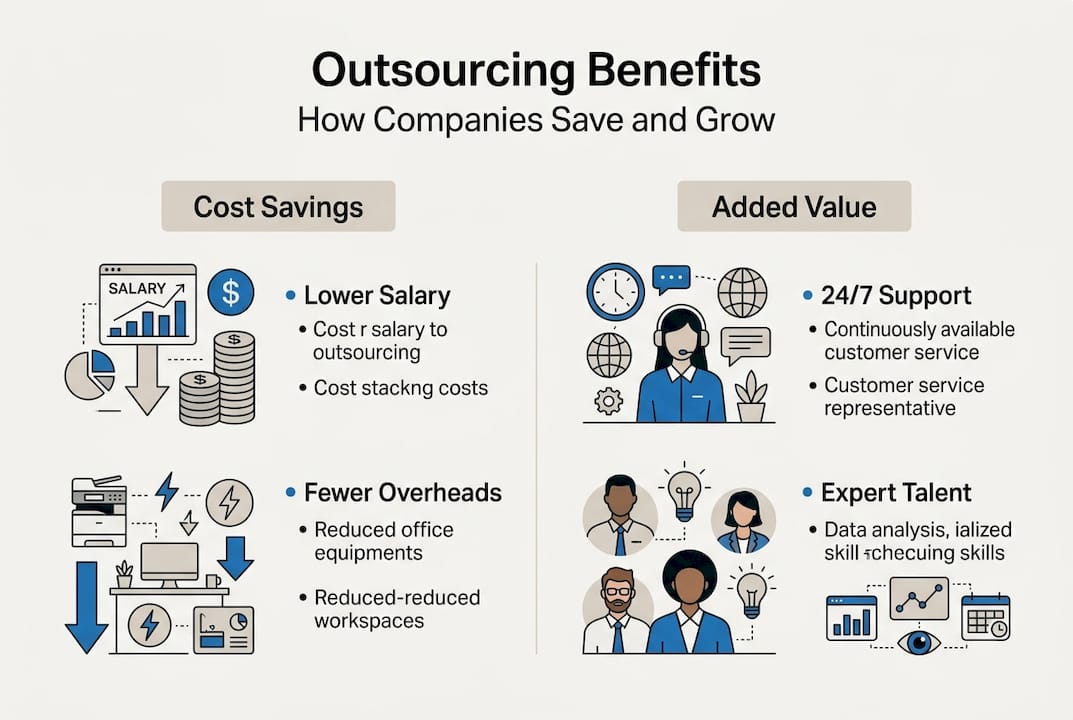
Labor arbitrage represents the primary driver of cost savings when outsourcing administrative services. By partnering with providers in regions offering competitive wage structures, companies access skilled professionals at significantly lower rates than domestic hiring. This advantage becomes particularly pronounced for customer support, data entry, scheduling, and back-office functions where operational costs drop 25-60% compared to maintaining equivalent in-house teams.
Beyond direct salary differences, outsourcing eliminates substantial hidden expenses. Recruitment processes consume weeks of management time and thousands in advertising, screening, and interviewing costs. Training new hires requires dedicated resources, onboarding programs, and productivity ramp-up periods. HR administration adds ongoing compliance, benefits management, and employee relations overhead. Outsourcing transfers these burdens to specialized providers who maintain trained, ready-to-deploy teams.

Process optimization delivers additional efficiency gains. Established outsourcing partners bring refined workflows, proven quality control systems, and technology infrastructure already configured for administrative excellence. They've solved common operational challenges across multiple clients, applying those learnings to your operations immediately. This expertise accelerates implementation timelines and reduces trial-and-error costs.
Pro Tip: Calculate total cost of ownership when evaluating outsourcing options. Include not just hourly rates but also avoided recruitment fees, training expenses, management overhead, technology infrastructure, and workspace costs to understand complete savings potential.
The financial comparison becomes clear when examining cost components side by side:
| Cost component | In-house team | Outsourced team |
|---|---|---|
| Base salary/wages | $45,000-65,000 per agent annually | $18,000-28,000 per agent annually |
| Recruitment costs | $3,000-5,000 per hire | Included in service fee |
| Training and onboarding | $2,000-4,000 per agent | Provider responsibility |
| Benefits and payroll taxes | 25-35% of salary | Not applicable |
| Technology and infrastructure | $500-1,200 per seat annually | Included in service model |
| Management overhead | 15-20% of team cost | Reduced supervision needed |
| Workspace and facilities | $8,000-12,000 per seat annually | Not required |
Companies leveraging offshore call centers for cost savings maintain service quality while redirecting saved capital toward product development, marketing, and strategic growth initiatives. The efficiency gains compound over time as outsourcing partners refine processes and scale operations without proportional cost increases.
Enhancing customer experience with multilingual, 24/7 support
Global markets demand customer support that transcends time zones and language barriers. Multilingual outsourcing teams enable seamless communication with customers across Europe, Asia, and Americas in their native languages. This capability boosts customer satisfaction by 15-25% compared to English-only support models that force non-native speakers into uncomfortable interactions.
Follow-the-sun operations eliminate traditional support limitations. When your New York office closes, your outsourced team in Manila or Bucharest continues handling inquiries without interruption. Customers receive immediate assistance regardless of when they contact you, dramatically reducing wait times and abandoned tickets. This 24/7 availability transforms customer perception, positioning your brand as responsive and globally capable.
Specialized talent acquisition becomes straightforward through outsourcing call center services. Providers maintain pools of agents fluent in German, French, Spanish, Italian, Polish, and other European languages. They handle recruitment, language proficiency testing, and cultural training. You gain instant access to multilingual capabilities that would take months to build internally and require ongoing management complexity.
Pro Tip: Ensure your outsourcing partner aligns agent training with your brand values, product knowledge, and communication style. Initial CSAT scores may dip during transition periods, but proper onboarding and continuous feedback loops restore and exceed previous performance levels within 60-90 days.
| Support capability | In-house multilingual team | Outsourced multilingual team |
|---|---|---|
| Language coverage | Limited to hired staff (typically 2-4 languages) | 15+ European languages readily available |
| Operating hours | Standard business hours with expensive shift premiums | True 24/7/365 coverage at standard rates |
| Scaling speed | 8-12 weeks to recruit and train new language speakers | 2-4 weeks to add new languages or expand capacity |
| Cultural expertise | Requires specific hiring and ongoing training | Built-in through native speakers in target markets |
| Cost per language | High due to specialized talent scarcity | Competitive through regional labor markets |
| Peak volume handling | Limited by fixed headcount | Flexible scaling for seasonal or campaign spikes |
Implementing a robust multilingual call center process requires coordination between your product team and outsourced agents. Regular knowledge base updates, product release communications, and feedback channels ensure agents represent your brand accurately across all languages. This investment in ongoing collaboration protects customer experience quality while maintaining the cost and flexibility advantages of outsourcing.
Short-term adaptation challenges emerge during transitions but prove manageable with structured approaches. Agents need time to internalize product nuances, understand customer pain points, and develop rapport with your specific customer base. Companies that invest in comprehensive onboarding, provide detailed documentation, and maintain open communication channels see faster performance recovery and stronger long-term results.
Navigating challenges and optimizing outsourced administrative services
Communication gaps represent the most cited concern when outsourcing administrative functions. Time zone differences, language nuances, and cultural communication styles can create misunderstandings that impact service quality. However, these challenges diminish rapidly with deliberate management practices and clear protocols.
Quality control requires different approaches than managing in-house teams. You lose direct supervision visibility but gain access to professional quality assurance systems that mature providers implement. The key lies in defining measurable performance indicators, establishing regular reporting cadence, and maintaining collaborative rather than authoritarian relationships with outsourcing partners.
Short-term customer satisfaction may lag during initial transition periods as outsourced teams learn your products, customers, and processes. This temporary dip recovers within 60-90 days when proper training and feedback mechanisms exist. Companies that accept this adaptation period and invest in thorough onboarding achieve superior long-term performance compared to rushed implementations.
Successful outsourcing partnerships require ongoing training, performance monitoring, and collaborative problem-solving rather than simple vendor management. Treat your outsourcing provider as an extension of your team, not an external commodity.
Implement these best practices to ensure smooth integration and sustained performance:
- Establish comprehensive service level agreements defining response times, resolution rates, quality scores, and escalation procedures with specific metrics and consequences.
- Create detailed knowledge bases, process documentation, and product guides accessible to outsourced teams with regular updates reflecting product changes and common customer issues.
- Schedule weekly alignment calls during initial months, transitioning to biweekly or monthly cadence as operations stabilize and performance metrics meet targets.
- Implement quality monitoring systems reviewing random ticket samples, call recordings, and customer feedback to identify training opportunities and recognize excellent performance.
- Develop clear escalation paths connecting outsourced agents with internal subject matter experts for complex technical issues or sensitive customer situations requiring specialized knowledge.
- Maintain open feedback channels allowing outsourced teams to share customer insights, process improvement suggestions, and operational challenges they encounter.
- Invest in cultural training helping outsourced agents understand your target markets, customer expectations, and brand personality beyond simple script adherence.
Cultural differences extend beyond language to encompass communication styles, problem-solving approaches, and customer service philosophies. European customers expect different interaction patterns than North American markets. Asian support teams may require guidance on assertiveness levels appropriate for Western customers. Address these nuances through cultural competency training and regular calibration sessions.
Technology integration deserves careful planning. Your CRM systems, ticketing platforms, and communication tools must accommodate outsourced team access while maintaining security protocols. Cloud-based platforms simplify this integration compared to legacy on-premise systems. Evaluate outsourcing telecom support tips for industry-specific implementation guidance that addresses common technical and operational challenges in telecom, SaaS, and e-commerce environments.
Applying outsourcing strategies for scalable growth in telecom, SaaS, and e-commerce
Selecting the right outsourcing partner determines success or failure of your administrative services strategy. The evaluation process requires examining multiple dimensions beyond simple cost comparison. Look for providers demonstrating proven experience in your industry, robust technology infrastructure, and cultural alignment with your business values.
Essential criteria for evaluating potential outsourcing partners include:
- Scalability capabilities allowing rapid team expansion during growth phases or seasonal peaks without quality degradation or extended ramp-up periods
- Language coverage matching your current and planned market expansion with native speakers rather than second-language proficiency
- Technology stack compatibility ensuring seamless integration with your existing CRM, ticketing, and communication platforms without expensive custom development
- Industry expertise reflected in client references, case studies, and agent training programs specific to telecom, SaaS, or e-commerce operations
- Quality assurance systems including call monitoring, ticket auditing, and continuous improvement processes with transparent reporting
- Security and compliance certifications appropriate for your data handling requirements and regulatory environment
- Cultural fit demonstrated through communication style, problem-solving approach, and willingness to adapt processes to your specific needs
Integration with existing internal teams requires thoughtful planning. Define clear boundaries between outsourced and in-house responsibilities. Typically, outsourced teams handle tier 1 support, routine administrative tasks, and high-volume transactional work while internal staff focus on complex problem resolution, strategic customer relationships, and product expertise requiring deep institutional knowledge. This division maximizes efficiency while maintaining quality on challenging interactions.
Technology platform selection impacts outsourcing success significantly. Modern cloud-based solutions enable distributed teams to access customer data, communication tools, and knowledge bases seamlessly. Evaluate call center platforms for telecom that support multilingual operations, provide robust reporting, and integrate with popular CRM systems. The right technology foundation eliminates common friction points and enables smooth collaboration.
Proactive performance monitoring separates successful outsourcing implementations from struggling ones. Establish weekly review cycles examining key metrics: first response time, resolution rate, customer satisfaction scores, ticket backlog, and quality audit results. Identify trends early and address issues before they impact customer experience. Celebrate wins and recognize high-performing agents to build engagement and loyalty within outsourced teams.
Continuous improvement mindset drives long-term value. Your outsourcing partner should proactively suggest process refinements, identify training opportunities, and share customer insights gathered through daily interactions. This collaborative approach enables scalable customer support that grows more efficient over time rather than simply maintaining baseline performance.
Leveraging outsourcing for core business focus represents the ultimate strategic advantage. Every hour your leadership team spends managing administrative functions diverts attention from product development, market expansion, and revenue growth. Outsourcing transfers operational burden to specialists, freeing your team to concentrate on activities directly impacting competitive position and market share.
Partner with CallTech for expert multilingual outsourcing
Transforming administrative overhead into strategic advantage requires partnering with experienced providers who understand telecom, SaaS, and e-commerce operational demands. CallTech delivers tailored outsourcing call center services combining nearly 20 years of multilingual expertise with modern technology infrastructure and competitive pricing structures.

Our teams support customers across 15+ European languages through follow-the-sun models ensuring 24/7 availability without premium pricing. We integrate seamlessly with your existing systems, maintain rigorous quality standards, and scale rapidly to match your growth trajectory. From customer care and technical support to subscription management and outbound campaigns, our comprehensive service portfolio addresses diverse administrative needs.
Pro Tip: Experienced providers like CallTech reduce transition risks through proven onboarding methodologies, established quality systems, and dedicated account management ensuring your outsourcing initiative delivers expected results from day one.
Key advantages of partnering with CallTech include:
- Multilingual native speakers covering major European markets plus English support
- Flexible scaling accommodating seasonal peaks and rapid business growth
- Modern VOIP and CRM infrastructure ensuring efficient operations
- Competitive pricing delivering 40-60% cost savings versus in-house teams
- Industry expertise serving telecom, SaaS, and e-commerce clients globally
Explore our call center platforms for telecom and discover why leading companies choose CallTech as their long-term outsourcing partner. Review our comprehensive guide to best call center services to understand how we deliver exceptional customer experience while maintaining operational efficiency.
Frequently asked questions about outsourcing administrative services
What types of administrative services are best to outsource?
Customer support, technical helpdesk, subscription and billing inquiries, data entry, appointment scheduling, and back-office processing deliver the highest ROI when outsourced. These high-volume, process-driven functions benefit most from labor arbitrage and specialized provider expertise while freeing internal teams for strategic work.
How soon can I expect cost savings after outsourcing?
Immediate savings appear in eliminated recruitment costs and reduced payroll expenses, typically within the first billing cycle. Full cost benefits including avoided HR overhead, training expenses, and infrastructure costs materialize over 90-180 days as you optimize team sizing and processes. Most companies achieve target ROI within six months.
How do multilingual teams improve my customer support?
Native language support eliminates communication barriers, reduces resolution times, and increases customer satisfaction by 15-25%. Customers feel more comfortable explaining complex issues in their primary language, leading to better problem understanding and faster solutions. This capability also expands addressable markets without proportional cost increases.
What should I look for when choosing an outsourcing partner?
Prioritize proven industry experience, scalable infrastructure, language capabilities matching your markets, robust quality assurance systems, and cultural alignment with your business values. Request client references, review case studies, and conduct pilot programs before full-scale commitments. Technology compatibility and security certifications also merit careful evaluation.
Can outsourcing impact my existing customer satisfaction scores?
Short-term CSAT may dip 5-10% during initial transition as outsourced teams learn your products and processes. This temporary decline reverses within 60-90 days with proper training and feedback systems. Long-term scores typically exceed previous levels due to improved availability, faster response times, and multilingual capabilities. Review outsourcing telecom support tips for strategies minimizing transition impact.
How does AI-assisted support work with outsourced teams?
Modern outsourcing incorporates AI tools for ticket routing, response suggestions, and sentiment analysis while maintaining human agents for complex interactions requiring empathy and judgment. Hybrid models use chatbots for simple FAQs and routine requests, escalating nuanced issues to multilingual agents. This combination delivers 24/7 automated coverage for basic needs while preserving personalized service for important customer interactions.