

Many business leaders hesitate to consider offshore call centers, fearing compromised service quality or communication breakdowns. Yet the reality challenges this misconception. Offshore call centers can reduce operational costs by 40-60% while simultaneously enhancing customer support through 24/7 global coverage and specialized expertise. As businesses navigate competitive markets in 2026, understanding how offshore centers deliver both financial efficiency and superior service becomes essential. This guide explores the strategic advantages that make offshore call centers a powerful solution for organizations seeking to optimize operations and expand their global reach.
Table of Contents
- Cost Advantages Of Offshore Call Centers
- Enhancing Customer Support With Global Coverage And Expertise
- Choosing The Right Offshore Location: Factors And Comparisons
- Operational Efficiency And Scalability Benefits Of Offshore Call Centers
- Why Choose Offshore Call Centers: Frequently Asked Questions
Key takeaways
| Point | Details |
|---|---|
| Cost efficiency | Offshore call centers deliver 40-60% operational cost reductions through lower labor and infrastructure expenses |
| Global coverage | Time zone differences enable continuous 24/7 customer support without additional shift premiums |
| Location strategy | Selecting the right offshore destination based on language skills and cultural alignment determines success |
| Scalability advantage | Offshore partners provide flexible staffing models that support rapid business growth and seasonal demands |
Cost advantages of offshore call centers
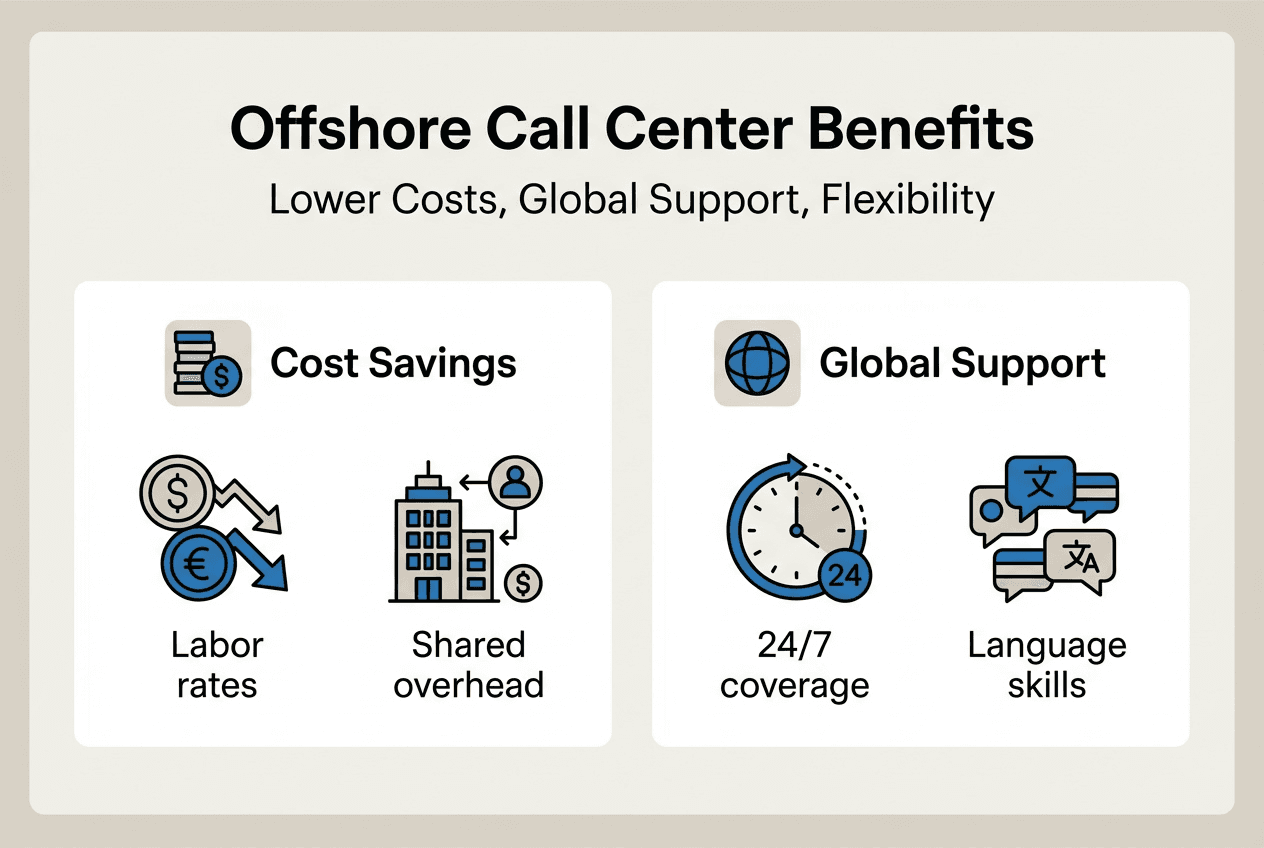
The financial case for offshore call centers extends far beyond simple wage differences. Cost savings range from 40% to 70% depending on location and service complexity, driven by three primary factors: labor costs, infrastructure expenses, and operational overhead.
Labor represents the most significant savings component. In the Philippines, skilled customer service agents earn $3-6 per hour compared to $15-25 in the United States. India offers even lower rates at $2-5 per hour, while Mexico provides $5-10 per hour with the added benefit of geographic proximity. These wage differences reflect local market conditions rather than skill disparities, as offshore locations maintain robust talent pools with strong educational systems.
Infrastructure costs compound these savings. Offshore providers absorb expenses for office space, telecommunications equipment, backup power systems, and technology platforms. A 50-seat call center in Manila costs roughly $8,000 monthly for facilities and utilities, versus $25,000 for equivalent space in major US cities. This infrastructure advantage allows businesses to redirect capital toward growth initiatives rather than operational overhead.
Operational overhead decreases through economies of scale. Established offshore providers spread fixed costs across multiple clients, reducing per-seat expenses for recruitment, training, quality assurance, and management. Benefits administration, payroll processing, and compliance management become the provider's responsibility, eliminating these internal burdens.
Pro Tip: Calculate total cost of ownership by including technology integration, management time, and transition expenses alongside per-hour rates. The lowest hourly rate doesn't guarantee the best value if hidden costs erode savings.
Consider outsourcing multilingual contact center services to access these cost advantages while maintaining service quality. The key lies in selecting partners who balance affordability with proven operational excellence, ensuring cost savings translate to sustainable competitive advantage rather than short-term budget relief.
Enhancing customer support with global coverage and expertise
Beyond cost reduction, offshore call centers enable 24/7 customer support coverage through strategic time zone positioning. When your US-based team ends their shift, agents in Manila or Bangalore begin theirs, creating seamless round-the-clock availability without expensive night shift premiums or weekend surcharges.
This continuous coverage transforms customer experience. Technical issues arising at 2 AM Eastern Time receive immediate attention from fully staffed teams operating during their standard business hours. E-commerce businesses handle order inquiries and cart abandonment recovery in real time across all time zones. SaaS companies provide instant troubleshooting when users encounter problems, reducing churn and improving satisfaction scores.

Language proficiency elevates service quality beyond simple availability. The Philippines produces over 500,000 college graduates annually, many with neutral English accents and strong communication skills honed through American cultural exposure. India's education system emphasizes English fluency, creating a workforce capable of handling complex technical support and financial services interactions. Mexico offers native Spanish speakers with English proficiency, ideal for serving Hispanic markets across the Americas.
Cultural alignment matters as much as language skills. Filipino agents excel in hospitality-oriented interactions, making them natural fits for customer service and retention campaigns. Indian teams bring analytical strengths to technical support and IT helpdesk roles. Eastern European agents offer cultural affinity with Western business practices, enhancing B2B support quality.
Pro Tip: Align your offshore provider's cultural strengths with your target market characteristics. A retail brand serving US consumers benefits from Filipino agents' service orientation, while a software company might prioritize Indian teams' technical depth.
The expertise advantage extends to specialized skills. Offshore markets develop concentrations of industry-specific talent. Manila hosts numerous healthcare BPO operations, creating deep pools of HIPAA-trained agents familiar with medical terminology. Indian cities like Bangalore and Hyderabad attract tech-savvy professionals suited for software support. This specialization allows businesses to access expertise that might prove scarce or expensive domestically.
Explore multilingual contact center services that combine global coverage with cultural competency, transforming offshore outsourcing from a cost play into a strategic service enhancement.
Choosing the right offshore location: factors and comparisons
Location selection directly impacts success as different regions offer distinct advantages aligned with specific business needs. Four criteria drive optimal location choice: language proficiency, cultural compatibility, time zone alignment, and cost structure.
Language proficiency determines communication quality. The Philippines ranks highest for neutral English accents and conversational fluency, making it ideal for US and UK markets. India offers strong English skills with greater accent variation, suited for technical support where expertise outweighs accent concerns. Mexico provides native Spanish with English proficiency, perfect for bilingual North American operations. Eastern Europe delivers multiple European languages with technical aptitude.
Cultural compatibility affects customer rapport. Filipino culture emphasizes hospitality and relationship building, creating warm customer interactions. Indian business culture values education and problem-solving, supporting analytical support roles. Mexican culture shares time zone and cultural touchpoints with US businesses, easing collaboration. Eastern European work culture aligns with Western business practices and communication styles.
Time zone alignment influences operational efficiency. Asian locations provide overnight coverage for US businesses but complicate real-time collaboration. Mexico operates in US time zones, enabling synchronous teamwork and immediate escalation handling. Eastern Europe bridges US and Asian hours, supporting global operations.
| Location | Primary Advantages | Best Use Cases | Typical Cost Range |
|---|---|---|---|
| Philippines | Neutral English accent, customer service culture, 24/7 US coverage | Retail support, customer retention, hospitality services | $3-6 per hour |
| India | Technical expertise, cost efficiency, large talent pool | IT helpdesk, technical support, back-office operations | $2-5 per hour |
| Mexico | Time zone alignment, Spanish fluency, cultural proximity | Bilingual support, real-time collaboration, US market focus | $5-10 per hour |
| Eastern Europe | European languages, technical skills, Western business alignment | B2B support, technical services, European market coverage | $8-15 per hour |
Pro Tip: Balance cost savings with quality factors by prioritizing locations that match your customer demographics and service complexity, not just the lowest hourly rate.
Consider outsourcing contact center services to providers with multi-location capabilities, allowing you to optimize different functions across complementary offshore destinations rather than forcing all operations into a single location.
Operational efficiency and scalability benefits of offshore call centers
Offshore outsourcing delivers faster scaling and operational efficiency when businesses choose the right partner and establish proper processes. The scalability advantage proves particularly valuable during growth phases, seasonal peaks, and market expansion.
Rapid team scaling becomes straightforward with offshore partners. Adding 20 agents domestically requires 6-8 weeks for recruitment, training, and onboarding. Established offshore providers maintain talent pipelines and training infrastructure, deploying new teams within 2-3 weeks. This agility supports product launches, seasonal campaigns, and unexpected demand spikes without lengthy preparation.
Flexible staffing models reduce risk. Month-to-month contracts allow volume adjustments without long-term commitments. Businesses scale up for holiday seasons or promotional campaigns, then scale down without severance costs or empty seats. This flexibility transforms fixed labor costs into variable expenses aligned with revenue.
Process standardization improves consistency. Offshore providers implement documented procedures, quality frameworks, and performance monitoring systems as core competencies. They invest in workforce management tools, call recording systems, and analytics platforms that smaller businesses might struggle to justify internally. This infrastructure ensures consistent service delivery across shifts and agent tenure.
Key steps to ensure efficient offshore operations:
- Establish detailed service level agreements covering response times, resolution rates, and quality scores with clear consequences for non-performance
- Implement real-time dashboards providing visibility into call volumes, wait times, and agent performance metrics
- Schedule weekly performance reviews and monthly business reviews to address trends and optimize processes
- Create escalation protocols defining when and how offshore teams engage internal resources for complex issues
- Develop comprehensive training programs covering product knowledge, communication standards, and brand voice guidelines
- Deploy collaboration tools enabling seamless communication between offshore teams and internal stakeholders
Pro Tip: Establish clear SLAs and frequent reporting cadences with offshore partners from day one, treating them as extensions of your internal team rather than distant vendors.
Monitoring tools maintain quality standards. Call recording and speech analytics identify coaching opportunities and compliance gaps. Customer satisfaction surveys provide direct feedback on agent performance. Quality assurance teams conduct random call reviews, ensuring adherence to scripts and procedures.
The efficiency gains extend beyond labor flexibility. Offshore providers absorb recruitment costs, reducing your hiring expenses to zero. They manage attrition and backfill positions, eliminating gaps in coverage. Their scale allows specialization, with dedicated teams for training, quality assurance, and workforce management.
Explore contact center outsourcing solutions that combine operational excellence with scalability, transforming offshore partnerships into strategic advantages rather than tactical cost moves.
Discover reliable offshore call center solutions with CallTech
CallTech Outsourcing specializes in multilingual contact center services that deliver the cost savings, global coverage, and operational efficiency explored throughout this guide. With nearly two decades of experience since 2005, CallTech combines competitive pricing with high-quality customer support across multiple languages and time zones.

Our infrastructure emphasizes reliability through advanced communication systems, redundant internet connectivity, and backup power, ensuring uninterrupted service for your customers. We leverage VOIP and CRM technologies to provide efficient, secure outsourcing solutions tailored to your industry and market requirements.
CallTech's client-first approach and cultural sensitivity align with the location selection and quality factors discussed earlier. Whether you need 24/7 English support, bilingual Spanish coverage, or specialized technical assistance, our experienced teams provide the expertise and flexibility to enhance your customer engagement while optimizing operational costs.
Pro Tip: Partner with providers experienced in your industry and target markets for best results, ensuring they understand your customers' expectations and your business challenges.
Contact CallTech today to explore how our multilingual offshore contact center services can support your global expansion and operational goals.
Why choose offshore call centers: frequently asked questions
What are the main cost savings of offshore call centers?
Offshore call centers reduce operational costs by 40-60% through substantially lower labor rates in markets like the Philippines, India, and Mexico compared to US or European wages. Additional savings come from reduced office space expenses, technology infrastructure costs, and operational overhead as providers absorb these fixed expenses across multiple clients.
How do offshore call centers maintain quality customer service?
Offshore providers maintain quality through rigorous hiring standards targeting skilled agents with strong language proficiency and customer service aptitude. They implement comprehensive training programs covering product knowledge and communication standards, while 24/7 coverage enabled by time zone differences ensures customers receive immediate attention regardless of when they reach out. Regular quality monitoring through call reviews and customer satisfaction surveys identifies improvement opportunities.
Which countries are best for offshore call centers?
The Philippines excels for English-language customer service due to neutral accents and hospitality-oriented culture, making it ideal for US retail and consumer brands. India offers the lowest costs with strong technical expertise, suited for IT support and high-volume operations. Mexico provides time zone alignment and native Spanish fluency, perfect for bilingual North American businesses. Eastern Europe delivers technical skills and European language capabilities for B2B and European market support.
How can my business ensure smooth communication with offshore teams?
Set clear expectations through detailed service level agreements covering response times, quality standards, and escalation procedures from the partnership's start. Use regular video meetings and collaboration platforms to maintain alignment and build relationships between offshore agents and internal teams. Choose partners with strong English proficiency and cultural training who understand your business context. Implement real-time dashboards and weekly performance reviews to identify issues quickly and maintain accountability.