

Many business leaders still view outsourcing as a simple cost-cutting tactic, missing its true potential for scalable multilingual customer support. Recent data shows outsourcing can deliver up to 60% cost savings while simultaneously improving customer satisfaction by 15% and reducing resolution times by 62%. For telecom, SaaS, and e-commerce companies expanding globally, understanding scalable outsourcing is no longer optional. This guide explains what scalable outsourcing truly means, its measurable benefits, the challenges you'll face, and practical steps to implement it successfully for multilingual customer support operations.
Table of Contents
- Understanding Scalable Outsourcing: Definitions And Core Concepts
- Benefits And Empirical Evidence Supporting Scalable Outsourcing In Multilingual Support
- Challenges, Risks, And Strategic Considerations In Scalable Outsourcing
- Implementing Scalable Outsourcing: Practical Steps And Best Practices For Global Customer Support
- Partner With CallTech For Scalable Multilingual Outsourcing
- Frequently Asked Questions
Key takeaways
| Point | Details |
|---|---|
| Scalable outsourcing definition | Flexible customer support model that adjusts capacity based on real-time demand across multiple languages and markets. |
| Cost and performance benefits | Delivers 60% cost savings, 15% CSAT improvement, 96.6% SLA adherence, and 62% faster resolution times. |
| Strategic risk management | Hybrid models combining insourcing and outsourcing balance control concerns with flexibility and innovation benefits. |
| Implementation success factors | Clear KPI monitoring, vendor evaluation frameworks, and cultural alignment drive sustainable multilingual support outcomes. |
| Industry fit assessment | Telecom, SaaS, and e-commerce gain maximum value from scalable outsourcing due to fluctuating demand patterns. |
Understanding scalable outsourcing: Definitions and core concepts
Scalable outsourcing refers to delegating business functions to external providers with the flexibility to rapidly adjust service capacity based on demand fluctuations. Unlike traditional fixed-capacity outsourcing, scalable models allow companies to expand or contract support resources in real time without long-term commitments or infrastructure investments. This approach proves particularly valuable for customer support operations where demand varies by season, product launches, or market conditions.
For telecom, SaaS, and e-commerce businesses operating globally, scalability becomes critical when managing multilingual customer interactions. A multilingual call center process requires native speakers across multiple languages, specialized training, and cultural competency that few companies can maintain in-house cost-effectively. Scalable outsourcing solves this by providing immediate access to pre-trained multilingual teams who can handle volume spikes without quality degradation.
The core distinction between basic outsourcing and scalable outsourcing lies in flexibility mechanisms. Scalable models incorporate variable pricing structures, on-demand agent pools, and technology platforms that enable seamless capacity adjustments. When a SaaS company launches in three new European markets simultaneously, scalable outsourcing allows instant deployment of German, French, and Spanish support teams without hiring, training, or infrastructure delays.
Key benefits of scalable outsourcing include:
- Rapid capacity adjustment matching real-time demand without fixed overhead costs
- Access to global talent pools with specialized language skills and cultural knowledge
- Technology infrastructure including CRM integration, VOIP systems, and analytics platforms
- Risk distribution across multiple service providers and geographic locations
- Focus on core business functions while experts handle complex multilingual support operations
Research shows outsourcing excels in flexibility and cost advantages for non-core scalable functions, making it ideal for customer support where demand patterns fluctuate significantly. Understanding these foundational concepts helps business leaders evaluate whether scalable outsourcing aligns with their strategic objectives and operational requirements.
Benefits and empirical evidence supporting scalable outsourcing in multilingual support
Empirical data from 2026 demonstrates compelling financial and operational advantages for companies implementing scalable outsourcing strategies. Industry benchmarks reveal up to 60% cost savings, 15% CSAT improvements, 96.6% SLA adherence, and 62% faster resolution times compared to in-house operations. These metrics represent substantial competitive advantages for businesses managing global customer interactions across multiple languages and time zones.

The BPO market is projected to reach $525 billion by 2030, with customer service representing the largest segment. This growth reflects increasing recognition that outsourcing delivers measurable value beyond simple cost reduction. For telecom companies managing technical support across 15 European languages, offshore solutions can reduce labor costs by 70% while maintaining or improving service quality through specialized training and process optimization.
| Metric | In-House Support | Outsourced Support | Improvement |
|---|---|---|---|
| Labor cost per contact | $12-18 | $4-7 | 60-70% reduction |
| Average CSAT score | 78% | 89% | +15% increase |
| SLA adherence rate | 88% | 96.6% | +8.6 points |
| Resolution time | 8.2 minutes | 3.1 minutes | 62% faster |
| Annual churn rate | 18% | 13% | 5% decrease |
Additional strategic benefits include:
- Immediate scalability allowing 200-300% capacity increases during peak periods without permanent headcount expansion
- Geographic diversification reducing operational risks from local disruptions or regulatory changes
- 24/7 multilingual coverage across time zones without expensive night shift premiums
- Access to specialized expertise in technical support, billing systems, and industry-specific processes
- Technology investments amortized across multiple clients lowering per-unit infrastructure costs
Pro Tip: Establish quarterly business reviews with outsourcing partners to monitor KPI trends, identify improvement opportunities, and ensure alignment with evolving business objectives. Track not just cost metrics but also quality indicators like first-call resolution rates and customer effort scores.
The global BPO market's trajectory toward $525 billion by 2030 reflects a fundamental shift in how companies view customer service operations. Outsourcing is no longer about cutting costs but about accessing specialized capabilities, advanced technologies, and flexible capacity that drive competitive advantage in global markets.
For e-commerce businesses experiencing seasonal volume fluctuations of 400% during holiday periods, scalable outsourcing eliminates the impossible choice between understaffing during peaks or maintaining expensive idle capacity year-round. SaaS companies launching new products can instantly deploy multilingual support teams trained on their platforms without months of recruitment and onboarding. These operational advantages translate directly to improved customer experience, reduced churn, and stronger revenue retention across international markets. Discover more about offshore call centers benefits for global expansion strategies.
Challenges, risks, and strategic considerations in scalable outsourcing
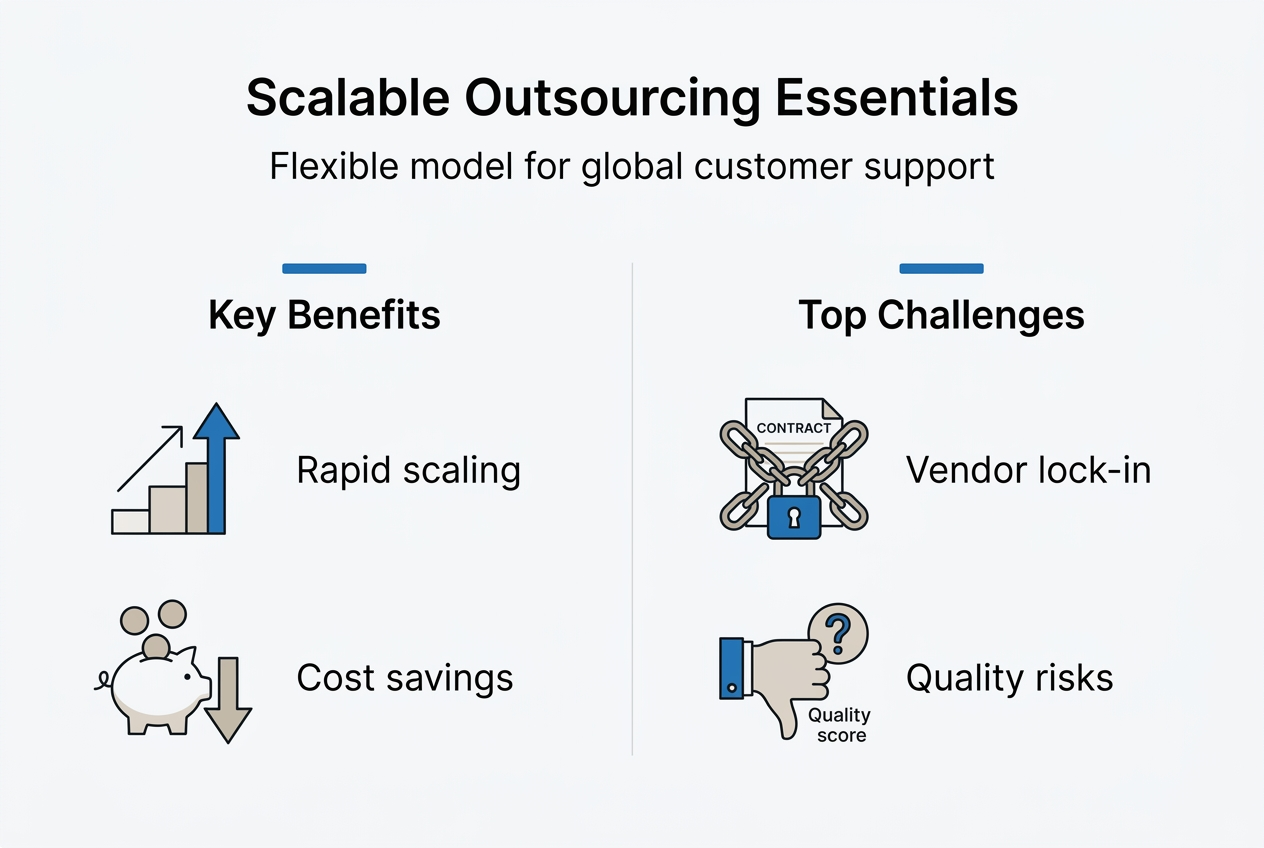
While empirical evidence supports scalable outsourcing benefits, business leaders must navigate significant challenges and strategic tradeoffs. Research indicates 87% of BPO relationships experience disruptions, highlighting the importance of careful vendor selection and ongoing relationship management. Understanding these risks enables decision-makers to implement mitigation strategies and set realistic expectations.
Vendor lock-in represents a primary concern when outsourcing critical customer support functions. Companies become dependent on external providers for institutional knowledge, customer relationships, and operational continuity. Switching vendors involves substantial transition costs, knowledge transfer challenges, and potential service disruptions. This dependency can limit negotiating leverage and reduce flexibility to adapt strategies as business needs evolve.
| Factor | Insourcing | Outsourcing |
|---|---|---|
| Initial cost | High capital investment | Low upfront expense |
| Long-term cost | Lower operational expenses | Higher per-unit costs |
| Control level | Complete operational control | Limited direct oversight |
| Flexibility | Slower capacity adjustments | Rapid scaling capability |
| Innovation | Direct R&D integration | Vendor-driven improvements |
| Strategic risk | Internal capability gaps | Vendor dependency |
Financial analysis reveals a U-shaped cost curve where outsourcing delivers immediate savings but insourcing becomes more cost-effective over extended timeframes as initial investments amortize and operational efficiencies compound. This pattern suggests outsourcing works best for non-core functions with variable demand, while strategic capabilities requiring deep integration may justify insourcing despite higher initial costs.
Common challenges requiring active management include:
- Quality control difficulties when support teams operate remotely across multiple time zones and cultural contexts
- Communication barriers including language nuances, technical terminology, and organizational alignment
- Data security concerns when sharing customer information with external vendors across international borders
- Cultural misalignment affecting brand representation and customer interaction quality
- Knowledge transfer gaps limiting vendor understanding of product complexities and business context
Pro Tip: Conduct formal make-or-buy analysis evaluating total cost of ownership, strategic importance, and capability requirements before committing to outsourcing. Consider hybrid models that insource core strategic functions while outsourcing scalable, non-core activities to balance control with flexibility.
For telecom companies, technical support requires deep product knowledge and system access that creates security and training challenges. SaaS businesses face risks when outsourced agents lack sufficient product expertise to resolve complex technical issues. E-commerce operations must ensure consistent brand experience across internal and external support channels. Learn more about outsourcing telecom support tips to address industry-specific challenges.
Successful scalable outsourcing requires ongoing monitoring, clear performance metrics, and contractual flexibility. Establish exit clauses, maintain documentation of processes and customer insights, and develop contingency plans for vendor transitions. Regular audits of quality metrics, security compliance, and strategic alignment help identify issues before they escalate into major disruptions.
Implementing scalable outsourcing: Practical steps and best practices for global customer support
Transforming outsourcing strategy from concept to operational reality requires systematic evaluation, careful partner selection, and disciplined implementation. Business leaders must balance speed to market with thorough due diligence to establish sustainable multilingual support operations that deliver measurable value.
Follow this implementation framework:
- Define requirements including language coverage, technical capabilities, volume projections, and integration needs with existing CRM and communication systems.
- Evaluate potential partners assessing track record, client references, technology infrastructure, security certifications, and cultural fit with your organization.
- Negotiate contracts establishing clear SLAs, pricing structures, performance metrics, exit clauses, and escalation procedures for issue resolution.
- Execute phased onboarding starting with limited scope to validate capabilities before full-scale deployment across all languages and channels.
- Integrate systems connecting outsourced teams to your CRM, knowledge bases, ticketing systems, and communication platforms for seamless operations.
- Monitor performance tracking KPIs weekly, conducting monthly business reviews, and implementing continuous improvement based on data insights.
- Optimize operations refining processes, updating training materials, and adjusting capacity allocation based on evolving demand patterns.
Research recommends assessing strategic fit via make-or-buy analysis and favoring outsourcing for multilingual peaks while monitoring for lock-in risks. Hybrid models that combine insourcing for core functions with outsourcing for scalable capacity offer optimal risk-reward balance for many organizations.
Critical KPIs to monitor include:
- Customer satisfaction (CSAT) scores measuring support interaction quality and issue resolution effectiveness
- Service level agreement (SLA) adherence tracking response times, availability, and performance commitments
- Average resolution time indicating efficiency and agent capability to resolve issues quickly
- First-call resolution rate showing whether customers receive complete solutions without escalations or callbacks
- Cost per contact calculating total outsourcing expenses divided by interaction volume
- Customer churn rate attributable to support experience quality and responsiveness
Pro Tip: Implement hybrid staffing models where internal teams handle complex escalations and strategic accounts while outsourced partners manage routine inquiries and volume fluctuations. This approach maintains critical institutional knowledge in-house while capturing outsourcing flexibility and cost benefits.
Technology integration proves essential for seamless multilingual support. Ensure outsourcing partners can connect to your existing systems through APIs, support omnichannel communication including phone, email, chat, and social media, and provide real-time reporting dashboards. Cloud-based platforms enable rapid scaling and geographic distribution while maintaining consistent service quality.
Cultural alignment requires ongoing attention. Conduct regular site visits, participate in training sessions, and establish clear brand guidelines covering tone, messaging, and customer interaction standards. For telecom and SaaS companies with technical products, invest in comprehensive product training and create detailed knowledge bases that external teams can reference during customer interactions.
E-commerce businesses should prioritize partners with experience managing seasonal volume spikes, understanding return policies, and handling payment-related inquiries across multiple currencies and languages. Explore outsourcing call center services to identify capabilities that match your specific industry requirements and growth objectives.
Partner with CallTech for scalable multilingual outsourcing
Implementing the strategies outlined in this guide requires a partner with proven expertise in scalable multilingual customer support. CallTech Outsourcing brings nearly 20 years of experience helping telecom, SaaS, and e-commerce companies expand globally while maintaining exceptional customer experience across more than 15 European languages.

Our flexible service model addresses the core challenges discussed, offering rapid capacity adjustments, native language expertise, and modern technology infrastructure that integrates seamlessly with your existing systems. We provide customer care, technical support, billing support, outbound campaigns, and market research tailored to your specific industry requirements.
Key advantages include:
- Immediate access to multilingual teams trained on your products and brand standards
- Scalable capacity that adjusts to seasonal demand without long-term commitments
- Competitive pricing delivering the cost savings and efficiency gains validated by industry benchmarks
- Modern VOIP infrastructure and CRM integration ensuring seamless operations
Pro Tip: Start with a pilot program covering one or two languages to validate service quality and operational fit before expanding to full multilingual coverage across all markets.
At CallTech, we view ourselves as long-term partners in your global expansion, not just service providers. Our mission is helping businesses deliver high-quality customer support that improves experience and operational efficiency across international markets.
Explore our outsourcing call center services to learn how we help companies scale efficiently. Review our outsourcing telecom support tips for industry-specific insights. Discover why we're recognized among the best call center services in 2026 for multilingual customer support.
Frequently asked questions
What industries benefit most from scalable outsourcing?
Telecom, SaaS, and e-commerce companies gain maximum value from scalable outsourcing due to fluctuating demand patterns, multilingual requirements, and global customer bases. These industries experience significant seasonal volume variations, require support across multiple languages and time zones, and benefit from flexible capacity that adjusts to real-time needs. Financial services, digital services, and subscription-based businesses also achieve strong results from scalable multilingual support models.
How can businesses avoid vendor lock-in when outsourcing?
Negotiate contracts with clear exit clauses, reasonable termination notice periods, and knowledge transfer requirements. Maintain detailed documentation of processes, customer insights, and operational procedures internally rather than relying solely on vendor systems. Consider hybrid models that keep core strategic functions in-house while outsourcing scalable, non-core activities. Regularly evaluate alternative vendors and maintain relationships with backup providers to preserve negotiating leverage and strategic flexibility.
What key performance indicators (KPIs) should be tracked in scalable outsourcing?
Monitor customer satisfaction (CSAT) scores, service level agreement (SLA) adherence rates, average resolution time, and first-call resolution percentages weekly. Track cost per contact, customer churn rates attributable to support quality, and agent utilization rates monthly. Establish quarterly business reviews analyzing trend data, identifying improvement opportunities, and ensuring alignment with evolving business objectives. Quality metrics prove more predictive of long-term success than cost metrics alone.
Is scalable outsourcing suitable for small or mid-sized companies?
Scalable outsourcing offers particular advantages for small and mid-sized businesses lacking resources to maintain in-house multilingual support teams. Variable pricing structures allow companies to pay only for capacity used, avoiding fixed overhead costs of permanent staff. Access to specialized expertise, advanced technology platforms, and global talent pools levels the competitive playing field against larger competitors. Adjustable service levels match business growth trajectories and seasonal demand patterns without requiring long-term commitments or capital investments.