

Many support leaders think call center reliability is just about keeping systems online. That's only half the story. True reliability in 2026 encompasses SLA compliance, agent performance consistency, first call resolution rates, and customer satisfaction scores alongside technical uptime. For SaaS and telecom companies scaling multilingual operations, understanding this broader definition separates functional call centers from exceptional ones. This guide clarifies what reliability really means and how to measure it effectively for sustainable growth.
Table of Contents
- Defining Call Center Reliability: Beyond System Uptime
- Key Reliability Metrics And Benchmarks For SaaS And Telecom Call Centers
- Balancing Technical Uptime With Service Quality: Nuanced Perspectives
- Implementing Best Practices To Enhance Call Center Reliability In Multilingual SaaS And Telecom Environments
- Enhance Your Call Center Reliability With CallTech's Expert Services
- Frequently Asked Questions
Key takeaways
| Point | Details |
|---|---|
| Reliability is multidimensional | Call center reliability combines technical uptime, SLA adherence, agent performance, and quality metrics rather than system availability alone. |
| Industry benchmarks guide targets | Service levels of 88% within 20 seconds, FCR rates around 74%, and CSAT scores near 85% define strong reliability performance. |
| Balance technical and human factors | Focusing solely on uptime or speed metrics like AHT can compromise service quality and customer satisfaction. |
| Proactive monitoring prevents failures | Real-time dashboards, system redundancy, and MTTR under 4 hours enable quick issue resolution before customer impact. |
| Quality drives customer loyalty | Peer-reviewed research confirms that service quality correlates directly with satisfaction and retention in competitive markets. |
Defining call center reliability: Beyond system uptime
Call center reliability extends far beyond keeping phone lines operational. It represents your ability to consistently meet service commitments while maintaining quality standards across every customer interaction. For SaaS and telecom operations managing complex technical queries in multiple languages, this definition becomes even more critical.
Reliability starts with SLA compliance tracking such as the 80/20 rule, where 80% of calls must be answered within 20 seconds. This baseline ensures customers reach agents quickly during peak demand periods. However, answering calls fast means nothing if agents lack the knowledge or resources to resolve issues effectively.
System uptime calculation provides the technical foundation. You measure total operational minutes minus downtime, divided by total available minutes, typically targeting 99.9% availability. Yet even perfect uptime fails if agents struggle with outdated scripts or insufficient training on your product ecosystem.
Mean time to repair matters significantly for critical failures. Industry standards aim for MTTR under 4 hours when systems go down, minimizing customer impact through rapid response protocols. Real-time monitoring with redundant systems catches issues before they cascade into major outages.
These technical metrics form your reliability foundation:
- SLA compliance rates measuring adherence to response time commitments
- System uptime percentages tracking operational availability
- MTTR benchmarks for incident resolution speed
- Network redundancy levels ensuring failover capability
- Real-time monitoring coverage across all communication channels
Pro Tip: Implement tiered alerting systems that escalate issues based on severity. Minor glitches get logged for review, while critical failures trigger immediate response from technical teams and backup systems activate automatically.
For telecom and SaaS companies, reliability must account for product complexity. Your agents handle subscription changes, billing disputes, technical troubleshooting, and feature explanations across diverse customer segments. Call center platforms for telecom companies need integration capabilities that surface customer data instantly, enabling agents to resolve issues without transfers or callbacks.
Key reliability metrics and benchmarks for SaaS and telecom call centers
Understanding industry benchmarks helps you set realistic targets and identify performance gaps. The data reveals what exceptional call centers achieve and where your operation stands comparatively.
Service level agreements targeting 88% of calls answered within 20 seconds represent top-tier performance. Most centers struggle to maintain this consistency during volume spikes or seasonal peaks. Achieving this benchmark requires accurate forecasting, flexible staffing models, and technology that routes calls intelligently based on agent skills and availability.
First call resolution rates averaging 74% across industries indicate how often agents solve problems without escalation or follow-up. Telecom-specific FCR hovers around 72% due to technical complexity and multi-step troubleshooting requirements. Every percentage point improvement in FCR reduces operational costs while boosting customer satisfaction significantly.

Customer satisfaction scores provide the ultimate reliability measure. Industry averages reach 85%, but this metric correlates directly with service consistency and agent expertise. When reliability falters, CSAT drops rapidly as customers experience longer wait times, repeated explanations, and unresolved issues.
Average handle time benchmarks near 6 minutes reflect the balance between efficiency and thoroughness. Rushing calls to hit aggressive AHT targets often sacrifices quality, leading to callbacks and lower FCR rates. The best call center services optimize AHT by improving agent knowledge and streamlining processes rather than pressuring speed alone.
Here are the critical benchmarks for 2026:
| Metric | Industry Average | Top Performers | Impact on Reliability | | --- | --- | --- | | Service Level (80/20) | 88% | 92%+ | Measures accessibility and responsiveness | | First Call Resolution | 74% | 80%+ | Indicates problem-solving effectiveness | | Customer Satisfaction | 85% | 90%+ | Reflects overall service quality | | Average Handle Time | 6m 12s | 5m 30s | Balances efficiency with thoroughness | | Agent Attrition | 35% | 20% | Affects consistency and expertise retention |
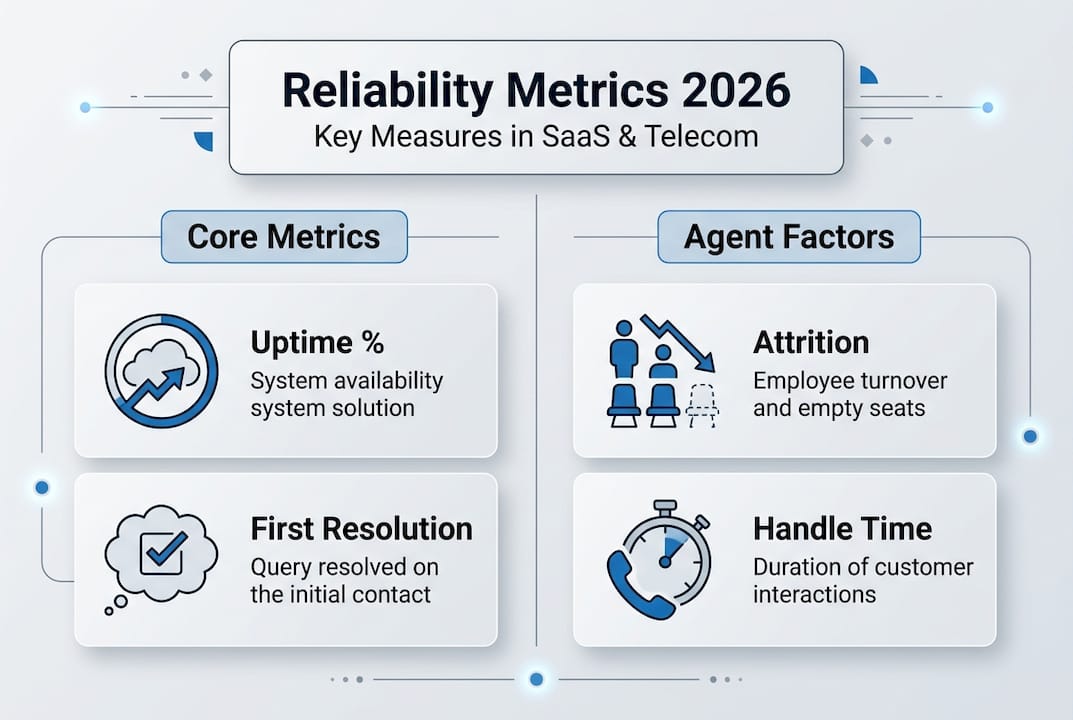
Agent attrition deserves special attention at 35% annually industry-wide. High turnover directly undermines reliability as experienced agents leave and replacements require months to reach full productivity. Training costs compound while service quality fluctuates during transition periods.
Pro Tip: Track attrition by tenure cohort to identify when agents typically leave. Many centers lose staff between 6 and 12 months as initial enthusiasm fades but before career advancement opportunities materialize. Targeted retention programs at this critical window significantly improve workforce stability.
For telecom and SaaS operations, these benchmarks must account for technical complexity. Your agents handle more intricate issues requiring deeper product knowledge than retail or hospitality call centers. Setting targets slightly below industry averages initially while building expertise makes sense, then pushing toward top performer levels as your team matures.
Balancing technical uptime with service quality: Nuanced perspectives
The reliability debate often pits technical metrics against human performance indicators. Some leaders obsess over system availability while neglecting agent development. Others invest heavily in training but tolerate outdated infrastructure. Neither extreme delivers sustainable reliability.
Focusing exclusively on Average Handle Time can compromise service quality by incentivizing agents to rush customers off calls. When speed becomes the primary metric, agents skip important verification steps, provide incomplete solutions, and transfer calls unnecessarily to meet time targets. This creates a false efficiency that generates callbacks and erodes customer trust.
System uptime remains critical but insufficient alone. You can maintain 99.99% availability while delivering terrible service if agents lack skills, scripts contain errors, or knowledge bases provide outdated information. Technical reliability enables service delivery but doesn't guarantee quality outcomes.
Agent performance and customer satisfaction must integrate into your reliability framework. The most stable infrastructure means nothing when customers hang up frustrated after speaking with unprepared agents. Conversely, exceptional agents cannot overcome constant system failures and dropped calls.
Peer-reviewed research confirms this integration necessity:
Service quality dimensions including reliability, responsiveness, and assurance directly influence customer satisfaction and loyalty in call center environments. Organizations focusing solely on operational efficiency metrics without quality considerations experience higher churn rates and lower customer lifetime value.
This research validates what support leaders observe daily. Customers remember how agents treated them and whether issues got resolved, not your uptime percentage. Technical reliability creates the foundation, but service quality builds customer relationships.
Implementing balanced KPI frameworks requires measuring both dimensions simultaneously:
- Technical metrics: uptime, MTTR, system response times, network latency
- Service metrics: FCR, CSAT, quality scores, resolution accuracy
- Efficiency metrics: AHT, cost per contact, schedule adherence
- Workforce metrics: attrition, training completion, skill development
Pro Tip: Create composite reliability scores combining technical and service metrics weighted by business impact. A center with 99% uptime but 60% FCR scores lower than one with 98% uptime and 80% FCR because customer outcomes matter more than pure availability.
For multilingual call center processes, this balance becomes even more complex. You need technical infrastructure supporting multiple languages, agents fluent in specific markets, and quality assurance programs accounting for cultural nuances. Reliability in this context means consistent service quality across all supported languages and regions, not just keeping systems running.
Implementing best practices to enhance call center reliability in multilingual SaaS and telecom environments
Moving from understanding to action requires systematic approaches tailored to your operational complexity. These strategies help SaaS and telecom leaders build reliability into their support infrastructure.
-
Implement redundant systems and failover protocols that activate automatically during outages. Your customers shouldn't notice when primary systems fail because backup infrastructure handles the transition seamlessly. Cloud-based solutions with geographic distribution provide this capability cost-effectively.
-
Deploy real-time monitoring dashboards tracking both technical and service metrics simultaneously. When you spot declining FCR rates or rising AHT alongside stable uptime, you know the issue involves agent performance or process problems rather than technical failures. This visibility enables targeted interventions.
-
Establish benchmarks aligned with telecom and SaaS industry standards rather than generic call center averages. Your technical support complexity justifies different targets than retail customer service. Set realistic goals that account for product sophistication while pushing toward continuous improvement.
-
Invest in comprehensive agent training covering both product knowledge and soft skills. Technical expertise means nothing if agents cannot communicate clearly or show empathy during stressful customer interactions. Regular refresher training keeps skills sharp as products evolve.
-
Focus on retention strategies that reduce the 35% industry average attrition rate. Every experienced agent who leaves takes institutional knowledge and customer relationships with them. Career development paths, competitive compensation, and positive work environments significantly improve retention.
-
Measure quality through balanced scorecards including FCR, CSAT, quality assurance scores, and compliance metrics alongside efficiency indicators. This prevents the tunnel vision that comes from optimizing single metrics at the expense of overall performance.
-
Create continuous improvement cycles using analytics to identify patterns and root causes. When specific issue types generate callbacks, update training and knowledge bases to address gaps. When certain agent cohorts outperform others, document their approaches and share best practices.
Here's how technical and service improvements compare:
| Improvement Area | Technical Focus | Service Focus | Combined Impact | | --- | --- | --- | | System Reliability | Redundancy, monitoring, MTTR reduction | Agent training on system status communication | Customers experience fewer disruptions and better updates during issues | | Response Speed | Call routing optimization, IVR efficiency | Agent skill-based routing, knowledge base access | Faster connections to qualified agents who resolve issues quickly | | Quality Consistency | CRM integration, screen pop automation | Quality assurance, coaching programs | Agents access customer context instantly and apply proven resolution approaches | | Scalability | Cloud infrastructure, elastic capacity | Multilingual hiring, flexible scheduling | Operations scale smoothly during growth without service degradation |
Pro Tip: Run quarterly reliability audits examining both technical logs and customer feedback together. You'll discover correlations between system events and satisfaction dips that individual metric tracking misses. This holistic view drives more effective improvement initiatives.
For companies outsourcing call center services, reliability requirements must appear explicitly in vendor agreements. Define SLA targets, quality expectations, reporting cadences, and escalation procedures upfront. The 7 tips for outsourcing telecom support include reliability specifications that protect service quality while leveraging external expertise and capacity.
Multilingual operations add another reliability dimension. You need consistent service quality across all supported languages, not just your primary market. This requires native speakers with cultural competency, translated materials that maintain accuracy, and quality assurance programs accounting for linguistic nuances. A center reliable in English but inconsistent in German or Spanish fails multilingual customers equally.
Enhance your call center reliability with CallTech's expert services
Applying these reliability principles requires expertise, infrastructure, and ongoing commitment. Many SaaS and telecom companies find that outsourcing call center services to specialists like CallTech delivers better results than building internal operations from scratch.

CallTech brings nearly 20 years of experience supporting companies across Europe and international markets with multilingual customer support in over 15 languages. Our modern VOIP infrastructure, CRM integrations, and redundant systems ensure the technical reliability your customers expect while our trained agents deliver the service quality that builds loyalty.
Whether you need to scale existing operations or establish new market support, our telecom support outsourcing expertise and specialized platforms help you meet SLA commitments while controlling costs. We handle the complexity of multilingual support so you can focus on product development and growth.
Frequently asked questions
What are the critical KPIs to monitor for call center reliability?
Monitor service level compliance (percentage of calls answered within target timeframes), first call resolution rates, customer satisfaction scores, average handle time, and system uptime together. These metrics balance technical performance with service quality outcomes. Track them daily and investigate when any metric deviates significantly from baselines.
How does call center reliability differ for SaaS versus telecom companies?
SaaS call centers often handle subscription management, billing inquiries, and feature education requiring product expertise. Telecom centers deal with technical troubleshooting, network issues, and device support demanding different skill sets. Both require high reliability but the complexity of technical issues in telecom often results in slightly longer handle times and more specialized agent training needs.
What is an acceptable system uptime percentage for call centers?
Industry standards target 99.9% uptime, allowing roughly 8.7 hours of downtime annually. Top performers achieve 99.99% uptime with only 52 minutes of annual downtime. However, uptime alone doesn't guarantee reliability since service quality depends equally on agent performance and process effectiveness.
How quickly should call centers resolve technical issues?
Mean time to repair for critical system failures should stay under 4 hours to minimize customer impact. Minor issues can tolerate longer resolution windows if workarounds exist. Implement tiered response protocols that prioritize issues by severity and customer impact rather than treating all problems equally.
Why does agent attrition matter for call center reliability?
High turnover at 35% annually disrupts service consistency as experienced agents leave and replacements require months to reach full productivity. Each departing agent takes product knowledge and customer relationship history with them. Reducing attrition to 20% or below significantly improves reliability by maintaining workforce expertise and institutional knowledge.
How can multilingual call centers maintain consistent reliability across languages?
Hire native speakers with cultural competency for each supported market, translate all materials professionally rather than using machine translation, and implement quality assurance programs that account for linguistic nuances. Track reliability metrics separately by language to identify performance gaps and ensure consistent service quality regardless of customer location. Visit the CallTech blog for more insights on multilingual support best practices.