

Cutting telephony costs by up to 94% sounds like a bold claim, but businesses switching to VoIP (Voice over Internet Protocol) for outsourced customer support are proving it every day. For decision-makers in telecom, SaaS, and e-commerce, the pressure to deliver fast, multilingual, round-the-clock support without ballooning operational costs is real. VoIP has fundamentally changed what outsourcing can deliver, making global support centers affordable, flexible, and scalable in ways traditional phone systems never could. This guide breaks down exactly how VoIP works in outsourcing, what the numbers look like, and what you need to know before making the switch.
Table of Contents
- Why VoIP is foundational for outsourcing
- Key cost savings and business impacts
- How VoIP works for global outsourced support
- Risks, edge cases, and trade-offs
- Best practices for VoIP-enabled outsourcing success
- Partner with a proven VoIP outsourcing solution
- Frequently asked questions
Key Takeaways
| Point | Details |
|---|---|
| Cost savings | VoIP can cut telephony and support costs by as much as 94% when used for outsourcing. |
| Global scalability | Cloud-hosted VoIP enables seamless support operations in any region without physical infrastructure. |
| Operational reliability | Proper VoIP setup delivers high reliability and uptime, but requires robust internet and security. |
| Key risk mitigation | Risks like call quality and security are managed with quality monitoring, redundancy, and encryption. |
| Smart provider selection | Choosing providers with SIP, CRM integration, AI support, and regional testing maximizes outsourcing success. |
Why VoIP is foundational for outsourcing
VoIP converts voice calls into digital data packets and transmits them over the internet instead of copper telephone lines. That single shift eliminates the need for expensive physical infrastructure, long-distance carrier fees, and rigid on-site hardware. Traditional telephony locks businesses into fixed lines, high per-minute international rates, and slow provisioning cycles. VoIP removes all three barriers at once.
BPO (business process outsourcing) providers have adopted VoIP as their default communication backbone because it aligns perfectly with how modern outsourcing works: distributed teams, remote agents, and clients spread across multiple time zones. When you explore outsourcing call center services, VoIP is almost always the infrastructure layer making it possible.
Here is why VoIP underpins modern outsourcing:
- Cost efficiency: Eliminates per-minute international charges and reduces hardware spend significantly
- Global reach: Agents anywhere with a stable connection can handle calls for clients in any country
- Cloud flexibility: Spin up new seats in hours, not weeks, without physical installation
- Scalability: Add or remove capacity based on seasonal demand without contract penalties
- CRM integration: Connect call data directly to customer records for seamless agent workflows
"VoIP enables cloud outsourcing with 30 to 90% cost savings for telecom, SaaS, and e-commerce businesses."
For companies evaluating cost-effective outsourcing methods, VoIP is not optional. It is the foundation that makes the economics work. VoIP call center outsourcing has matured to the point where quality rivals or exceeds what legacy systems deliver.
Key cost savings and business impacts
The numbers behind VoIP adoption in outsourcing are striking. Real-world case studies show savings that range from meaningful to transformational depending on the starting point and scale.

| Company / Scenario | Previous Setup | VoIP Saving | Key Driver |
|---|---|---|---|
| Straker Translations | Legacy PBX system | 29% cost reduction | Eliminated hardware maintenance |
| Teliqon PBX client | Traditional carrier lines | 94% cost reduction | Removed international per-minute fees |
| Mid-size e-commerce BPO | On-premise call center | 55% cost reduction | Cloud migration and remote agents |
| SaaS support team | Mixed legacy and VoIP | 38% cost reduction | Consolidated to single VoIP platform |
These are not outliers. The typical range for businesses migrating to VoIP-based outsourcing sits between 30% and 60% in telephony cost reduction, with outlier cases reaching that 94% figure when legacy infrastructure was particularly expensive.
Here is how those savings are actually realized, step by step:
- Eliminate physical hardware costs. No PBX boxes, no dedicated phone lines, no on-site technicians for maintenance.
- Remove international call charges. VoIP routes calls over the internet, so geography stops driving your phone bill.
- Reduce agent seat costs. Softphones (software-based phones on a laptop or mobile) replace desk phones entirely.
- Scale without capital expenditure. Adding 50 agents during a peak season costs a software license, not a hardware installation project.
- Consolidate vendors. One VoIP platform replaces multiple carriers, reducing billing complexity and negotiation overhead.
For businesses reviewing call center platforms or comparing outsourcing tools, these savings directly affect whether outsourcing a support function is financially viable. Smaller SaaS companies that previously could not afford a dedicated support team can now access best call center services at a fraction of the legacy cost.
How VoIP works for global outsourced support
Understanding the technology stack helps you ask the right questions when evaluating providers. A modern VoIP-enabled outsourcing setup typically includes several interconnected components.
Session Initiation Protocol (SIP) trunking is the backbone. It connects your VoIP system to the public telephone network, allowing agents to call any number worldwide. Cloud-hosted PBX (Private Branch Exchange) manages call routing without physical hardware. ACD (Automatic Call Distribution) routes incoming calls to the right agent or team based on rules you define. IVR (Interactive Voice Response) handles self-service options before a call reaches a live agent. Agents use softphones on their computers or mobile devices, meaning they can work from anywhere.
VoIP call centers use SIP trunking, cloud hosting, ACD/IVR, softphones, and CRM integration for seamless global operations, with top-tier deployments achieving 99.99% uptime.
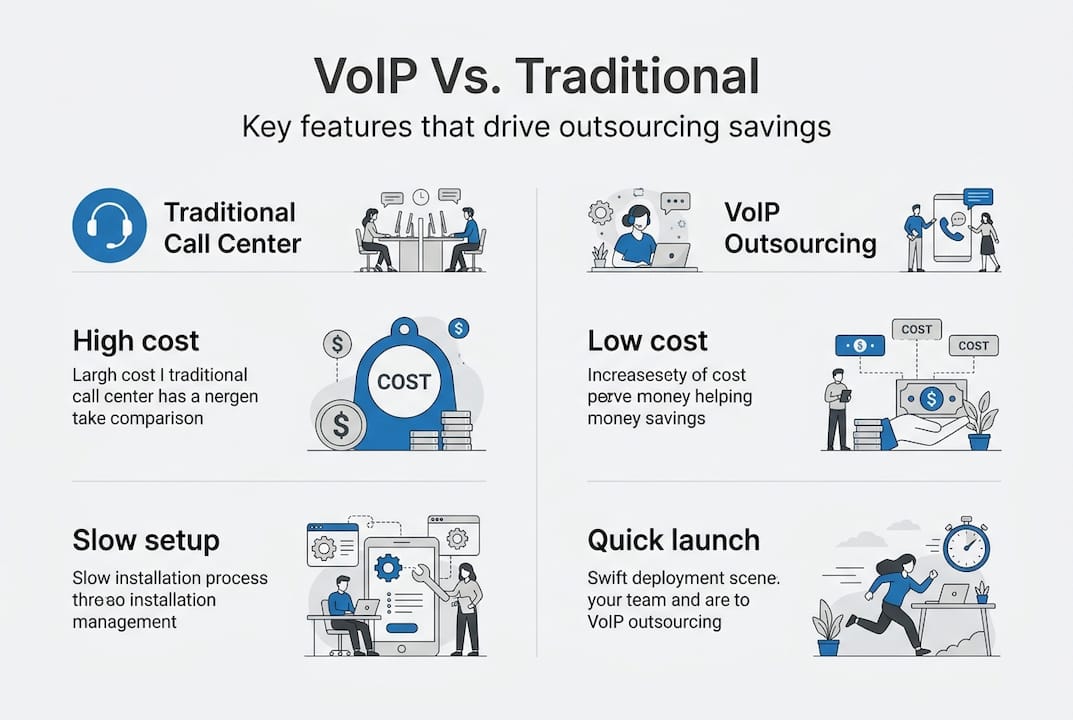
| Feature | Traditional call center | VoIP-enabled outsourcing |
|---|---|---|
| Setup time | Weeks to months | Hours to days |
| Geographic flexibility | Fixed location | Fully remote and distributed |
| Scaling speed | Slow, hardware-dependent | Instant, software-based |
| International call cost | High per-minute rates | Near-zero over internet |
| CRM integration | Complex, often manual | Native API connections |
| Uptime reliability | Dependent on physical lines | 99.99% with geo-redundancy |
For offshore call centers, VoIP makes the distance irrelevant from a technical standpoint. A multilingual call center process running across five countries operates on the same platform with the same call quality standards.
Pro Tip: When evaluating outsourcing destinations, test actual VoIP call quality from that region before committing. Latency above 150ms degrades call quality noticeably. Ask providers for uptime reports and geo-redundancy documentation before signing any agreement.
Risks, edge cases, and trade-offs
VoIP is not without its challenges. Decision-makers who go in with clear eyes make better vendor choices and avoid costly surprises.
The core risks to understand:
- Bandwidth dependency: VoIP requires at least 0.5 Mbps per call, and poor internet quality directly degrades voice clarity
- Latency and jitter: Packet delays cause choppy audio. Regions with inconsistent infrastructure amplify this problem
- Power outages: Unlike traditional landlines, VoIP goes down when power or internet fails without backup systems
- E911 limitations: Emergency call routing is more complex with VoIP, especially for distributed teams across multiple countries
- Security vulnerabilities: VoIP traffic can be intercepted if not encrypted, making security protocols non-negotiable
- Regional quality variance: Some outsourcing destinations have inconsistent internet infrastructure that affects call reliability
The good news is that VoIP security and reliability risks are well understood and manageable with the right vendor setup. Encryption, QoS (Quality of Service) prioritization, and geo-redundant failover systems address most of these concerns effectively.
Pro Tip: Never choose an outsourcing partner without asking specifically about their failover protocol. A geo-redundant setup means that if one data center goes down, calls automatically reroute through another. This is the difference between a minor blip and a full support outage.
For practical guidance, reviewing outsourcing tips specific to telecom and SaaS environments helps you build a vendor evaluation checklist that covers these risk factors systematically.
Best practices for VoIP-enabled outsourcing success
Knowing the risks is only useful if you act on them. Here is a structured approach to selecting and optimizing a VoIP-based outsourcing setup.
Selection steps:
- Audit your current telephony costs to establish a baseline. You cannot measure savings without knowing your starting point.
- Define your geographic coverage needs. Which languages, time zones, and regions must your support team cover?
- Evaluate provider infrastructure. Ask for uptime SLAs, geo-redundancy documentation, and security certifications.
- Test call quality in target regions before committing to a full rollout. Run a pilot with real call volume.
- Verify CRM and helpdesk integration. Your VoIP platform must connect natively with your existing tools to avoid manual data entry.
- Negotiate SLAs that include quality metrics, not just uptime. Call quality scores, first-call resolution rates, and response times should all be contractually defined.
Must-have features in your VoIP outsourcing platform:
- SIP trunking with international number support
- Native CRM integration (Salesforce, HubSpot, Zendesk, or equivalent)
- Geo-redundant infrastructure with automatic failover
- AI and human hybrid routing for intelligent call distribution
- Real-time call monitoring and recording for quality control
- Encryption and compliance with regional data protection regulations
Decision-makers should seek SIP, CRM integration, geo-redundancy, and hybrid AI-human routing for optimal cost and quality in outsourced support. The hybrid model matters especially for SaaS and e-commerce companies where some queries are simple enough for AI deflection while complex billing or technical issues need a skilled human agent.
When reviewing outsourcing tools, prioritize platforms that give you visibility into call quality metrics in real time. Blind outsourcing, where you hand off support and hope for the best, is a recipe for customer churn.
Partner with a proven VoIP outsourcing solution
If you have read this far, you understand that VoIP is not just a cost-cutting tool. It is the operational backbone that makes scalable, multilingual, global customer support actually work. The question is not whether to use VoIP in your outsourcing strategy. It is who you trust to run it.

CallTech Outsourcing has been building VoIP-backed customer support operations since 2005, serving clients across telecom, SaaS, digital services, and e-commerce in more than 15 European languages. Our infrastructure includes geo-redundant systems, CRM integration, and real-time quality monitoring built into every engagement. Whether you need to explore outsourcing call center services for the first time or want to compare cost-effective outsourcing methods against your current setup, we can map a solution to your specific goals. Start with our outsourcing telecom support tips to see how we approach the challenges your industry faces.
Frequently asked questions
What is VoIP's main advantage in outsourcing support?
VoIP dramatically reduces telephony and infrastructure costs, with businesses achieving up to 94% savings compared to traditional phone systems, making global outsourcing financially viable for companies of all sizes.
What infrastructure is required for VoIP-based outsourcing?
A reliable, high-speed internet connection of at least 0.5 Mbps per call is essential, along with a compatible cloud or on-premise VoIP platform that supports SIP trunking and CRM integration.
Can VoIP quality match traditional phone lines in outsourced teams?
With sufficient bandwidth and proper QoS configuration, modern VoIP delivers call quality that rivals traditional telephony. Top-tier deployments achieve 99.99% uptime, though regions with weak internet infrastructure remain a risk factor.
How do businesses address VoIP security risks when outsourcing?
Encryption, geo-redundant failover systems, and regular security audits are the primary defenses. Security risks like interception are well understood and effectively mitigated when vendors follow established security protocols.
What features should you look for in a VoIP outsourcing platform?
Prioritize SIP trunking, native CRM integration, geo-redundancy, real-time monitoring, and AI and human hybrid routing. These features together deliver the cost efficiency and quality control that make outsourced support scalable and reliable.