

Managing a global contact center that delivers seamless multilingual customer support across multiple regions presents complex coordination challenges. Enterprise decision-makers must navigate language barriers, time zones, technology integration, and quality control while maintaining cost efficiency. This guide provides actionable strategies to prepare, execute, and verify your global contact center workflow, ensuring your multilingual support operations scale effectively across international markets. You'll discover proven frameworks for optimizing workflows, selecting the right technology platforms, and implementing quality assurance processes that drive consistent customer experiences worldwide.
Table of Contents
- Key takeaways
- Understanding the challenges of global multilingual contact center workflows
- Preparing your enterprise for a scalable global contact center workflow
- Executing and managing efficient workflows for multilingual support
- Verifying and optimizing your global contact center workflow performance
- Optimize your global contact center with CallTech's multilingual outsourcing expertise
- Frequently asked questions
Key Takeaways
| Point | Details |
|---|---|
| Global workflow challenges | Coordinating across time zones, languages, and cultures adds operational complexity that affects service delivery. |
| Map current workflow | Visually map each touchpoint where language or regional differences create friction and prioritize fixes by impact and complexity. |
| Right technology platforms | Select cloud based platforms that support multilingual routing, CRM connectivity, real time translation, and analytics to enable scalable operations. |
| Quality assurance challenges | Quality monitoring must address cultural differences and provide consistent metrics across markets. |
Understanding the challenges of global multilingual contact center workflows
Running a global contact center requires coordinating teams across different time zones, languages, and cultural contexts simultaneously. Multilingual workflows require complex coordination across different regions and languages, creating operational complexity that impacts service delivery. Each market brings unique compliance requirements, customer expectations, and communication preferences that your workflow must accommodate.
Language-specific challenges extend beyond simple translation. Cultural nuances affect how customers express concerns, interpret solutions, and evaluate service quality. A workflow optimized for English-speaking markets may fail completely in Asian or European contexts where communication styles differ significantly. Your agents need cultural competency training alongside language skills to handle interactions appropriately.
Technology integration presents another major hurdle. Legacy systems often lack multilingual capabilities or require expensive customization to support global operations. Data silos between regional platforms prevent unified reporting and customer visibility. Without integrated systems, your teams cannot access complete customer histories or coordinate effectively across locations.
Pro Tip: Map your current workflow visually before scaling globally. Identify every touchpoint where language or regional differences create friction, then prioritize fixes based on customer impact and implementation complexity.
Consistent quality becomes exponentially harder as you add languages and locations. Monitoring call quality in 15 languages requires specialized quality assurance teams or sophisticated AI tools. Performance standards must account for cultural differences while maintaining brand consistency. Here are the most common quality control challenges:
- Inconsistent agent training across regional centers
- Difficulty standardizing scripts for cultural appropriateness
- Limited visibility into non-English customer interactions
- Varied interpretation of quality metrics across cultures
"The biggest mistake enterprises make is treating multilingual support as a translation problem rather than a workflow design challenge. Success requires rethinking your entire process through a global lens."
Preparing your enterprise for a scalable global contact center workflow
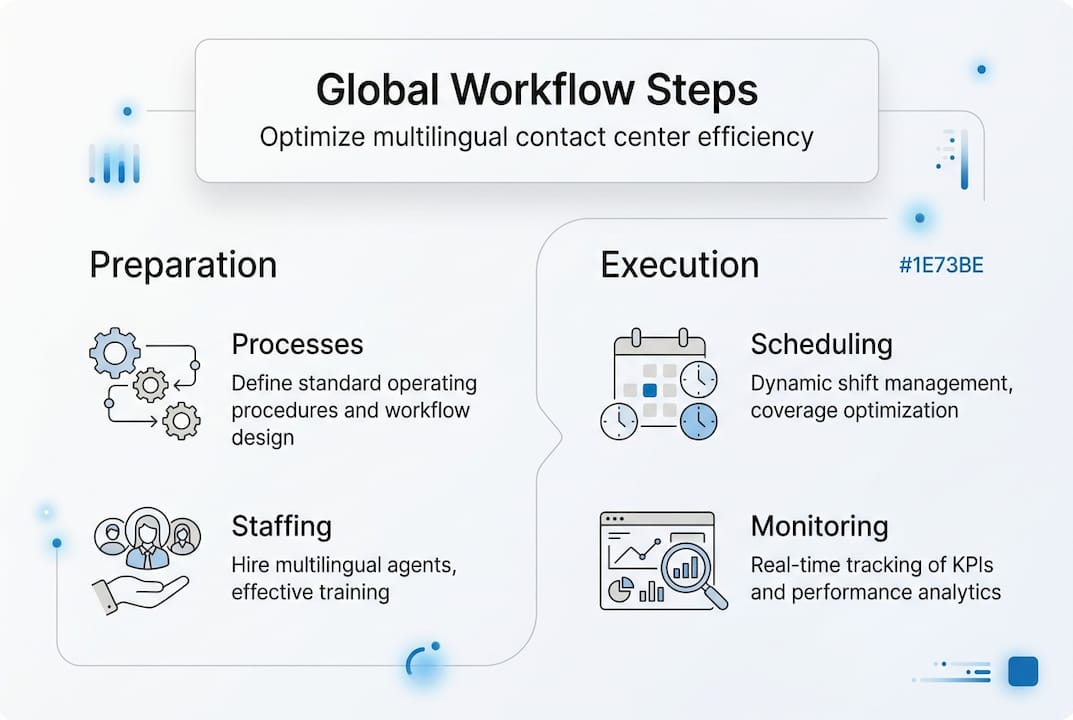
Successful preparation starts with defining clear processes adapted to each language market you serve. Document your ideal customer journey from initial contact through resolution, then identify where language or cultural factors require modifications. Successful global contact centers start with defining clear processes and choosing the right technology platforms that support multilingual operations from day one.

Your technology foundation determines scalability potential. Cloud-based platforms offer the flexibility and integration capabilities essential for global operations. Evaluate platforms based on multilingual routing, CRM connectivity, real-time translation support, and analytics capabilities. The right infrastructure investment now prevents costly migrations later.
Follow this preparation checklist before launching global workflows:
- Audit your current technology stack for multilingual capabilities and integration gaps
- Define service level agreements specific to each language and region
- Create standardized training programs adaptable to cultural contexts
- Establish quality metrics that account for language-specific factors
- Build escalation protocols that work across time zones
- Develop knowledge bases translated and localized for each market
Staffing strategy requires careful planning. Determine whether to build internal multilingual teams, partner with regional centers, or leverage outsourcing call center services that provide language expertise. Each approach offers different cost structures, control levels, and scalability options. Hybrid models combining internal oversight with outsourced execution often deliver the best balance.
| Platform Feature | Basic Tier | Enterprise Tier | Impact on Global Operations |
|---|---|---|---|
| Multilingual routing | Limited | Advanced AI-based | Critical for efficiency |
| CRM integration | Single system | Multiple systems | Essential for data flow |
| Real-time analytics | Standard metrics | Custom dashboards | Enables quick optimization |
| Translation tools | Manual only | AI-assisted | Reduces handle time |
Pro Tip: Start with three to five core languages that represent 80% of your customer base. Perfect your workflow at this scale before expanding to additional markets. Rapid expansion without proven processes leads to quality deterioration.
Communication protocols must bridge language and time zone barriers. Establish clear handoff procedures between shifts and regions. Create documentation standards that ensure context preservation across language transitions. Regular cross-regional team meetings build cohesion and share best practices. Technology alone cannot solve coordination challenges without strong communication frameworks.
Executing and managing efficient workflows for multilingual support
Effective execution begins with intelligent call routing that matches customers to appropriately skilled agents. Modern platforms use language detection, customer data, and agent availability to route interactions optimally. Executing multilingual workflows demands continuous coordination, real-time quality monitoring, and adaptive scheduling that responds to fluctuating demand across regions.
Implement your workflow using these sequential steps:
- Configure routing rules prioritizing language match, then skill level, then availability
- Establish real-time dashboards visible to supervisors across all locations
- Deploy quality monitoring sampling at least 5% of interactions per language
- Create feedback loops where agents report workflow friction points weekly
- Schedule regular calibration sessions to align quality standards globally
- Build escalation paths that function 24/7 across time zones
Scheduling for continuous multilingual coverage requires strategic planning. You need sufficient agent capacity in each language during peak hours while avoiding excessive idle time. Follow-the-sun models distribute work across regions to maximize utilization. Flexible scheduling accommodates volume fluctuations without overstaffing.
Monitoring quality across languages presents unique challenges. Automated speech analytics can flag potential issues in real time, but human review remains essential for cultural appropriateness. Build multilingual quality assurance teams or partner with specialists who understand linguistic nuances. Sample interactions randomly and based on customer sentiment signals.
Pro Tip: Create language-specific performance benchmarks rather than applying uniform targets. Handle times, first call resolution rates, and customer satisfaction scores vary naturally across languages and cultures. Forcing identical targets creates unfair comparisons and demotivates teams.
| Workflow Approach | Advantages | Disadvantages | Best For |
|---|---|---|---|
| Centralized multilingual hub | Unified management, consistent training | Higher facility costs, limited hours | Companies with concentrated markets |
| Regional distributed centers | Local cultural expertise, 24/7 coverage | Coordination complexity, variable quality | Global enterprises with diverse markets |
| Hybrid model | Flexibility, optimized costs | Requires strong governance | Most mid to large enterprises |
| Fully outsourced | Rapid scaling, specialized expertise | Less direct control | Companies prioritizing speed and efficiency |
Workflow optimization never stops. Analyze performance data weekly to identify bottlenecks and improvement opportunities. Common friction points include:
- Language handoffs when initial routing fails
- Knowledge base gaps in specific languages
- Technology issues affecting particular regions
- Training deficiencies revealed through quality scores
AI-assisted workflows enhance efficiency without replacing human agents. Chatbots handle routine inquiries in multiple languages, freeing agents for complex issues. Automated ticket categorization and routing reduce manual work. Real-time translation tools assist agents supporting secondary languages. The most effective approach combines AI automation for efficiency with human expertise for relationship building and complex problem solving.
Verifying and optimizing your global contact center workflow performance
Measuring workflow effectiveness requires tracking both operational metrics and customer experience indicators. Continuous verification through KPIs and customer feedback drives workflow improvement in global contact centers, ensuring your operations deliver consistent value across all markets. Establish baseline performance levels for each language before implementing changes, then monitor improvements systematically.
Track these essential performance indicators:
- First call resolution rate by language and issue type
- Average handle time adjusted for language complexity
- Customer satisfaction scores segmented by region and language
- Agent utilization rates across time zones
- Escalation frequency and resolution time
- Cost per contact by language and channel
Customer feedback collection must account for cultural communication preferences. Some markets respond well to post-interaction surveys, while others prefer relationship-based feedback mechanisms. Deploy multiple collection methods including surveys, social listening, and direct outreach. Analyze feedback for patterns indicating workflow problems versus agent performance issues.
| KPI Category | Metric | Target Range | Monitoring Frequency |
|---|---|---|---|
| Efficiency | Average handle time | 4-8 minutes (varies by language) | Daily |
| Quality | First call resolution | 75-85% | Weekly |
| Satisfaction | Customer satisfaction score | 4.2-4.7 out of 5 | Weekly |
| Productivity | Agent utilization | 75-85% | Daily |
Common workflow performance pitfalls undermine even well-designed systems. Technology issues like poor integration or system downtime create immediate customer impact. Inadequate agent training leads to longer handle times and lower resolution rates. Insufficient staffing during peak periods damages customer experience. Poor knowledge management leaves agents searching for information during interactions.
Pro Tip: Conduct quarterly workflow audits where you trace sample customer journeys end-to-end across all touchpoints. This reveals hidden friction points that metrics alone might miss, especially issues affecting specific language groups.
Iterative optimization follows a continuous improvement cycle. Identify the highest-impact improvement opportunity based on data analysis. Implement changes in a controlled pilot with one language or region. Measure results against baseline performance. Scale successful changes across other markets while adapting for local context. This disciplined approach prevents widespread disruption while driving steady improvement.
Benchmarking against industry standards provides context for your performance. Research typical metrics for your industry and company size. Recognize that language complexity affects benchmarks significantly. Adjust expectations based on your specific market mix and service complexity. Focus on improving your own baseline rather than chasing arbitrary external targets.
Technology upgrades should align with verified workflow needs. Avoid implementing new tools without clear performance gaps they address. Pilot new technologies with limited scope before full deployment. Measure actual impact on workflow efficiency and customer experience. The newest platform features only add value when they solve real problems your team faces.
Optimize your global contact center with CallTech's multilingual outsourcing expertise
Implementing the strategies outlined in this guide requires specialized expertise and proven multilingual capabilities. CallTech Outsourcing brings nearly 20 years of experience helping enterprises scale customer support operations across more than 15 European languages. Our teams understand the workflow complexities you face and deliver solutions tailored to telecom, SaaS, and digital services industries.

We provide comprehensive outsourcing call center services that integrate seamlessly with your existing operations while delivering the language coverage and scalability your global expansion demands. Our modern infrastructure, CRM integration capabilities, and quality assurance frameworks ensure consistent service delivery across all markets. Whether you need complete outsourcing or hybrid support augmenting your internal teams, we customize solutions matching your specific workflow requirements.
Explore our guide to the best call center services 2026 offers or review our recommended call center platforms for telecom companies to understand how the right partnership accelerates your global contact center success.
Frequently asked questions
What languages should my global contact center support?
Language coverage depends on your customer demographics and the regions where you operate. Prioritize languages based on market size, support volume, and strategic importance to your business. Consider regional dialects and cultural nuances when choosing languages, as customers expect native-level fluency and cultural understanding, not just basic translation.
How do I measure the effectiveness of my global contact center workflow?
Track KPIs like first call resolution, average handle time, and customer satisfaction scores segmented by language and region. Use multilingual customer feedback to gauge effectiveness beyond operational metrics. Compare performance across languages to identify workflow gaps and training needs. Establish language-specific benchmarks that account for natural variations in communication styles and issue complexity.
What technologies are essential for managing multilingual global contact centers?
Cloud-based call routing platforms and CRM integration form the foundation of effective multilingual operations. These systems enable seamless data flow, intelligent routing, and unified customer visibility across regions. Translation and analytics tools aid multilingual support and quality monitoring, while AI-assisted features like chatbots and automated categorization improve efficiency without sacrificing quality.
How can outsourcing improve my global contact center workflow?
Outsourcing offers access to language expertise and scalable staffing without the overhead of building internal multilingual teams. Specialized providers bring proven workflows, technology infrastructure, and quality assurance processes refined across multiple clients. It can reduce costs and improve service quality through specialized providers who focus exclusively on multilingual customer support, allowing your team to concentrate on core business activities.