

Running a multilingual call center across multiple markets is one of the most operationally demanding challenges in customer support. When agents handle calls in 10 different languages, serve customers across 5 time zones, and rely on fragmented tools, even small inefficiencies compound fast. The result is longer handle times, inconsistent service quality, and frustrated customers who churn. This guide walks through a practical, step-by-step approach to optimizing your global call center operations, from diagnosing root causes to sustaining performance improvements over time.
Table of Contents
- Identifying common call center operation challenges
- Preparing your call center for optimization
- The step-by-step call center optimization process
- Troubleshooting and avoiding common optimization pitfalls
- Measuring and sustaining call center performance improvements
- Partnering for sustainable call center optimization
- Frequently asked questions
Key Takeaways
| Point | Details |
|---|---|
| Pinpoint operational challenges | Diagnosing bottlenecks and inefficiencies is the foundation for targeted call center optimization. |
| Prepare prerequisites | Ensure your technology, staffing, and workflow data are ready before starting optimization. |
| Follow stepwise improvements | Apply structured steps and automation to achieve scalable efficiency and strong performance. |
| Avoid common mistakes | Consistency in multilingual training and adapting for cultural nuances helps prevent costly errors. |
| Monitor and adapt | Regular performance analytics are vital to sustaining and enhancing optimized operations. |
Identifying common call center operation challenges
Before you can fix what's broken, you need to name it clearly. Global, multilingual call centers face a distinct set of operational pressures that single-language, single-market operations simply don't encounter.
Poor workflow design leads to bottlenecks and agent inefficiency, especially when processes aren't standardized across language teams. Add cultural differences in communication styles, and you have a recipe for inconsistent customer experiences. Scaling these problems across 10 or 15 markets only amplifies the damage.
Here are the most common operational challenges in multilingual call centers:
- Fragmented processes across language teams with no unified standard operating procedure
- Language and culture gaps that create inconsistent tone, resolution quality, and customer satisfaction
- Tool overload where agents juggle multiple platforms, slowing response times
- Scaling barriers when adding a new language market requires rebuilding workflows from scratch
- Data silos that prevent managers from getting a unified view of performance across regions
- High agent turnover driven by burnout, unclear processes, and inadequate training
"Scalability in multinational call centers isn't just about hiring more agents. It requires standardized processes, integrated technology, and a clear governance model that works across every language and market you serve." — Operations Director, European BPO sector
Multilingual customers also carry higher expectations. A customer calling in German expects the same resolution speed and quality as one calling in English. When your master multilingual process isn't built to deliver that consistency, satisfaction scores drop across the board.
Preparing your call center for optimization
Once pain points are mapped, it's critical to assemble the right prerequisites for optimization. Jumping straight into process changes without the right foundation wastes time and creates new problems.
Start by auditing your current technology stack. Customer service outsourcing tools that integrate workflow management with CRM and reporting give you the data visibility you need to make smart decisions. Implementation of specialized workflow systems improves data-driven decision making across language teams.
Here's a quick reference for what you need before optimization begins:
| Prerequisite | Why it matters | Recommended action |
|---|---|---|
| Unified CRM platform | Single source of truth for all agents | Consolidate to one system |
| VoIP infrastructure | Reliable, scalable voice communication | Audit call quality and uptime |
| Multilingual staffing map | Know your language coverage gaps | Map agents to market demand |
| Performance baseline data | Measure improvement accurately | Pull 90-day historical reports |
| QA framework | Consistent evaluation across languages | Define scoring criteria per language |
| AI-assisted agent tools | Boost productivity on chat and email | Pilot on highest-volume channels |
On the staffing side, multilingual operations require more than just native speakers. Agents need cultural fluency, product knowledge, and clear escalation paths. Map your current language coverage against your actual market demand. Gaps here are often the single biggest driver of poor CSAT scores.

For data collection, you need at minimum: average handle time (AHT) per language team, first call resolution (FCR) rates, customer satisfaction scores (CSAT), and agent utilization rates. Without this baseline, you're optimizing blind.
Pro Tip: Centralize all communication platforms into one interface before starting any process changes. Agents switching between 4 or 5 tools per interaction lose an average of 15 to 20 seconds per task. Across thousands of daily interactions, that adds up to hours of lost productivity.
Also consider cost-effective outsourcing methods as part of your preparation. Flexible outsourcing models where you pay only for productive hours eliminate HR overhead like recruitment, onboarding, and turnover costs, which are especially high in multilingual hiring.
The step-by-step call center optimization process
With all preparations in place, here's how to execute a scalable optimization plan. This sequence works whether you're optimizing an in-house team, an outsourced operation, or a hybrid model.
- Conduct a full operational assessment. Audit workflows, tools, staffing, and performance data across every language team. Document what's working and what isn't.
- Map your core processes. Create visual process maps for your top 10 contact reasons in each language. Identify where handoffs break down or steps are duplicated.
- Select and integrate technology. Choose tools that support multilingual routing, CRM integration, and real-time reporting. Evaluate best call center services that offer built-in multilingual capabilities.
- Train agents on standardized processes. Roll out updated procedures with language-specific training materials. Include cultural communication guidelines, not just scripts.
- Launch and monitor performance. Go live with new processes and track KPIs weekly for the first 60 days. Adjust based on real data, not assumptions.
- Scale what works. Once a process improvement proves effective in one language market, replicate it systematically across others.
Automated quality assurance tools reduce manual workload and enhance consistency, which is critical when you're managing QA across 10 or more languages simultaneously.
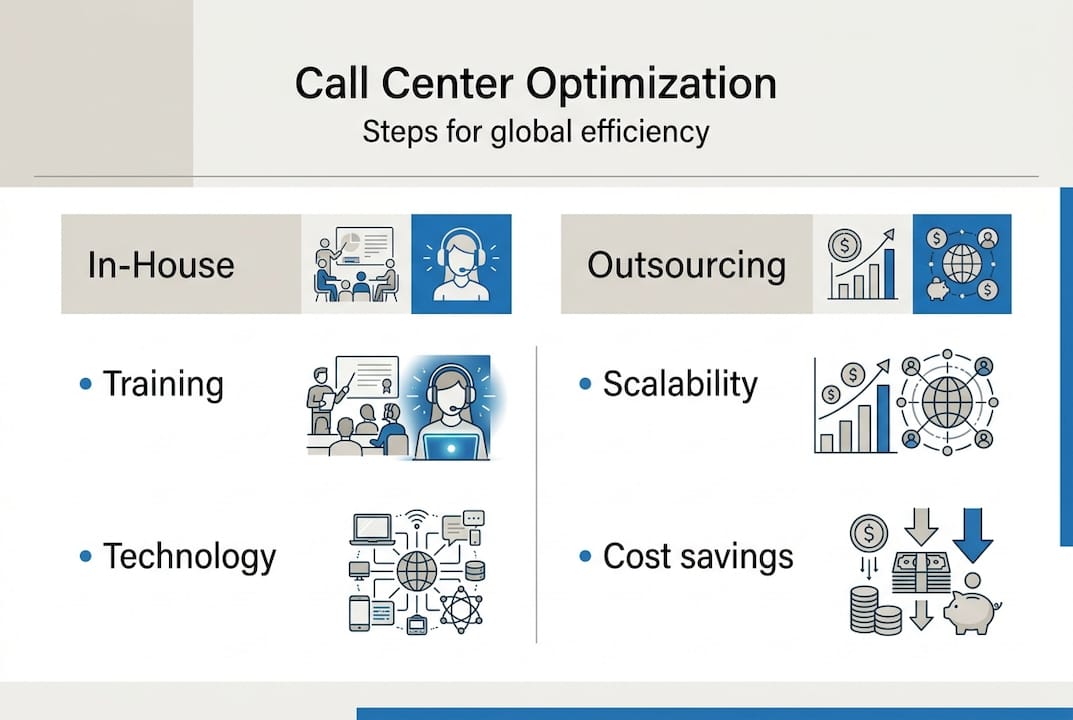
Here's how in-house optimization compares to outsourcing enhancements:
| Factor | In-house optimization | Outsourcing enhancements |
|---|---|---|
| Speed to implement | Slower, internal change management | Faster, partner handles setup |
| Cost structure | High fixed costs | Variable, pay-per-productive-hour |
| Language scalability | Limited by internal hiring | Immediate access to language talent |
| Technology investment | Capital expenditure required | Often included in service package |
| Control and visibility | Full internal control | Dependent on partner transparency |
Many operations leaders find that offshore call centers offer the fastest path to multilingual scalability, especially when entering new markets. If you're evaluating providers, reviewing calltechglobal.com alternatives can help you benchmark service quality and pricing.
Pro Tip: Use automation for QA and reporting from day one. AI-assisted tools can score 100% of interactions across all languages, while manual QA typically covers only 3 to 5%. That coverage gap is where quality problems hide.
Troubleshooting and avoiding common optimization pitfalls
After launching optimization, you may encounter unexpected challenges. Most of them are predictable if you know what to look for.
Lack of consistent multilingual training leads to irregular customer experience, where one language team delivers excellent service while another struggles with the same contact type. This is one of the most common and most damaging pitfalls in global operations.
Here are the most frequent mistakes and how to fix them:
- Skipping cultural adaptation: Translating scripts isn't enough. Adapt tone, formality, and resolution approaches for each market. Fix: involve native-speaking team leads in process design.
- Over-automating too fast: Deploying chatbots or AI tools before agents are trained creates confusion and customer frustration. Fix: pilot automation on low-complexity contact types first.
- Ignoring agent feedback: Frontline agents spot process failures before managers do. Fix: build structured feedback channels into your weekly operations rhythm.
- Inconsistent QA standards: Scoring agents differently across language teams creates unfair comparisons and misses real quality issues. Fix: define universal QA criteria with language-specific annotations.
- Neglecting telecom support tips for technical channels: Voice-only optimization misses the growing volume of chat, email, and ticket interactions. Fix: apply the same process rigor to written channels.
"Standardized training frameworks, adapted for each language and culture, are the single most effective lever for improving consistency in multinational call centers. Without them, every market becomes its own island." — Customer Experience Lead, SaaS industry
Pro Tip: Implement a weekly feedback loop where team leads in each language market report the top 3 process friction points. Review these in a cross-market operations call every Monday. Small issues caught early rarely become expensive problems.
Multilingual call center training that combines universal standards with local cultural context is the most reliable way to close the consistency gap across markets.
Measuring and sustaining call center performance improvements
Finally, ensuring ongoing improvement requires strong measurement and adaptability. Optimization isn't a one-time project. It's a continuous operating discipline.
Track these core metrics across every language team:
- Average handle time (AHT): Measures efficiency per interaction. Target reductions without sacrificing resolution quality.
- First call resolution (FCR): The percentage of issues resolved on the first contact. Higher FCR directly reduces costs and improves CSAT.
- Customer satisfaction score (CSAT): Collected via post-interaction surveys. Segment by language and market for actionable insights.
- Agent utilization rate: Tracks productive time versus idle time. Helps identify staffing imbalances across language teams.
- Quality assurance scores: Measure adherence to process standards and communication quality per agent and team.
Regular performance analytics drive ongoing efficiency and customer satisfaction. Operations teams that run workflow analytics reviews monthly see measurably better outcomes than those that rely on quarterly or annual reporting cycles. In fact, companies that automate workflow reporting consistently report a 15% or greater increase in CSAT scores within the first six months.
Sustaining performance requires three habits: regular review cycles, fast response to metric deviations, and continuous agent development. Set monthly performance reviews at the team level and quarterly strategic reviews at the operations level. When a metric drops, investigate within 48 hours, not at the next scheduled review.
Sustaining scalable support also means building flexibility into your model. Markets change, volumes shift, and new languages get added. Your optimization framework needs to accommodate growth without requiring a full rebuild every time.
Partnering for sustainable call center optimization
Optimizing a global, multilingual call center is a significant operational undertaking. The strategies in this guide give you a clear path forward, but execution requires the right resources, tools, and expertise.

CallTech Outsourcing has been helping companies scale multilingual customer support since 2005, with nearly 20 years of experience serving clients across Europe, the US, and the UAE. We provide outsourcing call center services in more than 15 European languages, covering customer care, technical support, billing, and outbound campaigns. Our flexible model means you pay only for productive hours, eliminating the HR overhead that makes in-house multilingual hiring so costly. From workflow optimization support to AI-assisted agent tools and modern VoIP infrastructure, we bring the full stack. Explore our outsourcing tools and service options to find the right fit for your operation.
Frequently asked questions
What are the first steps to optimize a multilingual call center?
Assess your current workflows, technology, and staffing levels to establish a performance baseline before making any changes. Without that baseline, you can't measure whether your improvements are actually working.
Which metrics should I track to measure optimization success?
Monitor average handle time, first call resolution rates, and customer satisfaction scores consistently across all language teams. Routine performance analytics help you catch regressions early and confirm that improvements are holding.
How can automation help multilingual call center operations?
Automated tools reduce manual workload and enhance consistency, particularly for QA and reporting across multiple languages. AI-assisted agents on chat and email channels also increase productivity while keeping costs down.
What are common pitfalls in optimizing global call centers?
Neglecting consistent multilingual training and failing to adapt processes for cultural differences are the two most damaging mistakes. Both lead to uneven customer experience across markets.
Should I outsource for scalability or optimize internally?
Outsourcing methods offer immediate scalability and access to specialist language talent, while internal optimization builds long-term institutional capability. Most high-performing operations use both in combination.