

TL;DR:
- Multilingual inbound call services are essential for global customer satisfaction across industries.
- Hybrid models combine in-house control for high-value support with outsourced volume handling.
- Effective providers have robust technology, industry experience, and scalable staffing for growth.
Most customer support leaders in telecom, SaaS, and e-commerce know the feeling: your team is stretched thin, customers want answers in their own language, and your in-house setup simply wasn't built for this kind of volume. The assumption that a well-trained internal team can handle global, multilingual demand at scale is one of the most expensive beliefs in customer operations. Hybrid in-house/outsourced models consistently outperform either extreme. This guide walks you through inbound call center services from the ground up, covering what they are, what features actually matter, how models compare, and how to deploy the right solution for your specific industry.
Table of Contents
- What are inbound call center services?
- Key features of effective inbound call center services
- In-house vs. outsourced inbound call centers: How do they compare?
- Selecting and implementing inbound call center services for telecom, SaaS, and e-commerce
- A modern perspective: The hybrid approach is the new standard
- Ready to transform your customer support?
- Frequently asked questions
Key Takeaways
| Point | Details |
|---|---|
| Hybrid solutions excel | Mixing in-house quality with outsourced scale and multilingual reach delivers the best customer support outcomes. |
| Provider selection matters | Choosing a call center with the right technology, staffing, and industry knowledge shapes the customer experience. |
| Multilingual capability improves satisfaction | Supporting every major language across channels builds loyalty and global competitiveness. |
| Outsourcing cuts costs and risk | Leveraging expert partners reduces overhead and enables rapid, secure scaling during peak periods. |
What are inbound call center services?
Inbound call center services manage every incoming customer interaction. That means phone calls, live chat, email, and increasingly social messaging. When a customer calls to dispute a billing charge, report a service outage, or ask how to cancel a subscription, an inbound team is the frontline response. These aren't just answering services. They're structured operations with trained agents, defined workflows, and performance targets.
The core functions typically include:
- Customer care and general inquiries: Resolving questions about products, services, and accounts
- Technical support: Guiding users through troubleshooting steps and escalating complex issues
- Subscription and billing support: Handling payment disputes, plan changes, and renewals
- Order management: Tracking shipments, processing returns, and managing exchanges
- Complaint handling: Capturing feedback and resolving escalated issues professionally
Now, why does multilingual capability matter so much? Because your customers don't all speak English as a first language, and they notice when support does. Customers who receive help in their native language report significantly higher satisfaction scores. For telecom operators serving multiple European markets, SaaS platforms with international user bases, or e-commerce brands shipping across borders, this is not a nice-to-have. It's table stakes.
The strategic move many companies are making is the hybrid model. Hybrid inbound call center models combine in-house control over high-value interactions with outsourced volume handling and multilingual reach. Your internal team manages exceptions and complex cases. Your outsourced partner handles the daily flood. This split lets you maintain quality exactly where it matters most while still scaling globally without hiring waves of multilingual staff. If you're looking deeper into how this plays out operationally, mastering multilingual call centers is a practical starting point.
Pro Tip: Before assuming you need a fully outsourced solution, map your current call volume by language and channel. You might find that 30% of your tickets require a language your internal team doesn't cover. That gap alone justifies a hybrid model.
Key features of effective inbound call center services
Not all call centers are built the same. The difference between a provider that boosts your NPS and one that quietly erodes customer trust often comes down to a handful of operational details.
Here's what to look for in a world-class inbound operation:
- Omnichannel routing and IVR: Modern systems route customers to the right agent based on language, issue type, and priority, not just availability
- CRM integration: Agents should see full customer history before they say hello. Disconnected systems create repetitive, frustrating experiences
- AI-driven analytics: Real-time sentiment analysis and call scoring let managers catch problems before they become patterns
- Multilingual agent teams: Fluency is non-negotiable, but so is cultural awareness. An agent who speaks the language but not the context misses the mark
- QA and continuous upskilling: Weekly calibration sessions, call monitoring, and structured coaching keep quality high across time zones
The technology side gets overlooked too often. CRM systems can power outsourced multilingual support with up to 70% savings over equivalent in-house infrastructure, because the provider spreads platform costs across multiple clients. You don't build the system. You use it.
| Feature | Entry-level provider | Enterprise-grade provider |
|---|---|---|
| Channel support | Voice only | Voice, chat, email, social |
| Language coverage | 1 to 3 languages | 10 to 15+ languages |
| CRM integration | Manual or basic | Deep API integration |
| Reporting | Monthly summary | Real-time dashboards |
| QA process | Ad hoc | Structured, scored, weekly |
Scalability is another dimension that separates good from great. If your e-commerce brand runs a Black Friday campaign or your SaaS product goes viral, your call center volume can triple overnight. A provider with elastic staffing models and pre-trained multilingual agents ready to deploy is worth far more than a cheaper option that needs six weeks of notice. For a practical look at optimizing workflow for multilingual support, the operational setup matters as much as agent count.

Pro Tip: Ask any shortlisted provider how quickly they can add 20 agents in a new language. The answer tells you everything about their actual capacity versus their sales pitch. Also review the call center best practices that high-performing operations follow regardless of size.
In-house vs. outsourced inbound call centers: How do they compare?
This is the decision that shapes your cost structure, team culture, and long-term flexibility. Let's break it down directly.
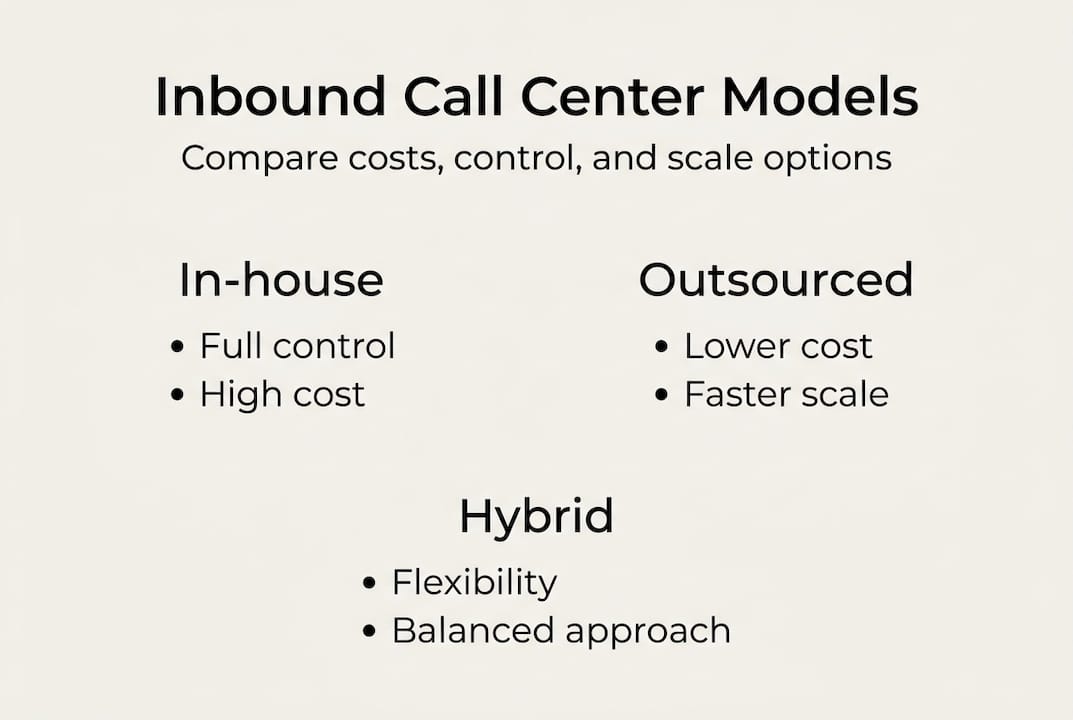
| Criteria | In-house | Outsourced | Hybrid |
|---|---|---|---|
| Cost | High fixed cost | 50 to 70% lower | Balanced |
| Language coverage | Limited by hiring | Wide and immediate | Flexible |
| Control | Full | Shared via SLAs | Selective |
| Scalability | Slow | Fast | Fast where needed |
| Cultural alignment | Strong | Depends on provider | Managed |
The cost argument for outsourcing is well documented. But cost alone is the wrong lens. The real question is where your support interactions create or destroy value.
Consider a SaaS company with a complex enterprise product. Those enterprise customers need to reach someone who knows the product deeply, can escalate to engineering, and understands contractual nuances. Keeping that interaction in-house makes sense. But the same company handles thousands of basic password resets, billing questions, and trial inquiries every month. Outsourcing that volume to a trained multilingual partner frees your internal specialists for work that actually moves revenue.
For a grounded in-house vs outsourced comparison that factors in hidden costs like recruitment, training, turnover, and infrastructure, the savings gap is often larger than it first appears. And when you add multilingual coverage requirements, the offshore call center benefits become even more pronounced.
Hybrid models optimize for high-value in-house support while outsourcing volume. The companies getting this right aren't choosing between control and efficiency. They're designing for both.
The most common mistake is treating this as a binary choice. It isn't. The best-performing support organizations in telecom and e-commerce run deliberate hybrid structures with clear ownership over each interaction type.
Selecting and implementing inbound call center services for telecom, SaaS, and e-commerce
Knowing the models is one thing. Making the right choice for your specific operation requires a structured approach. Here's a practical implementation roadmap:
- Audit your current support load: Document call volume by language, channel, issue type, and peak period. Most teams discover surprises here, like a significant portion of tickets in a language nobody on staff speaks fluently
- Define your non-negotiables: SLA response times, required languages, CRM platforms, and compliance requirements. These filter your vendor list before you even start conversations
- Evaluate vendors on sector experience: A provider that has served telecom operators understands number portability disputes. One with SaaS experience knows subscription billing edge cases. Success depends on aligning call center capabilities with the nuances of your specific industry
- Run a pilot before full deployment: Start with one language, one channel, or one issue category. Measure quality, speed, and customer satisfaction for 60 days before scaling
- Build escalation paths into the contract: Define exactly which issues get routed where, how agents flag urgent cases, and how you retain visibility into partner performance
- Monitor and iterate continuously: Track first-contact resolution, average handle time, CSAT, and language-specific performance. Review efficiency and CX best practices quarterly to stay ahead of drift
Pro Tip: When evaluating providers, request a sample QA scorecard and a real anonymized call recording. You'll learn more from three minutes of actual agent interaction than from any capability deck. See how the best inbound call center services stack up when evaluated against these criteria.
A modern perspective: The hybrid approach is the new standard
Here's something worth saying plainly: purely in-house or fully outsourced models are increasingly the wrong answer for growth-stage companies. We've seen this pattern repeatedly across nearly two decades of working with telecom, SaaS, and e-commerce clients.
The organizations that build genuine competitive advantage in customer experience are not the ones with the largest internal teams. They're the ones who are honest about where their internal team creates irreplaceable value and where a specialized partner simply performs better, faster, and cheaper.
The nuanced part that most articles skip is the leadership requirement. A hybrid model doesn't run itself. It requires someone internally who owns the integration, communicates standards across both teams, and treats the outsourcing partner as a genuine extension of the brand. Without that, you get two siloed operations that customers experience as inconsistent. With it, you get a unified CX at a fraction of the cost of full in-house staffing.
Change management matters too. Internal agents sometimes resist hybrid models, fearing replacement. Addressing that directly, by defining what stays internal and why, is what separates successful rollouts from painful ones. If you're working through outsourcing partner strategies for the first time, the organizational dimension deserves as much attention as the vendor selection.
Ready to transform your customer support?
Building a high-performance inbound call center operation is achievable, but only when you partner with a provider who understands your industry, speaks your customers' languages, and can scale without sacrificing quality. Across telecom, SaaS, and e-commerce, the gap between average and excellent support comes down to execution.

At CallTech Outsourcing, we've spent nearly 20 years helping companies across Europe and international markets build exactly that. From multilingual outsourcing services across more than 15 European languages to a scalable support workflow designed for growth, we bring the infrastructure, talent, and experience to make your support operation a competitive advantage. Reach out for a consultation and find out what a purpose-built inbound solution looks like for your business.
Frequently asked questions
What is an inbound call center service?
Inbound call center services handle all incoming customer inquiries and support requests across voice and digital channels to ensure fast, accurate, and empathetic responses. They cover everything from billing questions to technical troubleshooting across phone, email, and live chat.
Why choose a multilingual inbound call center?
Multilingual call center teams extend global reach and enhance customer experience by delivering support in each customer's preferred language. Businesses serving multiple markets see measurable gains in satisfaction and loyalty when language barriers are removed.
What are the major benefits of outsourcing inbound call center services?
Outsourcing offers cost savings, access to specialized multilingual talent, multichannel coverage, and faster scalability compared to fully in-house teams. CRM systems can power outsourced multilingual support with up to 70% savings over in-house solutions.
How do hybrid call center models work?
Hybrid in-house/outsourced models let companies keep critical, high-value support internal while outsourcing high-volume or multilingual needs for efficiency and flexibility. This structure optimizes for both quality control and cost performance.
What should I look for in an inbound call center provider?
Prioritize industry expertise, a robust technology stack, multilingual staff, and clear service level agreements when choosing a provider. Vendor evaluation should focus on these factors to ensure long-term fit and consistent CX delivery.