

Support teams in telecom, SaaS, and e-commerce are under real pressure. CSAT scores are slipping, cost-per-ticket budgets are tightening, and customers expect fast, accurate answers in their own language. The gap between what customers expect and what fragmented, inconsistent support delivers is widening fast. AI chatbots handle up to 40% of support queries today, yet most organizations still struggle to build a coherent process around automation and human agents. This guide gives you a practical, data-backed framework to fix that, covering preparation, execution, and measurement for multilingual customer support process improvement.
Table of Contents
- Understanding modern customer support process challenges
- Preparing for customer support process improvement
- Implementing multilingual and AI-driven process improvements
- Monitoring, measuring, and troubleshooting support process improvements
- Scale your multilingual customer support with proven partners
- Frequently asked questions
Key Takeaways
| Point | Details |
|---|---|
| Prioritize process bottlenecks | Use benchmarks and language data to find and address the most urgent support gaps first. |
| Leverage hybrid AI-human models | Combine automation for routine queries with skilled agents for complex issues to maximize efficiency and satisfaction. |
| Track quality by language | Monitor CSAT, FCR, and reopen rates per language to catch and resolve support quality issues early. |
| Empower self-service | Expand knowledge bases and portals, as over 60% of customers now prefer to resolve simple issues themselves. |
Understanding modern customer support process challenges
Customer expectations shifted dramatically after 2023. Speed is no longer a differentiator; it is the baseline. Customers expect first responses in minutes, not hours, and they expect support in their native language regardless of channel. For telecom, SaaS, and e-commerce companies operating across European markets, that creates compounding complexity.
Here is how 2026 benchmarks break down by sector, according to industry benchmark data:
| Sector | Avg. CSAT | First Response Time | Cost per Ticket |
|---|---|---|---|
| Telecom | 74% | Under 4 hours | $8 to $14 |
| SaaS | 82% | Under 2 hours | $10 to $18 |
| E-commerce | 78% | Under 1 hour | $5 to $10 |
The gap between top-decile performers and average teams is not marginal. Top performers in SaaS hit CSAT above 90% and resolve tickets in under 30 minutes. The difference is almost always process, not headcount.
Key pain points driving underperformance include:
- Inconsistent multilingual coverage: Agents handling languages outside their fluency create tone drift and resolution failures
- Fragmented channels: Phone, email, chat, and social handled in silos produce duplicate tickets and slow resolution
- No standardized escalation paths: Without clear handoff rules, complex issues bounce between teams
- Lagging self-service: Customers who prefer to solve problems independently hit dead ends
Multilingual coverage is now a retention lever, not a nice-to-have. Companies that invest in outsourcing multilingual support consistently outperform those relying on ad-hoc translation or bilingual generalists. The customer service guide from Salesforce confirms that 61% of customers prefer self-service, which means your knowledge base and IVR flows need to work in every language you serve. Learning how to master multilingual call center process is no longer optional for companies with cross-border ambitions.
Preparing for customer support process improvement
Once you have identified where your support process lags, it is time to get your data, people, and tools aligned before making changes. Jumping straight to automation or outsourcing without this groundwork wastes budget and creates new problems.

Start by analyzing your support ticket data by language and region. Which languages generate the most reopen rates? Where is average handle time highest? This tells you where to prioritize. 76% of buyers prefer products with information in their native language, and multilingual support boosts retention by 30%. That is a measurable business case for language-specific investment.
Use this comparison to assess your current state against best practice:
| Capability | Current State (Typical) | Best Practice |
|---|---|---|
| Language coverage | 2 to 4 languages | 10 or more languages |
| Escalation paths | Manual, inconsistent | Automated, language-aware |
| Knowledge base | English only | Localized per market |
| QA process | Periodic, general | Weekly, per-language |
| CRM integration | Partial | Full omnichannel view |
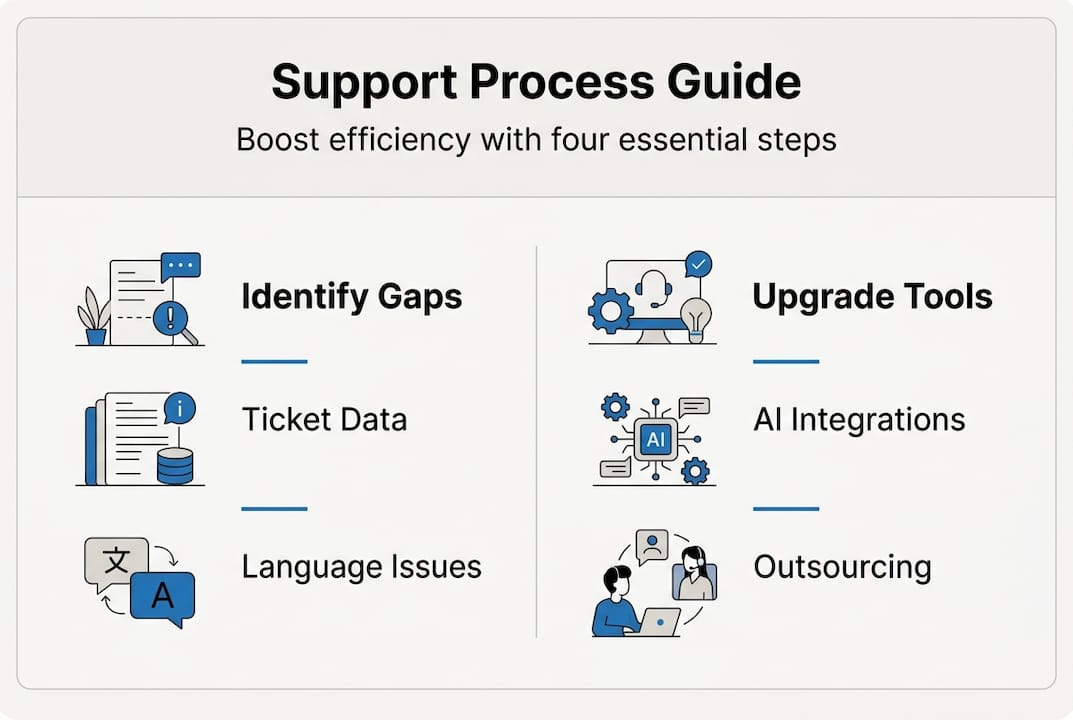
When choosing upgrade priorities, focus on the areas with the highest cost or satisfaction impact first. For most telecom and SaaS companies, that means reducing escalation volume and improving first contact resolution (FCR). For e-commerce, speed and self-service deflection usually deliver the fastest ROI. Explore multilingual support strategies to benchmark your language coverage against competitors.
Cost-effective outsourcing is often the fastest path to closing language coverage gaps without hiring full-time staff in every market.
Pro Tip: Audit your current escalation paths and ticket handoff workflows specifically for language-related bottlenecks. A ticket that gets handed off three times because no agent speaks the customer's language is not a staffing problem; it is a process failure.
Implementing multilingual and AI-driven process improvements
With priorities set and readiness mapped, here is how to execute improvements using blended AI, automation, and human models. The key is sequencing. Doing everything at once creates confusion and makes it impossible to isolate what is working.
- Set language-specific KPIs. Define CSAT, FCR, and average handle time targets for each language you support. Generic targets mask per-language failures.
- Choose your AI and self-service stack. Deploy chatbots for tier-one queries in high-volume languages first. AI chatbots now handle 21 to 40% of queries, and hybrid AI-human models consistently outperform either approach alone.
- Configure hybrid workflows. Route routine queries to automation. Flag complex or emotionally sensitive tickets for human agents immediately. Do not let AI attempt retention conversations or billing disputes.
- Deploy localized knowledge bases. Build and maintain articles in every language you serve. Enforce translation glossaries so terminology stays consistent across agents and bots.
- Monitor per-language FCR and CSAT weekly. Do not wait for quarterly reviews to catch drift.
"AI can deflect more than 40% of routine tickets, but humans must manage complex or sensitive escalations. The organizations that get this balance right see the strongest combined CSAT and cost outcomes."
The right customer service tools for process improvement make this sequencing manageable. For companies considering offshore call center strategies, the cost savings on tier-one volume can fund the human expertise needed for complex escalations. Research on blended AI and human support consistently shows that neither pure automation nor pure human support delivers optimal results at scale.
Pro Tip: Track language-specific reopen rates every week. A spike in reopens for a specific language almost always signals a translation gap, a workflow handoff failure, or an agent fluency issue. Catching it early saves CSAT points and prevents churn.
Monitoring, measuring, and troubleshooting support process improvements
Having begun implementation, it is vital to validate success and adapt continuously. Measurement is where most improvement programs stall. Teams track overall CSAT but miss the per-language variance that reveals real problems.
Here are the metrics that matter most, benchmarked against 2026 top-decile standards from industry benchmark data:
| Metric | Industry Average | Top Decile Target |
|---|---|---|
| CSAT | 74 to 82% | Above 90% |
| First Contact Resolution | 65 to 72% | Above 85% |
| Cost per Ticket | $8 to $18 | Below $7 |
| Reopen Rate | 12 to 18% | Below 6% |
Common issues to watch for and address:
- Tone drift: Automated translations or non-native agents produce responses that feel cold or confusing to local customers. Fix with native-speaker QA reviews.
- Handoff failures: Tickets transferred between agents or channels lose context. Fix with CRM tagging and mandatory handoff notes.
- FCR variance by language: If French tickets resolve in one contact but Polish tickets require three, the process is not the same across languages. Investigate and standardize.
- Self-service dead ends: Monitor where customers abandon your knowledge base or IVR. Those drop-off points are content gaps.
"Tracking support metrics by language, not just overall, is the single most effective way to catch process failures before they become churn events."
For teams working on mastering multilingual call center results, the discipline of per-language reporting separates high-performing operations from average ones. Resources on optimizing global customer support confirm that segmented reporting is the fastest path to identifying and fixing quality gaps.
Scale your multilingual customer support with proven partners
When in-house efforts hit their ceiling, specialized outsourcing partners can multiply your results without multiplying your headcount or overhead. CallTech Outsourcing has been delivering multilingual customer support since 2005, covering more than 15 European languages for telecom, SaaS, and e-commerce clients.

Our teams integrate directly with your CRM and existing workflows, so there is no disruption to your current operations. Whether you need to close language coverage gaps, reduce cost per ticket, or scale rapidly into new markets, outsourcing multilingual support through a proven partner is faster and more cost-effective than building in-house capacity. Explore top call center platforms built for telecom and SaaS environments, or review top call center services to find the right fit for your operation. Contact us to start with a consultation and see where your support process can improve fastest.
Frequently asked questions
What are the most impactful ways to improve customer support processes in telecom and SaaS?
Integrating AI for routine queries, empowering self-service, and using hybrid human-AI workflows are the most proven strategies. AI and automation for routine tasks combined with skilled human agents for complex issues consistently deliver the strongest CSAT and cost outcomes.
How do I measure the success of multilingual support improvements?
Track CSAT, first contact resolution rates, cost per ticket, and reopen rates segmented by language. CSAT, FCR, and reopen rates reveal per-language support quality that overall metrics will miss.
What are common pitfalls in multilingual customer support upgrades?
Cultural and tone drift in translation, poor escalation design, and failing to track quality by language are the most frequent issues. Reopen rates by language are one of the clearest early signals of translation or workflow failures.
Should all support be automated or should humans handle some cases?
Automation handles routine issues efficiently, but complex or sensitive cases need skilled human agents. AI excels for speed and routine queries, while humans are essential for retention conversations, billing disputes, and emotionally charged interactions.
How does process improvement in customer support impact retention?
Better multilingual support directly improves retention. Multilingual support boosts retention by up to 30%, making language coverage one of the highest-ROI investments a customer support team can make.
Recommended
- Master the multilingual call center process in 2026
- Top 8 Customer Service Outsourcing Tools 2026
- Top 7 Call Center Platforms for Telecom Companies 2026
- Top 7 Best Call Center Services 2026
- Step-by-step production quality improvement for results
- Guide to efficient table service: 30% faster processing