

Many business leaders still operate under a quiet assumption: if your support team speaks English, you're covered globally. That assumption is expensive. Over half of global businesses have already lost deals because they failed to communicate in their customers' language. As international markets grow more competitive and customer expectations rise, the gap between English-only support and true multilingual engagement is widening fast. This article breaks down the real cost of ignoring language barriers, what the data says about customer loyalty, and how modern businesses are building scalable multilingual support that actually works.
Table of Contents
- The true cost of ignoring multilingual support
- Customer preferences and the business growth equation
- What successful multilingual support looks like
- How technology is reshaping multilingual support
- Common challenges and real-world solutions
- Partner with experts for seamless multilingual support
- Frequently asked questions
Key Takeaways
| Point | Details |
|---|---|
| Market access | Multilingual support unlocks new business opportunities and prevents costly lost deals in global markets. |
| Customer loyalty | Most consumers are more loyal to brands offering support in their native language. |
| Cost-efficiency | AI-driven support reduces operational costs up to 85% while speeding up service resolution. |
| Hybrid approach | Combining AI with human expertise ensures efficient and culturally accurate communication. |
| Future readiness | Investing in multilingual frameworks prepares your business for evolving regulations and market needs. |
The true cost of ignoring multilingual support
The numbers are hard to ignore. 90% of global businesses plan to expand into new-language markets, yet more than half have already lost business because they couldn't communicate effectively with local customers. That's not a minor operational gap. That's a structural revenue problem.
When customers can't get support in their own language, the consequences stack up quickly:
- Lost conversions: Prospects who can't understand your support process simply don't buy.
- Reduced trust: Customers who feel misunderstood disengage and rarely return.
- Lower retention rates: Unresolved issues in a foreign language accelerate churn.
- Damaged brand reputation: Negative reviews citing language barriers spread fast in local markets.
Language isn't just a communication tool. It's a signal of respect and commitment to a market. When a company invests in multilingual contact centers, it signals to customers that their experience matters. When it doesn't, customers notice immediately.
"Language is the first handshake with a new market. Get it wrong, and no amount of product quality will recover the relationship."
The good news is that cost-effective outsourcing has made multilingual support accessible even for mid-sized companies scaling internationally. The barrier to entry is lower than most leaders think. The cost of inaction, however, keeps rising.
Customer preferences and the business growth equation
Customer behavior data tells a consistent story. 76% of consumers prefer support in their native language, and that preference directly translates into loyalty, repeat purchases, and higher lifetime value. This isn't a soft metric. It's a growth lever.

Research on purchasing habits by language consistently shows that customers spend more and stay longer when they can communicate in their first language. The table below shows how native language support affects key business metrics:
| Metric | English-only support | Native language support |
|---|---|---|
| Customer retention rate | Lower by 20-30% | Significantly higher |
| Net Promoter Score (NPS) | Below market average | Above market average |
| Average order value | Standard | Up to 25% higher |
| First-contact resolution | Slower, more escalations | Faster, fewer escalations |
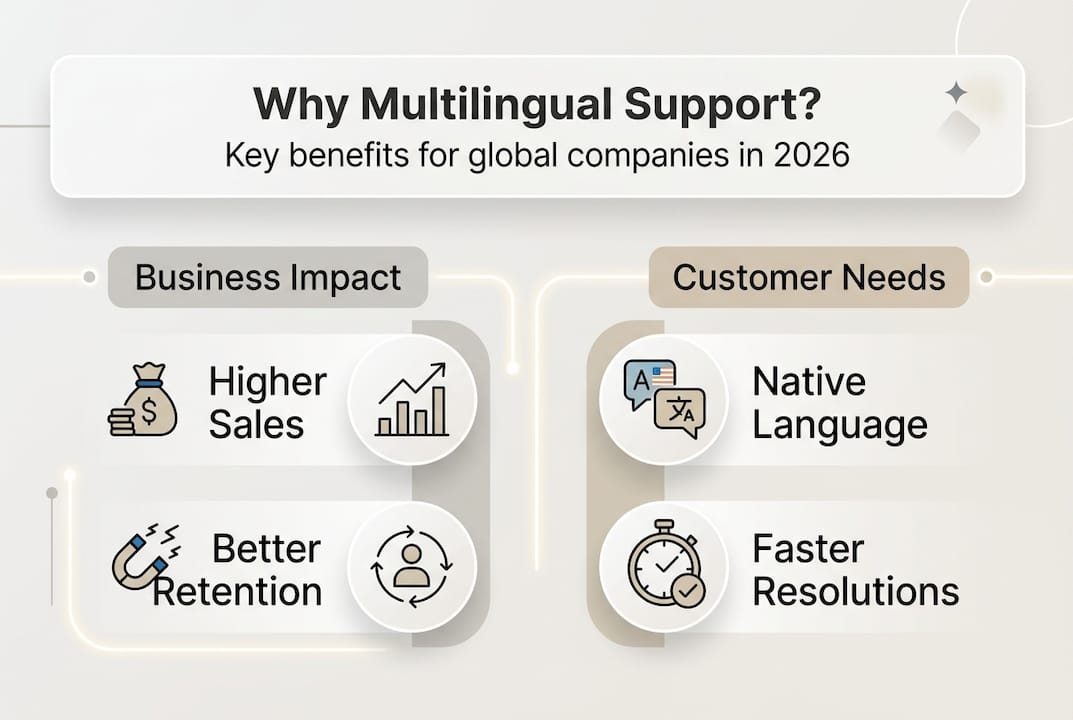
The pattern is clear. Customers who feel understood buy more, complain less, and recommend more. For global businesses, that's the difference between a market that grows and one that stagnates.
Effective multilingual support also means optimizing contact center workflow so agents can handle volume without sacrificing quality. A well-designed multilingual call center process reduces average handle time and improves first-contact resolution across all language queues.
"Customers don't just want answers. They want to feel heard in the language they think in."
What successful multilingual support looks like
The most effective multilingual support operations today don't rely on a single strategy. They combine speed with cultural intelligence. The framework that works at scale looks like this: AI handles detection, routing, and initial translation, while human agents manage nuance, escalations, and high-stakes conversations.
Here's how the three main approaches compare:
| Approach | Speed | Cultural accuracy | Scalability | Risk level |
|---|---|---|---|---|
| English-only | Fast | Low | Limited | High (market loss) |
| Machine translation only | Very fast | Medium | High | Medium (errors possible) |
| Human-only localization | Slower | Very high | Limited | Low |
| AI + human hybrid | Fast | High | Very high | Low |
The hybrid model wins on every dimension that matters for global operations. Localization vs translation is a critical distinction here. Translation converts words. Localization adapts meaning, tone, and cultural context. Customers feel the difference immediately.
According to Forrester, the right approach is to combine AI with human agents for cultural context and high-stakes conversations. AI alone creates risk. Human agents alone don't scale. Together, they deliver both quality and efficiency.
The right top multilingual support tools integrate with your CRM, flag language-specific issues automatically, and route conversations to the right agent without friction. That's what modern outsourcing multilingual contact centers deliver.
Pro Tip: Never deploy AI translation in customer-facing channels without a human review layer. Even a single mistranslation in a billing dispute or legal context can damage trust in an entire market segment.
How technology is reshaping multilingual support
The efficiency gains from AI-driven multilingual support are substantial. AI-driven multilingual support reduces support costs by 65 to 85%, cuts resolution time by 73%, and delivers a 3.2x ROI in the first year. Those are numbers that change how CFOs think about outsourcing.
But technology adoption without a clear process creates chaos. Here's a sequential approach that works:
- Audit your current language coverage. Identify which markets you serve and which languages are underserved.
- Select AI tools with strong multilingual models. Not all translation engines perform equally across languages.
- Build a human escalation layer. Define which conversation types always require a native-speaking agent.
- Integrate with your CRM. Language data should inform customer profiles and support history.
- Measure and iterate. Track resolution rates, CSAT scores, and escalation frequency by language.
The AI-powered call center model works best when technology handles volume and humans handle complexity. That balance is what separates efficient global operations from expensive, error-prone ones.
One critical warning: unchecked AI in multilingual support can produce confident-sounding but culturally wrong responses. In regulated industries like telecom or financial services, that's not just a customer experience problem. It's a compliance risk.
Pro Tip: Always run post-edit quality checks on AI-generated translations before they reach customers. A small investment in human review protects your brand reputation in every market you serve.
Common challenges and real-world solutions
Even well-resourced companies run into predictable obstacles when scaling multilingual support. Knowing them in advance lets you plan around them.
The three most common challenges are:
- Cultural fit: Literal translations miss idioms, humor, and local expectations. A phrase that reassures customers in German may sound dismissive in Portuguese.
- Regulatory compliance: Low-resource languages and compliance requirements create real risk. Legal disclosures, billing terms, and data privacy notices must be precisely localized, not just translated.
- AI performance gaps: AI models perform well in high-resource languages like Spanish or French. For less common languages, error rates climb and language pitfalls multiply.
The solutions are practical:
- Hire native-speaking agents for markets where cultural nuance is high-stakes.
- Build a post-translation QA process with native reviewers before content goes live.
- Conduct compliance reviews with local legal counsel for regulated industries.
- Use contact center optimization frameworks to identify language-specific bottlenecks before they become customer complaints.
"Localization is not a translation project. It's a market entry strategy. Companies that treat it as the former consistently underperform in new regions."
The businesses that get multilingual support right treat language as a strategic investment, not an operational afterthought. They build processes, hire the right people, and use technology to scale what works.
Partner with experts for seamless multilingual support
Scaling multilingual support across 10 or 15 markets is a serious operational challenge. Getting the language right, the culture right, the compliance right, and the technology right simultaneously is exactly where most in-house teams hit their limits.

CallTech Outsourcing has been helping global businesses solve this challenge since 2005. With nearly 20 years of experience and support in more than 15 European languages, we provide outsourcing multilingual support that combines native-speaking agents, modern VOIP infrastructure, and CRM integration. Whether you need customer care, technical support, or billing assistance across multiple markets, our teams are built to scale with you. Explore how workflow optimization and expert multilingual support can accelerate your international growth without the operational risk of building it all in-house.
Frequently asked questions
Why isn't English-only support enough for international businesses?
English-only support excludes the majority of global consumers who prefer their native language. Over half of businesses have already lost revenue because of this gap, making language coverage a direct revenue issue.
How does multilingual support directly impact customer loyalty?
76% of consumers show greater loyalty to brands that support them in their native language, which translates into higher retention rates and stronger lifetime value.
Can AI replace human agents for multilingual support?
AI improves speed and scale, but combining AI with human oversight is essential for cultural accuracy, compliance, and handling complex or sensitive conversations.
What's the ROI of implementing multilingual support solutions?
AI-driven multilingual support can reduce support costs by up to 85% and deliver a 3.2x ROI within the first year of implementation.
What are the main challenges businesses face with multilingual support?
Low-resource languages, regulatory compliance, and cultural nuance are the most common obstacles, all of which require a combination of native expertise and structured QA processes to manage effectively.