

Many business leaders assume international customer service simply means translating scripts into different languages. This misconception costs companies millions in lost customers and damaged brand reputation across global markets. Effective international support requires deep cultural understanding, strategic time zone management, and localized communication approaches that go far beyond word-for-word translation. Companies that master these elements see measurably higher satisfaction scores, stronger customer loyalty, and significantly reduced churn rates. This guide reveals the core concepts, practical challenges, and proven strategies that transform international customer service from a costly necessity into a powerful competitive advantage for businesses expanding across borders.
Table of Contents
- Key takeaways
- Understanding international customer service: core elements and definitions
- Cultural nuances and communication challenges in global customer service
- The business impact of multilingual support: metrics and benefits
- Strategies for managing time zones and localization in global customer support
- Enhance your international customer service with expert multilingual outsourcing
- Frequently asked questions
Key Takeaways
| Point | Details |
|---|---|
| Cultural adaptation required | International service hinges on understanding local customs, expectations, and etiquette beyond literal translation. |
| Multilingual support boosts satisfaction | Native or fluent language capabilities capture nuance and context, driving higher satisfaction and loyalty. |
| Time zone management | Strategic scheduling ensures customers receive help during local business hours, reducing wait times and churn. |
| Localization matters | Localizing currency, holidays, regulations, and product details creates authentically localized experiences. |
Understanding international customer service: core elements and definitions
International customer service represents customer support provided across borders with cultural sensitivity, multilingual communication, and localization tailored to diverse global markets. Unlike domestic support that operates within a single cultural and linguistic framework, international service demands sophisticated approaches that account for varying customer expectations, communication preferences, and cultural norms across different countries and regions. This complexity multiplies exponentially as companies expand into new markets, making strategic planning essential for success.
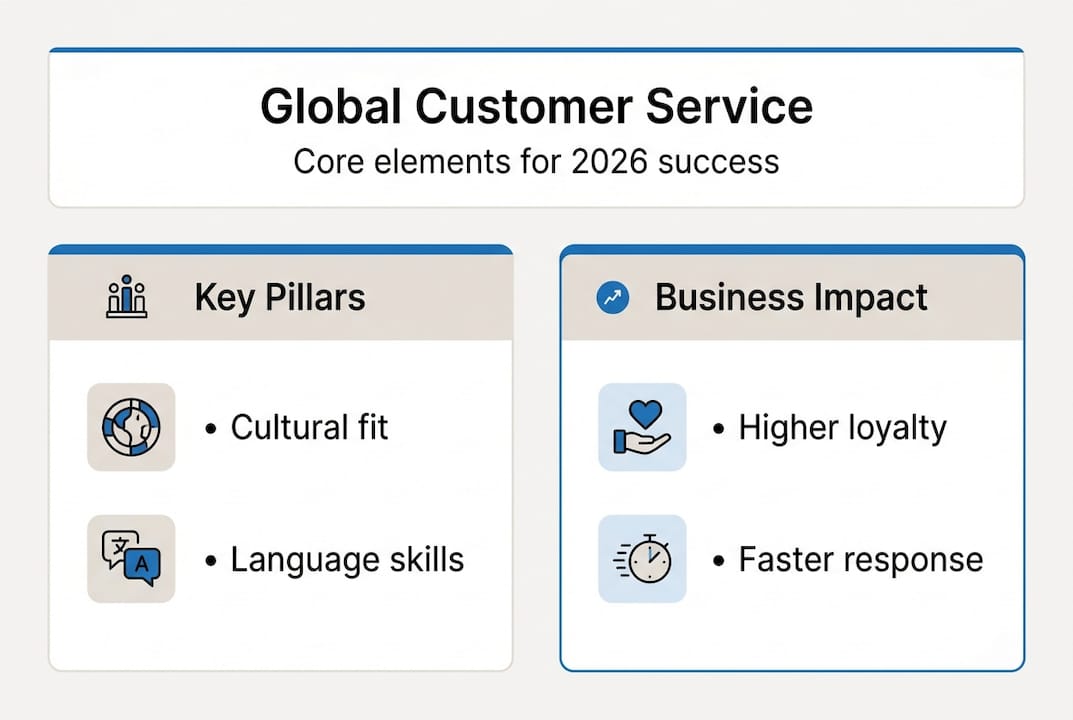
The foundation of effective international customer service rests on several interconnected elements that work together to create seamless experiences. Cultural sensitivity ensures your team understands and respects local customs, communication styles, and business etiquette that shape customer expectations. Multilingual support provides native or fluent language capabilities that go beyond basic translation to capture nuance, emotion, and context. Time zone management guarantees customers receive timely assistance during their local business hours rather than waiting for your headquarters to open. Localization adapts everything from currency displays to holiday schedules, creating experiences that feel genuinely local rather than foreign.
The fundamentals of services in international contexts introduce layers of complexity absent from domestic operations. When you cross borders, you encounter different regulatory requirements, payment preferences, communication technologies, and customer service expectations that vary significantly by region. A support approach that works brilliantly in Germany may fail completely in Japan or Brazil because cultural context shapes how customers perceive helpfulness, professionalism, and problem resolution effectiveness.
Consider these core components when building your international customer service strategy:
- Native language support from fluent speakers who understand regional dialects and colloquialisms
- Cultural training programs that teach teams about communication styles, relationship expectations, and etiquette norms
- Flexible staffing models that provide coverage across multiple time zones without burning out your team
- Localized knowledge bases that reflect regional regulations, payment methods, and product variations
- Technology infrastructure supporting international phone systems, messaging platforms, and CRM integration
Pro Tip: Invest equally in cultural adaptation training and language skills when building international support teams. Many companies over-prioritize translation accuracy while neglecting the cultural context that determines whether customers feel truly understood and valued.
Partnering with experienced providers offering outsourcing call center services eliminates the complexity of building these capabilities in-house while providing immediate access to multilingual teams with established cultural expertise and proven international service frameworks.
Cultural nuances and communication challenges in global customer service
Cultural differences create the most significant challenges in international customer service because they operate beneath the surface of language, shaping expectations and interpretations in ways that catch unprepared teams off guard. High-context cultures like Russia, Japan, and many Middle Eastern countries rely heavily on implicit communication, relationship history, and non-verbal cues to convey meaning. Customers from these markets expect service representatives to read between the lines, understand unstated concerns, and prioritize relationship building over transactional efficiency. Conversely, low-context cultures including Germany, Switzerland, and Scandinavia value direct, explicit communication where all relevant information gets stated clearly and efficiency trumps extended relationship development.
This fundamental difference explains why literal translation fails so dramatically in international service scenarios. A perfectly translated script that works in Berlin may offend customers in Tokyo because it violates unspoken expectations about politeness, indirectness, and relationship acknowledgment. German customers appreciate straightforward problem-solving and clear timelines without excessive pleasantries, while Japanese customers may interpret this directness as rudeness or disrespect. Brazilian customers expect warm, personal interactions with genuine emotional connection, whereas Finnish customers prefer concise, fact-based exchanges that respect their time.
AI mismatch in high-context markets leads to poor trust and requires adaptive models for cultural nuances because automated systems struggle to interpret implicit communication signals and adjust tone appropriately for relationship-focused cultures.
Apology customs illustrate these cultural complexities perfectly. Japanese business culture requires elaborate apologies that acknowledge responsibility and express sincere remorse even for minor issues, with the depth of the apology reflecting respect for the customer relationship. American customers expect quick acknowledgment followed by immediate solution focus, viewing extended apologies as time-wasting or insincere. French customers want acknowledgment but may interpret excessive apologizing as weakness or incompetence rather than customer focus.

Implementing effective multilingual call center processes requires deep understanding of these cultural communication patterns to avoid costly missteps that damage customer relationships and brand reputation across international markets.
Common cultural communication challenges that international service teams must navigate include:
- Directness expectations varying from blunt honesty to subtle implication across different markets
- Relationship building requirements ranging from immediate transaction focus to extended rapport development
- Emotional expression norms spanning enthusiastic warmth to reserved professionalism
- Hierarchy and authority respect influencing how customers expect to be addressed and escalations handled
- Time perception differences affecting urgency interpretation and acceptable response timeframes
- Conflict resolution approaches varying from confrontational problem-solving to harmony-preserving indirectness
These cultural nuances compound when managing service across multiple markets simultaneously, requiring sophisticated training programs and cultural intelligence frameworks that go far beyond language translation to address the deeper expectations shaping customer satisfaction and loyalty in each region you serve.
The business impact of multilingual support: metrics and benefits
The financial case for investing in comprehensive multilingual customer service becomes undeniable when examining key performance metrics across companies that prioritize native language support versus those offering English-only assistance. Multilingual support boosts CSAT scores by 15-17%, reduces churn by 10-29%, and improves loyalty with 70% higher repurchase rates compared to English-only service models, demonstrating measurable returns that justify the investment in cultural and linguistic capabilities.
These improvements stem from fundamental psychological factors that influence customer satisfaction and loyalty. When customers interact with support representatives in their native language, cognitive load decreases dramatically because they can express complex problems naturally without translating thoughts or struggling with unfamiliar vocabulary. This linguistic comfort reduces frustration, speeds problem resolution, and creates positive emotional associations with your brand. Customers feel genuinely understood rather than merely tolerated, building the emotional connection that drives long-term loyalty and advocacy.
| Metric | English-only support | Multilingual support | Improvement |
|---|---|---|---|
| Customer satisfaction (CSAT) score | 72% | 87% | +15 percentage points |
| Annual churn rate | 28% | 19% | -9 percentage points |
| Net promoter score (NPS) | +18 | +34 | +16 points |
| Repeat purchase rate | 41% | 70% | +29 percentage points |
| Average resolution time | 12.4 minutes | 8.7 minutes | -30% faster |
The efficiency gains surprise many business leaders who assume multilingual support increases complexity and costs. Resolution times actually decrease when customers communicate in their native language because misunderstandings drop dramatically, customers explain issues more clearly, and representatives grasp problems faster without language barriers creating confusion. This efficiency translates directly to cost savings through reduced handle times and fewer repeat contacts for the same issue.
Customer lifetime value increases substantially when you provide native language support because satisfaction and loyalty improvements compound over time. A customer who receives excellent support in their preferred language becomes more likely to upgrade services, purchase additional products, and refer other customers from their market. The best call center services in 2026 prioritize these multilingual capabilities precisely because they recognize the measurable business impact on retention, expansion revenue, and organic growth through customer advocacy.
Pro Tip: Track these metrics separately for each language and market you serve rather than averaging across your entire customer base. This granular analysis reveals which markets benefit most from enhanced support and helps justify expansion into additional languages based on concrete ROI data rather than assumptions about market importance.
Beyond direct financial metrics, multilingual support provides competitive differentiation in markets where most competitors offer only English assistance. Customers actively seek out companies that respect their language preferences, creating acquisition advantages that complement the retention benefits. This combination of improved acquisition, higher satisfaction, lower churn, and increased lifetime value creates compounding returns that grow more valuable as your international customer base expands.
Strategies for managing time zones and localization in global customer support
Time zone management represents one of the most challenging logistical hurdles in international customer service because customers expect support during their local business hours regardless of where your company headquarters operates. Handling time zones effectively and localizing content boosts satisfaction while avoiding availability conflicts that frustrate customers and damage brand perception across international markets. Companies that fail to address this challenge force customers to wait hours or even days for responses, creating friction that drives churn and negative word-of-mouth.
Successful time zone strategies require thoughtful approaches that balance coverage needs with operational efficiency and team sustainability. Follow these proven practices for managing global support scheduling:
- Map your customer distribution across time zones to identify peak demand periods requiring maximum staffing levels and overnight hours where asynchronous support suffices.
- Implement follow-the-sun models where support responsibilities shift between regional teams as business hours move across the globe, ensuring continuous live coverage without requiring night shifts.
- Staff strategically in locations that naturally cover multiple target markets, such as Central European teams serving both morning contacts from Asia and afternoon inquiries from the Americas.
- Offer tiered support levels with premium customers receiving 24/7 live assistance while standard tiers access comprehensive self-service resources plus business-hours live support.
- Leverage asynchronous channels like email and messaging for non-urgent issues, setting clear response time expectations that respect both customer needs and operational realities.
- Build knowledge bases and self-service resources that provide instant answers during off-hours, reducing dependency on live agent availability for common questions.
The choice between synchronous live support and asynchronous assistance involves tradeoffs that vary by customer segment, issue complexity, and market expectations. Understanding these differences helps you design the optimal mix for your specific situation.
| Support mode | Strengths | Weaknesses | Best for |
|---|---|---|---|
| Synchronous (live chat, phone) | Immediate resolution, builds rapport, handles complex issues | Requires 24/7 staffing, higher cost per contact, time zone challenges | Urgent problems, premium customers, complex technical issues |
| Asynchronous (email, ticketing) | Flexible timing, allows research, cost-effective scaling | Slower resolution, multiple exchanges, less personal connection | Non-urgent requests, detailed explanations, standard inquiries |
Localization extends far beyond language translation to encompass every element of the customer experience that varies by geography. Effective localization adapts currency displays, date formats, measurement units, payment methods, shipping options, and holiday schedules to match local expectations. Customers notice when your service acknowledges their regional context through these details, creating impressions of thoughtfulness and customer focus that strengthen brand affinity.
Regulatory compliance represents another critical localization dimension that varies dramatically across markets. GDPR requirements in Europe, data residency rules in Russia and China, consumer protection laws in Brazil, and accessibility standards in the United States all demand localized approaches to data handling, privacy policies, and service delivery. Companies that treat these requirements as afterthoughts face legal risks and customer trust issues that undermine international expansion efforts.
Exploring outsourcing telecom support tips reveals how specialized BPO providers handle these complexities through established infrastructure, trained multilingual teams, and proven processes that eliminate the learning curve companies face when building international capabilities from scratch.
Enhance your international customer service with expert multilingual outsourcing
Building world-class international customer service capabilities in-house requires years of investment in recruiting multilingual talent, developing cultural training programs, implementing global infrastructure, and refining processes through trial and error across diverse markets. Smart business leaders recognize that partnering with established multilingual BPO providers delivers these capabilities immediately while avoiding the costs and risks of building from scratch.

CallTech Outsourcing brings nearly 20 years of multilingual customer support expertise serving clients across Europe and international markets with professional teams fluent in more than 15 European languages. Our cultural intelligence, modern infrastructure, and proven processes help companies scale their international support operations efficiently while maintaining the quality standards that drive customer satisfaction and loyalty. Whether you need comprehensive outsourcing call center services or specialized support for specific markets, our experienced teams provide the multilingual capabilities and cultural expertise that transform international service from a challenge into a competitive advantage. Explore our outsourcing telecom support tips and discover why leading companies trust CallTech as their long-term partner for best call center services in 2026 across global markets.
Frequently asked questions
What is international customer service?
International customer service is support provided to customers across different countries and cultures, requiring multilingual communication, cultural sensitivity, and localized approaches that respect regional expectations. It goes beyond translation to address time zones, local regulations, and cultural communication styles that shape customer satisfaction.
Why does multilingual support matter for business success?
Multilingual support increases customer satisfaction by 15-17% and reduces churn by 10-29% because customers can communicate complex problems naturally in their native language. This linguistic comfort speeds resolution, builds emotional connection, and drives loyalty that translates to higher lifetime value and repeat purchase rates.
How do cultural differences affect customer service approaches?
Cultural differences determine whether customers expect direct or indirect communication, transactional efficiency or relationship building, and formal or casual interactions. High-context cultures require reading between the lines and prioritizing rapport, while low-context cultures value explicit information and quick problem-solving, making one-size-fits-all approaches ineffective.
What role does time zone management play in international service?
Time zone management ensures customers receive timely support during their local business hours rather than waiting for your headquarters to open. Effective strategies include follow-the-sun models, strategic geographic staffing, tiered support levels, and asynchronous channels that balance live coverage needs with operational efficiency.
How can companies measure international customer service success?
Track customer satisfaction scores, churn rates, net promoter scores, repeat purchase rates, and resolution times separately for each language and market you serve. This granular measurement reveals which markets benefit most from enhanced support and provides concrete ROI data justifying investments in additional languages and cultural capabilities.