

TL;DR:
- Effective European appointment setting requires native-level language skills, cultural adaptation, and GDPR compliance to build trust and ensure success. Outsourcing to a multilingual provider with market-specific expertise offers scalable, cost-effective advantages over in-house or local agencies. Relying on generic global tactics risks low engagement, regulatory issues, and damaging brand perceptions across diverse European markets.
Appointment setting sounds simple on the surface. You call prospects, schedule meetings, and hand them off to your sales team. But that mental picture misses nearly everything that matters, especially when your markets stretch across Germany, France, Poland, and a dozen other European countries. European success hinges on GDPR compliance, deep cultural adaptation, and native-level outreach in ways that generic global tactics simply cannot deliver. This article walks you through what effective multilingual appointment setting really involves, how to compare your options, and how to select a partner that moves the needle.
Table of Contents
- What are appointment setting services and why multilingual matters
- Key features of effective multilingual appointment setting services
- Comparing appointment setting models: In-house, local agency, or outsourcing
- Steps to select the right multilingual appointment setting partner
- Why 'global' doesn't mean effective: Hard-won lessons in European appointment setting
- Discover your multilingual appointment setting edge
- Frequently asked questions
Key Takeaways
| Point | Details |
|---|---|
| Multilingual is essential | Appointment setting in Europe requires native-level language and cultural adaptation to achieve strong results. |
| GDPR sets the rules | Compliance with European privacy laws should be a top priority in any outsourced outreach. |
| In-house vs. outsourcing | Outsourced multilingual services often deliver greater flexibility, scale, and lower overhead than in-house options. |
| Vet providers wisely | Evaluate partners based on language coverage, compliance record, and process transparency for best results. |
What are appointment setting services and why multilingual matters
Appointment setting is a dedicated sales support function where trained agents contact qualified prospects, qualify their interest, and schedule confirmed meetings directly into your sales team's calendar. It sits between lead generation and the sales close, and it is one of the highest-leverage steps in your pipeline. Done well, it means your salespeople spend their time in meetings, not on the phone chasing cold contacts.
The "multilingual" part is not a marketing flourish. It is a functional requirement for any business operating across European borders. Consider what happens when a German-speaking procurement manager receives an outreach call conducted in accented, non-native German. The conversation feels transactional and impersonal. Trust erodes before your product is even mentioned. Native-level fluency removes that friction instantly, allowing the conversation to flow naturally and build rapport.
Several concrete factors make multilingual capability essential for European appointment setting:
- Language coverage: Europe has more than 24 official languages. Reaching prospects in their own language increases pickup rates, reduces call abandonment, and leads to longer, more productive conversations.
- Cultural communication styles: Business communication norms vary sharply. Dutch professionals tend to be direct and time-conscious. Italian and Spanish counterparts often place greater value on relationship-building before discussing business. Nordic markets lean toward understated professionalism rather than high-energy sales pitches.
- GDPR and regional privacy rules: The General Data Protection Regulation governs how prospect data may be collected, stored, and used during outreach campaigns. Agents must understand consent rules, opt-out handling, and data retention policies specific to each market.
- Local business calendars and timing: School holidays, national observances, and local business rhythms vary country by country. An agent unfamiliar with these nuances will call at the wrong time and wonder why engagement is low.
Understanding outsourced appointment efficiency means recognizing that these variables compound. When you get all of them right together, conversion rates improve dramatically. When even one is off, your entire campaign underperforms.
Pro Tip: Before launching any European appointment setting campaign, map each target country's primary language, business communication style, and top GDPR consent requirement. Use this map as your campaign configuration checklist, not just background reading.
Key features of effective multilingual appointment setting services
Once you understand why multilingual capability is central, the next question is: what does an excellent multilingual appointment setting provider actually offer? Not every provider that claims multilingual capability delivers it at a meaningful level. Here is what to look for.
Native-level language fluency, not conversational proficiency. There is a significant gap between agents who "speak" a language and agents who are native or near-native speakers. Native fluency means understanding humor, idioms, tone shifts, and formality conventions. A French prospect will notice immediately when the agent is translating thoughts from English into French in real time. That gap breaks trust. Top providers employ agents whose primary language matches the market they call.

GDPR-embedded workflows. Compliance cannot be bolted on as an afterthought. The best providers build GDPR adherence into every step: script design, data sourcing, opt-out management, call recording consent, and lead record handling. Ask any prospective provider to walk you through their data processing agreement and their consent management process before signing anything.
CRM integration and multichannel outreach. Modern appointment setting is not phone-only. Effective customer engagement strategies combine voice calls, email follow-ups, LinkedIn touchpoints, and SMS reminders in a coordinated sequence. Your provider should be able to sync booked appointments directly into your CRM so your sales team sees confirmed meetings in real time without any manual entry.
Ongoing cultural and etiquette training. Business norms shift. New regulations emerge. Market conditions change. Providers who invest in continuous training for their agents stay ahead of these changes rather than reacting to complaints after the fact.
Transparent reporting and KPI tracking. You should receive regular reports on call volume, connection rates, appointment show rates, and pipeline value generated. If a provider cannot show you these numbers clearly, you cannot manage the program or improve it.
"European success hinges on GDPR, cultural adaptation, and native outreach. Generic global tactics consistently produce low engagement and compliance risk across diverse European markets." — B2B Appointment Setting Best Practices
Reviewing outsourcing partners for support through this lens reveals that not every provider operates at the same level of sophistication. Many offer language support on paper while relying on second-language agents in practice. Vetting this distinction is one of the most important steps you will take during provider selection.
Comparing appointment setting models: In-house, local agency, or outsourcing
Once you know what you need in a provider, you must choose the structural model that fits your business. Three main options exist: building an in-house team, engaging a local agency in each target market, or partnering with a specialized multilingual outsourcing provider.
| Model | Language coverage | Cost structure | Scalability | GDPR expertise | Best for |
|---|---|---|---|---|---|
| In-house team | Limited to hires made | High fixed costs | Slow to scale | Depends on HR | Large enterprises, single-market |
| Local agencies | Native, market-specific | Medium, per-market | Moderate | Locally strong | Companies with 1-3 target markets |
| Multilingual outsourcing | 15+ languages, one partner | Flexible, lower overhead | Fast, on-demand | Centralized compliance | Mid-sized businesses, multi-market |
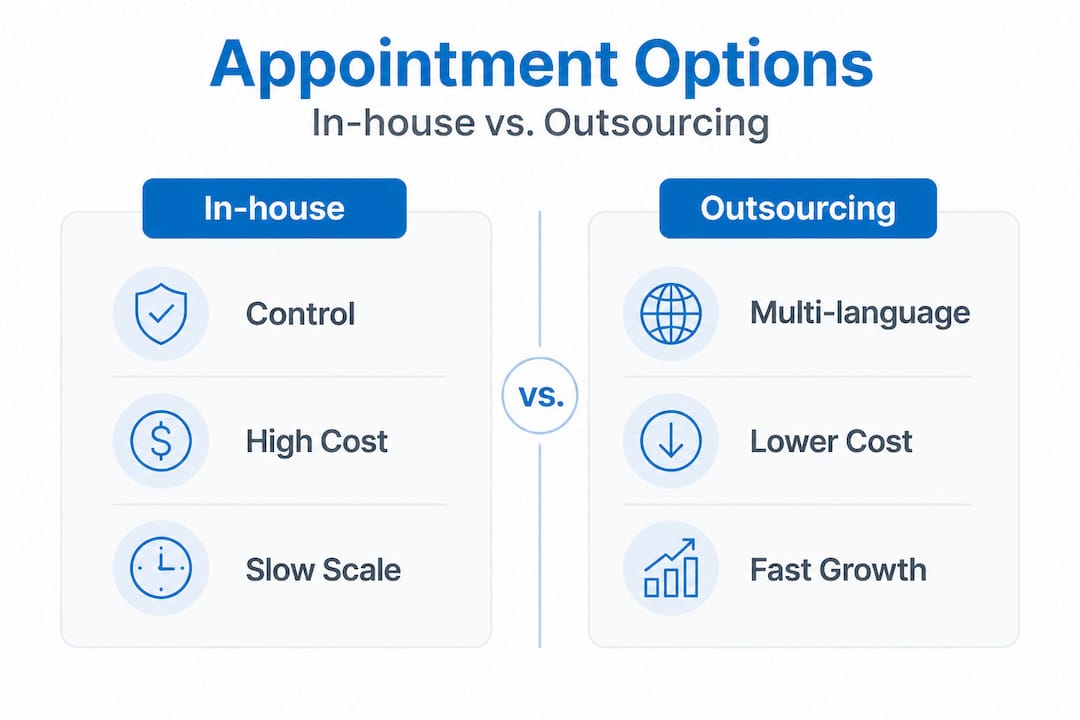
In-house teams give you maximum control over messaging and brand tone. Your agents sit inside your culture and know your product deeply. The downside is cost and coverage. Hiring native speakers of Polish, Dutch, Swedish, and Portuguese across a single internal team is expensive and logistically complex. Scaling up for a campaign and back down afterward is slow and costly.
Local agencies offer genuine cultural expertise in their home market. A Paris-based agency calling French prospects will understand local business culture intuitively. But managing six agencies across six markets means six sets of contracts, reporting formats, compliance documentation, and relationship management overhead. Coordination becomes a project in itself.
Multilingual outsourcing consolidates all of this under one partner. A single provider with outsourcing for efficiency across more than 15 European languages means one contract, one reporting dashboard, and one compliance framework. Scaling up for a campaign launch or pulling back during a slow quarter happens quickly without the HR overhead of an in-house team. This is why mid-sized businesses expanding across Europe increasingly favor this model.
For B2B lead generation strategies that span multiple countries, the outsourcing model typically delivers the best combination of speed, coverage, and cost-effectiveness.
Pro Tip: Even if you start with a single target market, choose a provider with multi-market capability from day one. Switching providers mid-expansion is expensive and disruptive. Build the relationship once and grow within it.
Steps to select the right multilingual appointment setting partner
Knowing which model to use is only half the decision. Selecting the right specific partner within that model requires a structured evaluation process.
- Define your campaign goals clearly. Before reaching out to any provider, document your target markets, ideal customer profile, monthly meeting targets, and success metrics. Providers who ask the right questions during discovery are the ones worth talking to further.
- Request GDPR compliance documentation. Ask for their data processing agreement, their consent management policy, and any certifications they hold. A credible provider will have these documents ready, not under preparation.
- Assess language and country coverage in detail. Ask specifically which languages are covered by native speakers versus proficient second-language speakers. Request sample call recordings in your target languages if possible.
- Evaluate their technology stack. Confirm CRM integration capabilities, multichannel outreach support, and call recording practices. CRM-driven support savings are only possible when your provider's systems connect smoothly to yours.
- Review KPIs and reporting formats. Ask what metrics they track, how often they report, and what a sample report looks like. Vague answers here signal operational immaturity.
- Check references in your target markets. Ask for client references specifically from companies that ran campaigns in your target countries. Market-specific experience matters far more than general testimonials.
- Pilot before committing. Run a paid pilot campaign in one market before expanding. This gives you real performance data and a clear picture of the working relationship before you scale.
Here is a quick-reference checklist of what to verify in any formal proposal:
| Evaluation area | What to verify |
|---|---|
| Language coverage | Native speakers confirmed per market |
| GDPR compliance | Signed DPA, consent management process |
| Technology | CRM integration, multichannel capability |
| Reporting | Frequency, KPIs tracked, format |
| Pricing model | Per-appointment, retainer, or hybrid |
| Client references | References in your specific target markets |
Cost-effective appointment solutions are easiest to identify when you compare providers on these structured criteria rather than price alone. A cheaper provider with weak compliance practices will cost you far more in the long run through poor results and potential regulatory exposure.
Why 'global' doesn't mean effective: Hard-won lessons in European appointment setting
Here is a perspective that rarely appears in sales outsourcing conversations: the word "global" in a provider's pitch is often a warning sign, not a feature. After working with European businesses across many markets and industries, the pattern is consistent. Providers who lead with global reach frequently underdeliver on local depth.
Think about what happens when a US-based or globally oriented provider calls a senior buyer in Munich using a script optimized for North American business conversations. The agent opens with enthusiasm and informality that reads as unprofessional to a German counterpart. The GDPR opt-in language is adapted from American CAN-SPAM rules and misses several EU-specific consent requirements. The call comes in at 8:30 a.m. on a German public holiday. The result is not just a missed appointment. It is a damaged brand impression that the prospect will share with colleagues.
These are not hypothetical edge cases. They are predictable failures that emerge directly from treating European markets as extensions of a single global approach. European success hinges on market-specific knowledge that cannot be simulated by translation software or a language proficiency test.
The uncomfortable truth is that many businesses select appointment setting partners based on price, slick dashboards, and impressive client logos, without verifying whether those clients operated in their specific target markets. Native teams are not a premium feature. They are the baseline requirement for any European campaign that expects meaningful results.
What changes when you work with genuinely localized, native teams? Pickup rates improve because prospects hear a familiar voice and communication pattern. Trust forms faster because the agent understands unspoken cultural expectations. Compliance is built in because the agent actually understands what GDPR consent language means in their country's legal context. Exploring multilingual engagement insights consistently shows that native-led outreach outperforms translated outreach by a margin that compounds over any campaign longer than four weeks.
The conventional wisdom says: find a big provider with lots of language options and let them handle it. The harder but more accurate advice is: find a provider who can demonstrate genuine local expertise in your specific markets, and prioritize that depth over breadth every time.
Discover your multilingual appointment setting edge
European markets reward businesses that show up prepared, compliant, and culturally fluent. Finding the right partner to deliver that is not a minor procurement decision, it is a strategic one.

At CallTech Outsourcing, we have been building multilingual outreach capabilities since 2005, serving clients across telecom, SaaS, e-commerce, and digital services in more than 15 European languages. Our appointment setting programs are built on native-speaker teams, GDPR-compliant workflows, and deep CRM integration that fits directly into your sales process. Whether you need to enter a single new market or coordinate campaigns across six countries simultaneously, our outsourcing call center services scale with your ambitions. Explore how our approach to engagement with multilingual support can help your team close more meetings across borders, with less compliance risk and a stronger brand presence in every market you target.
Frequently asked questions
What is an appointment setting service?
It is a specialized outreach service that contacts qualified prospects, assesses their interest, and schedules confirmed sales meetings on your behalf, keeping your sales team focused on closing rather than prospecting.
Why is multilingual outreach important for appointment setting in Europe?
European outreach demands native-level language skills, cultural understanding, and GDPR compliance to generate meaningful engagement across diverse markets where generic tactics consistently underperform.
How can businesses verify GDPR compliance of appointment setting services?
Request a signed data processing agreement, a written consent management policy, and specific examples of how the provider handles opt-outs and data retention before signing any contract.
What's the difference between in-house, agency, and outsourced appointment setting?
In-house teams offer deep brand alignment but are costly and slow to scale; local agencies provide strong market expertise for one or two countries; outsourced multilingual providers deliver multi-market coverage, flexible pricing, and centralized compliance under a single partnership.
What are the main risks with generic or global appointment setting tactics in Europe?
Generic global tactics produce low engagement rates, cultural mismatches that damage brand reputation, and significant exposure to GDPR violations that can result in regulatory penalties and lost prospect trust.