

TL;DR:
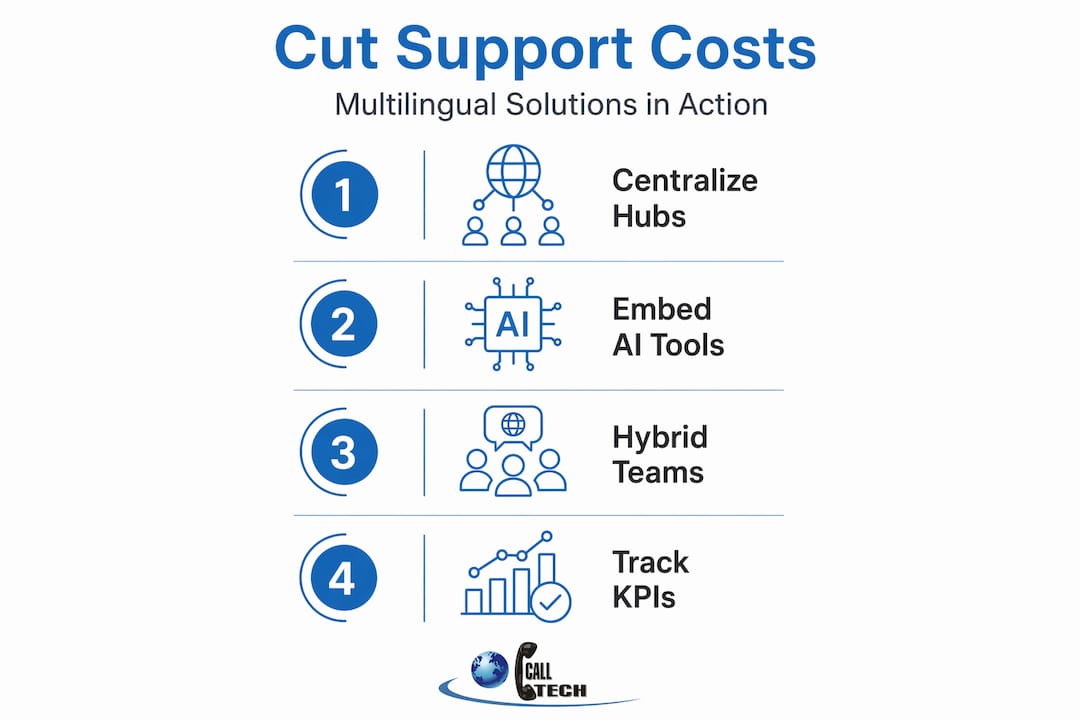
- Expanding multilingual support increases costs due to cultural expertise, time zone coverage, and volume growth. Implementing centralized, AI-integrated workflows and hybrid team models enables cost-effective scaling without sacrificing quality. Regularly measuring key support metrics ensures sustainable savings and continuous improvement.
Scaling customer support across borders sounds like a growth milestone until the invoices arrive. For telecom operators, SaaS companies, and e-commerce businesses expanding into new markets, the pressure to reduce customer support costs collides directly with the reality of multilingual demand: more languages, more agents, more complexity, and more spend. But the companies winning this challenge are not simply cutting headcount. They are rethinking how multilingual support is structured, automated, and measured. This guide walks you through exactly how to do that.
Table of Contents
- Understanding the cost drivers in multilingual customer support
- Preparing to reduce costs: tools, workflows, and team structures
- Executing cost reductions: leveraging AI, self-service, and intelligent routing
- Verifying results and sustaining cost-effective multilingual support
- Why chasing full AI automation to cut costs can backfire
- Partner with experts for cost-effective multilingual customer support
- Frequently asked questions
Key Takeaways
| Point | Details |
|---|---|
| Centralize multilingual support | Centralizing customer support hubs and integrating AI translation enables scaling globally without proportional cost increases. |
| Leverage assisted AI workflows | Using AI to assist agents with triage and responses drives productivity gains better than full automation attempts. |
| Implement self-service strategically | Ticket deflection through well-measured self-service channels reduces live support load and lowers cost per ticket. |
| Measure holistic KPIs | Track ticket deflection, FCR, repeat contacts, and cost per resolution together to accurately assess savings and quality. |
| Balance AI and human agents | Combining AI assistance with skilled human agents provides optimal cost control without sacrificing customer experience. |
Understanding the cost drivers in multilingual customer support
Before you can lower support service costs, you need to know precisely what is inflating them. Multilingual support is expensive for reasons that go beyond hiring bilingual agents, and most budget overruns trace back to a handful of structural problems.
International customer service creates cost pressure from several directions at once:
- Language and cultural expertise. Fluent agents who understand regional business culture command higher salaries and are harder to retain. A German-speaking technical support agent is not interchangeable with a French-speaking one, so you cannot simply redistribute headcount when volume spikes in one region.
- 24/7 coverage across time zones. Covering European, North American, and Asian markets simultaneously requires either multiple staffed regional hubs or expensive shift premiums for agents working overnight.
- Volume growth outpacing capacity. When a SaaS platform adds 50,000 users in Poland and Spain in one quarter, ticket volume in those languages can double within weeks. Existing teams absorb the overflow, but not cheaply.
- Inconsistency between regional teams. When translation and tone are handled differently across offices, customers receive inconsistent answers. That drives repeat contacts, escalations, and the hidden cost of rework.
As documented in a European fintech case study, rising complexity, language coverage, 24/7 availability, and volume growth are the core factors that inflate support costs at scale. Understanding which of these is your biggest driver shapes every decision that follows.
Preparing to reduce costs: tools, workflows, and team structures
Once you understand what is driving your costs, the next step is building the infrastructure that makes cost reduction possible without eroding quality. Three areas matter most: centralization, AI integration, and team design.
Centralize before you expand. Running separate support hubs in each market feels locally responsive but multiplies overhead fast. A centralized global support hub, where agents handle multiple markets from a single location, reduces redundant management layers, standardizes quality, and makes scheduling efficient. The European fintech case showed that centralizing global coverage with AI-powered translation enables scaling multilingual support without tripling headcount, a finding that aligns with what we see across our own client base.
Integrate AI translation and triage into your ticketing system. AI translation embedded directly into tools like Zendesk or Salesforce Service Cloud means agents do not need to speak every language they handle. They read translated tickets, respond in their native language, and the system handles conversion. According to SAP's own support function data, deploying AI for triage, summaries, and response suggestions increases productivity and controls costs across large support operations.
Design your team structure around the hybrid model. Rather than choosing between full automation and all-human teams, the highest-performing operations blend both. AI handles classification, routing, and first drafts. Human agents handle nuance, escalations, and relationship-sensitive interactions.

Here is a practical comparison of common team structures and their cost implications:
| Team structure | Cost profile | Best suited for |
|---|---|---|
| Regional hubs per market | High fixed overhead | Established markets with large volume |
| Centralized multilingual hub | Lower overhead, higher flexibility | International expansion phase |
| Outsourced multilingual partner | Variable cost, fast to scale | SaaS and e-commerce with fluctuating demand |
| Fully automated AI-only | Low per-ticket cost initially | Simple, high-volume queries only |
| AI-assisted human hybrid | Balanced cost and quality | Complex technical and billing support |
Resources on building remote multilingual teams and AI-assisted support technologies can help you design the right blend for your business size and market footprint.
Pro Tip: Before buying any AI tooling, audit your top 20 ticket types by language and volume. You will likely find that 40 to 60 percent of your incoming tickets fall into five to eight repeatable categories. That is your automation target, and it is more specific than any vendor pitch will tell you.
Executing cost reductions: leveraging AI, self-service, and intelligent routing
Preparation sets the foundation. Execution is where you actually reduce helpdesk operational costs. Here is a practical sequence that works for telecom, SaaS, and e-commerce companies operating across multiple languages.
-
Implement AI-assisted ticket triage and agent helper tools. Start by deploying AI that classifies incoming tickets by issue type, language, and priority, then routes them to the right agent or queue automatically. Pair this with AI-generated response suggestions that agents can edit and send. This cuts average handle time without removing human judgment. SAP's AI deployment demonstrates that AI can fully resolve 20% of tickets while assisting on 100%, delivering significant productivity gains across the entire support function.
-
Build and promote self-service channels in every language you support. A knowledge base in English only is not a self-service channel for your French or Dutch customers. Invest in localized FAQs, guided troubleshooting pages, and AI chatbots trained on your actual ticket history. Ticket deflection via self-service reduces live ticket volume and lowers cost per ticket while maintaining customer experience when the content is accurate and regularly updated.
-
Deploy bilingual AI voice agents and intelligent routing for phone support. Voice channels are among the most expensive per-contact. A bilingual AI voice agent can handle first-level queries, authenticate callers, and collect issue details before transferring to a human. In one documented telecom deployment, bilingual AI voice agents improved first call resolution by 34%, accelerated service delivery by 50%, and reduced costs by 70%.
-
Measure everything from day one. Ticket deflection rate, cost per resolved ticket, first contact resolution (FCR), and repeat contact rate are your four primary indicators. Track them weekly, not monthly, especially in the first 90 days after any workflow change.
Here is a side-by-side view of what changes before and after deploying AI-assisted workflows:
| Metric | Before AI-assisted workflows | After AI-assisted workflows |
|---|---|---|
| Average handle time | 8 to 12 minutes | 5 to 7 minutes |
| First contact resolution rate | 65 to 70% | 80 to 85% |
| Tickets resolved without agent | 0% | 15 to 25% |
| Cost per resolved ticket | High baseline | 20 to 40% reduction |
| Agent capacity per shift | Standard | Increased by 20 to 35% |
Detailed guidance on reducing support costs effectively and cost cutting with quality covers how to apply these steps without degrading the customer experience your brand has built.
Pro Tip: Do not launch a chatbot and call it self-service. Track what percentage of users who start a chatbot conversation actually resolve their issue without opening a ticket. That number, not chatbot usage volume, tells you whether deflection is actually working.
Verifying results and sustaining cost-effective multilingual support
Execution without measurement is just spending differently, not spending less. To sustain savings over time, you need a clear verification framework.
The metrics that actually matter:
- Ticket deflection rate: The share of potential tickets resolved through self-service before a live agent is involved.
- Cost per resolved ticket: Total support spend divided by resolved contacts. This is your single most important efficiency indicator.
- First contact resolution (FCR): The percentage of contacts resolved without a follow-up. Low FCR inflates costs silently.
- Average handle time (AHT): Shorter AHT from AI assistance means more contacts handled per agent hour.
- Repeat contact rate: If customers call back within 7 days on the same issue, your resolution quality is failing even if your speed looks good.
As the Onix telecom case study confirms, cost savings depend on improvements in contact containment, repeat contact prevention, FCR, and AHT measured together, not in isolation.
Segment your data by language and channel. A deflection rate of 35% across all channels might look healthy until you discover that English self-service is deflecting at 55% while your Spanish knowledge base is deflecting at 12%. That gap represents both a cost problem and a customer experience gap in your Spanish-speaking markets.
Measuring ticket deflection as a channel metric with proper segmentation, as Zendesk's analysis shows, avoids overestimating savings and surfaces where optimization efforts will have the most impact.
Here is a simple tracking framework for monthly review:
| KPI | Target range | Warning signal |
|---|---|---|
| Ticket deflection rate | 30 to 50% | Below 20% |
| Cost per resolved ticket | Declining quarter on quarter | Plateauing or rising |
| First contact resolution | Above 80% | Below 70% |
| Average handle time | Under 7 minutes | Above 10 minutes |
| Repeat contact rate | Below 10% | Above 15% |
Review your global support strategies and contact center best practices alongside these metrics to identify structural issues, not just surface-level fluctuations.
Pro Tip: Set a monthly "language audit" where you pull your bottom three performing languages by FCR and review those tickets manually. You will consistently find either a content gap in your knowledge base or an AI routing error. Both are fixable, and fixing them moves your cost numbers faster than any technology purchase.
Why chasing full AI automation to cut costs can backfire
Here is the view from nearly 20 years of running multilingual support operations: the businesses that cut costs most effectively are not the ones that automate the most. They are the ones that measure the most precisely.
The push toward full AI automation in customer support has an uncomfortable ceiling. Gartner predicts that GenAI cost per resolution for customer service will exceed offshore human agent costs by 2030. That is not a fringe opinion. It reflects the reality that large language models are computationally expensive to run at scale, and that fully automated systems fail on complex issues in ways that generate expensive human escalations anyway.
The smarter path is one most vendors will not suggest because it does not sell software: use AI to assist your human agents, not replace them. An agent handling 8 tickets per hour with AI-generated drafts and smart routing is more cost-effective than a fully automated system that resolves 80% of tickets but generates a flood of frustrated callbacks on the other 20%.
In multilingual environments, this matters even more. A bilingual customer with a billing dispute in Polish does not want a bot that technically understands their words but misses the tone of frustration in their message. That interaction, handled poorly, costs you the customer. Gartner's recommendation mirrors what we have seen in practice: optimize AI to assist workflows and measure cost per resolution with real numbers rather than chasing blanket automation targets.
The reduce support costs guide we developed from real client deployments reflects this philosophy. Cost per resolution is the only metric that tells you whether your support operation is genuinely getting more efficient. Everything else, from CSAT scores to deflection rates, is an input into that number.
Partner with experts for cost-effective multilingual customer support
Implementing everything covered in this guide requires real infrastructure, experienced teams, and proven workflows. That is where a specialist partner makes the difference.

CallTech Outsourcing has been delivering outsourcing multilingual support services since 2005, covering more than 15 European languages across telecom, SaaS, digital services, and e-commerce. Our centralized contact center model gives you 24/7 coverage without the overhead of building regional hubs, and our AI-assisted workflows are already integrated into the platforms your teams use. Whether you need to control costs during rapid international expansion or want to improve FCR in underperforming language markets, we design solutions that fit your operational reality. Explore how multilingual support drives e-commerce conversion and learn more about building effective remote teams to take the next step.
Frequently asked questions
What is ticket deflection and how does it reduce support costs?
Ticket deflection means customers resolve issues themselves through self-service tools like FAQs, chatbots, or knowledge bases, reducing the volume of live agent contacts. Fewer live tickets directly lower staffing requirements and cost per resolution.
Can AI fully automate multilingual customer support effectively?
Full AI automation is often more expensive than it appears and less reliable on complex or nuanced issues. Gartner's 2026 analysis predicts GenAI will exceed offshore human agent costs by 2030, making AI-assisted hybrid models the more cost-effective approach.
How does multilingual AI improve first call resolution in telecom?
Multilingual AI improves routing accuracy and reduces miscommunication, which are the two leading causes of repeat contacts. In a Canadian telecom deployment, bilingual AI agents boosted FCR by 34% and cut costs by 70%.
What key metrics should be tracked to sustain support cost reductions?
Track ticket deflection rate, cost per resolved ticket, first contact resolution, average handle time, and repeat contact rate together. Measuring them in isolation gives a misleading picture. Combined metric tracking across these KPIs is what distinguishes genuine savings from shifted costs.