

TL;DR:
- Traditional cost-cutting methods often harm customer satisfaction and fail to deliver sustainable savings.
- A holistic approach focuses on IT maturity, hybrid AI-human models, and unified platforms for better ROI.
- Continuous improvement and strategic outsourcing are key to maintaining quality while reducing support costs.
Most operations leaders in telecom and SaaS have tried the obvious moves: offshore a tier, trim headcount, push customers toward self-service bots. The logic is clean on a spreadsheet. The results, however, rarely match the projections. Pure cost-cutting approaches like aggressive offshoring and headcount reductions consistently degrade customer satisfaction scores while failing to generate the lasting savings they promise. This article lays out the strategies that actually work: approaches built on IT maturity, hybrid AI-human models, and unified platforms that reduce cost without eroding the customer relationships you've spent years building.
Table of Contents
- Why traditional customer service cost cuts fall short
- The new framework: IT maturity, hybrid AI, and unified platforms
- Comparing cost-saving strategies: Traditional vs. holistic approaches
- How to apply customer service cost reductions without risking quality
- The uncomfortable truth about customer service cost reduction
- Accelerate transformation with expert outsourcing and support partners
- Frequently asked questions
Key Takeaways
| Point | Details |
|---|---|
| Short-term cuts risk CSAT | Relying solely on offshoring or staff reductions can lower customer satisfaction and fail to produce lasting savings. |
| Hybrid models drive results | Combining AI automation with skilled agents and unified platforms slashes costs while improving service quality. |
| IT maturity multiplies ROI | Investments in IT maturity can yield 2–8x ROI within a year, outperforming quick-fix cost cuts. |
| Sustainable change needs learning | Continuous improvement and adaptive leadership outperform generic cost-reduction playbooks. |
Why traditional customer service cost cuts fall short
The pressure to cut customer service spend is real. For mid-sized telecom and SaaS companies competing on thin margins across multiple markets, every basis point matters. So the instinct to offshore entire support tiers, deploy aggressive automation, or simply reduce headcount is completely understandable. The problem is that these moves almost always carry hidden costs that don't show up until months later.
When you cut experienced agents, you lose institutional knowledge. Customers who call about complex billing disputes or technical escalations end up bouncing between underprepared staff or disconnected bots. That friction drives churn. It increases repeat contact rates. It creates a downstream cost that often exceeds whatever you saved on labor. Here's what the evidence consistently shows:
- Offshoring without quality controls erodes context and continuity, especially for customers dealing with multi-touchpoint issues
- Aggressive automation that lacks human fallback sends frustration levels soaring, particularly for SaaS users mid-troubleshooting
- Headcount reductions reduce queue capacity and push average handle times up as remaining agents struggle with higher volumes and more complex queries
- Siloed cuts (trimming one department or channel without considering the broader system) simply shift costs rather than eliminating them
"Investments in unified platforms and AI produce 2–8x ROI in 9–12 months, while pure cost-cutting through offshoring and headcount reductions degrades CSAT and rarely delivers sustained savings. Holistic IT maturity consistently outperforms siloed cuts." — McKinsey
The data reinforces this. By 2027, 50% of organizations will abandon plans to reduce their customer service workforce through AI, according to Gartner. That's not because AI failed them technically. It's because they realized human expertise is harder to replace than it looks on a planning spreadsheet. The leaders who figure this out early are the ones who shift their thinking toward reducing support costs without losing quality through smarter structural design rather than blunt force cuts.
If you're still weighing the real financial difference between internal and external delivery, a detailed outsourced vs. in-house cost comparison can sharpen that picture considerably. The true cost of in-house support, when you factor in recruitment, training, benefits, attrition, and infrastructure, is consistently higher than most finance teams account for.
The new framework: IT maturity, hybrid AI, and unified platforms
The companies achieving the best cost-to-quality outcomes in customer service aren't doing something radically new. They're doing existing things in a much more integrated way. The framework has three pillars: IT maturity, hybrid AI-human models, and unified knowledge platforms. Each one amplifies the others.
IT maturity is the foundation. Operators in the top quartile for IT maturity carry a 30% lower IT cost to revenue ratio (3.7% versus 5.2% for lower-maturity operators). That gap translates directly into operating leverage. Mature IT environments mean fewer system failures, faster integrations, and agents who spend their time solving customer problems rather than fighting their own tools. In telecom specifically, where billing systems, network management platforms, and CRM tools often exist in fragmented stacks, the payoff from modernizing the underlying architecture is enormous.

Hybrid AI-human models are the second pillar, and this is where most of the misconceptions live. The goal isn't to replace agents with AI. It's to use AI where it excels (high-volume, repeatable, low-complexity queries) and preserve human expertise where it matters most (escalations, retention conversations, technical troubleshooting). AI-assisted help desk implementations have demonstrated a 35% cost-per-call reduction alongside a 60% improvement in first-contact resolution rates. Those numbers don't come from replacing humans. They come from giving humans better tools and routing the right volume away from them. Understanding AI chatbot efficiency in support operations can help you design automation tiers that genuinely assist rather than frustrate.
Unified knowledge platforms close the loop. When agents across channels and geographies can access the same up-to-date knowledge base, resolution times fall, inconsistency drops, and training costs shrink. This is especially critical for global telecom and SaaS companies running support across multiple languages and time zones.
| Strategy | Cost impact | CSAT impact | Time to ROI |
|---|---|---|---|
| Pure headcount reduction | Short-term savings | Negative | 3-6 months (then reversal) |
| AI-only automation | Moderate savings | Mixed to negative | 6-12 months |
| Hybrid AI-human model | 35% cost/call reduction | Positive | 9-12 months |
| Unified platform investment | 2-8x ROI | Strongly positive | 9-12 months |
| IT maturity uplift | 30% lower cost/revenue | Strongly positive | 12-24 months |
Gartner projects that agentic AI will resolve 80% of common customer service issues autonomously by 2029, contributing to a projected 30% operational cost reduction across the industry. That's a genuine opportunity, but it assumes you've already built the human-AI collaboration layer that makes agentic AI trustworthy. Organizations that haven't laid that groundwork will see the same failures they've seen with every prior wave of automation.
Pro Tip: Before deploying any new automation layer, map your top 20 contact drivers by volume and complexity. Apply AI to the high-volume, low-complexity tier first, and design clear escalation paths to human agents for everything else. You'll get faster ROI and protect your CSAT scores.
Review the contact center best practices that leading operations teams use to balance efficiency and experience. And if you're managing support across multiple countries, integrating the lessons from global customer support strategies will help you adapt this framework for linguistic and cultural complexity.
Comparing cost-saving strategies: Traditional vs. holistic approaches
Understanding the framework is one thing. Seeing how it compares to what you might already be doing is where the decisions get real.
| Dimension | Traditional (siloed) cuts | Holistic IT maturity approach |
|---|---|---|
| Primary method | Headcount, offshoring | Platform investment, hybrid AI |
| Short-term cost savings | High | Moderate to high |
| Long-term sustainability | Low | High |
| CSAT trajectory | Declining | Improving |
| Repeat contact rate | Increases | Decreases |
| Knowledge retention | Lost with attrition | Embedded in systems |
| Agent productivity | Decreases over time | Increases with tooling |
| ARPU impact | Neutral to negative | 5-15% uplift possible |
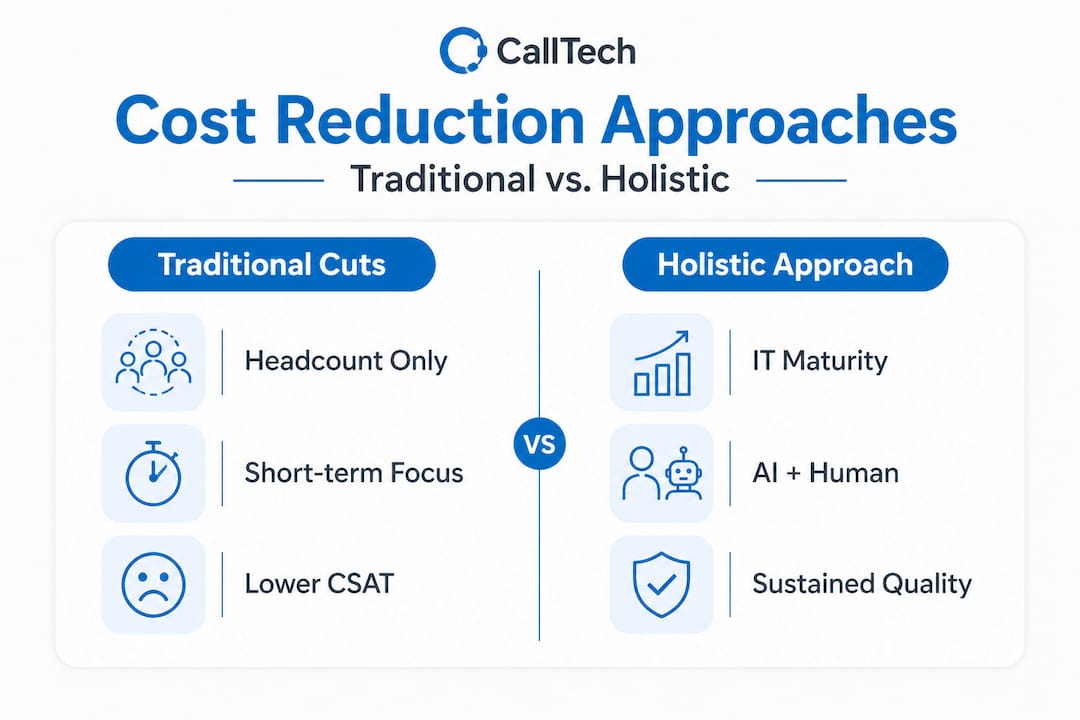
Operators focused on IT maturity consistently achieve better cost-to-revenue ratios and service outcomes than those pursuing siloed cost cuts. This isn't theoretical. It shows up in retention metrics, upsell rates, and agent turnover figures.
Here's a practical sequence for evaluating your current strategy and switching if needed:
- Audit your current cost breakdown. Separate labor costs, technology costs, and rework costs (repeat contacts, escalations, complaints). Rework is usually where the most money is being silently wasted.
- Benchmark your contact driver mix. What percentage of your volume is genuinely automatable right now? Most organizations overestimate this by 30-40%.
- Identify your knowledge fragmentation points. Where are agents going off-script, using outdated information, or spending time searching for answers? These gaps are costing you per handle time.
- Model total cost of ownership for platform vs. headcount. A proper help desk outsourcing guide walks through this calculation in practical terms.
- Design a phased transition plan that preserves service continuity while you build the new capability layer. Switching everything at once is a common mistake.
The benefits of a well-designed AI chatbot business strategy are real, but only when they're part of a broader operational design, not a standalone replacement for service infrastructure. Avoid the outsourcing mistakes that derail even well-funded transformation initiatives.
Pro Tip: Run a 90-day pilot of your hybrid model on a single market or language before scaling. Measure CSAT, first-contact resolution, and cost-per-contact in parallel. Real-world data from a constrained environment will sharpen your scaling plan significantly.
How to apply customer service cost reductions without risking quality
Knowing the framework and comparing strategies is useful. Actually executing the change without degrading service in the transition is where most operations leaders feel the most pressure. Here's how to approach it practically.
The goal is to build a resource mix that scales with demand without linearly scaling cost. That means you need both the right technology layer and the right human expertise layer, and they need to be genuinely integrated rather than operating in parallel silos.
Concrete steps that consistently produce results:
- Start with knowledge unification. Before adding any automation, consolidate your knowledge base into a single source of truth accessible to all agents and AI tools. This one step often reduces handle time by 15-20% on its own.
- Implement tiered routing deliberately. Map contact types to resolution tiers. Tier 1 handles via AI or self-service. Tier 2 uses assisted AI with human oversight. Tier 3 is fully human for complex or sensitive interactions.
- Measure what actually matters. Track first-contact resolution rate, customer effort score, cost per contact, and ARPU alongside traditional handle time metrics. Handle time in isolation is a misleading proxy for efficiency.
- Invest in agent tooling as much as agent hiring. An agent with a good AI copilot, integrated CRM, and unified knowledge base outperforms two agents without those tools, at lower total cost.
- Build change management into the plan. Agents who understand why changes are happening and are trained properly on new tools adopt them faster and use them more effectively.
Unified AI and knowledge platform investments deliver 2-8x ROI within 9-12 months, including an ARPU uplift of 5-15% through improved retention and upsell conversion. That's a return profile that justifies the upfront investment decisively. Review cost-effective outsourcing methods to understand how to combine internal capability building with external partners for maximum flexibility. And if geographic distribution is part of your model, the economics and quality implications of offshore call center strategies are worth examining carefully before committing to any specific delivery model.
Continuous improvement needs to be built into the operating rhythm, not treated as a project. Monthly reviews of contact driver trends, quarterly audits of automation performance, and annual reassessments of your human-AI ratio are the habits that separate organizations that sustain cost efficiency from those that achieve it briefly and then backslide.
The uncomfortable truth about customer service cost reduction
After nearly 20 years of working with telecom and SaaS companies across European and international markets, one pattern stands out more than any other: organizations that copy generic cost-cutting playbooks almost always underperform, and often harm themselves in ways that take years to fully unwind.
The uncomfortable truth is that most "cost reduction" initiatives in customer service are actually complexity-transfer exercises. You move cost from one visible line item to several invisible ones: higher churn, lower ARPU, increased escalation handling, accelerated agent attrition, and the enormous but rarely measured cost of rebuilding customer trust after a service degradation event.
The companies that genuinely reduce cost sustainably share three habits that have nothing to do with the technology they use. First, they treat customer service as a revenue-protection function, not a cost center. That framing changes which investments get approved and which metrics get tracked. Second, they build genuine learning cycles into their operations. Every month, they ask: what did we learn from our contact patterns, and what are we changing because of it? That discipline compounds over time in ways that one-time automation projects simply cannot match.
Third, and most importantly, their leadership actively resists the pressure to declare victory too early. Cost savings that show up in month three often have a CSAT bill that arrives in month nine. The leaders who have learned to look for lagging indicators before celebrating leading ones are the ones who build durable operational models.
Automation is a force-multiplier for great operational design. It is not a substitute for it. The proven customer support strategies that actually hold up over time are the ones built on that principle.
Accelerate transformation with expert outsourcing and support partners
If you're ready to move from strategy to execution, the right outsourcing partner can compress your timeline and reduce the risk of missteps significantly.

CallTech Outsourcing has been helping telecom and SaaS companies build scalable, multilingual customer support operations since 2005. We bring nearly two decades of experience across more than 15 European languages, with modern VOIP infrastructure, CRM integration, and hybrid AI-human delivery models already in place. Whether you're looking to outsource call center services for the first time or restructure an existing model for better efficiency, we offer flexible engagement models designed for your specific market realities. We help you enhance customer engagement across languages and time zones without the overhead of building that capability internally. Explore our customer support strategy examples to see how companies like yours have reduced costs while improving customer outcomes.
Frequently asked questions
What is the most sustainable way to reduce customer service costs in telecom or SaaS?
The most sustainable approach combines IT maturity, hybrid AI-human models, and unified platforms rather than relying on offshoring or headcount cuts. Top IT maturity operators achieve a 30% lower IT cost-to-revenue ratio compared to those pursuing siloed cost reductions.
How much can AI reduce support costs, and does it eliminate the need for human agents?
AI-assisted help desks have achieved a 35% cost-per-call reduction and 60% improvement in first-contact resolution, but human agents remain essential. By 2027, 95% of organizations will still retain human staff in customer service despite AI deployment.
Why do customer satisfaction scores sometimes drop after cost-cutting measures?
Aggressive offshoring and headcount cuts remove the expertise, context, and continuity that customers depend on for complex issues. Pure cost-cutting approaches consistently degrade CSAT while holistic investments in platforms and maturity produce the opposite result.
How quickly can ROI be realized from holistic cost reduction initiatives?
Unified platform and hybrid AI investments can deliver 2–8x ROI within 9–12 months, including a 5–15% ARPU uplift driven by improved retention and upsell performance.