

TL;DR:
- Outsourcing offers operational agility, multilingual support, and advanced tech integration beyond cost savings.
- Hybrid models optimize support by blending offshore and onshore teams based on ticket complexity.
- Selecting a strategic partner involves industry experience, transparency, SaaS-specific training, and scalable workflows.
Most business leaders assume outsourcing is primarily a cost-cutting move. Cut headcount, move tickets offshore, save money. But that framing misses most of the value on the table. Outsourcing delivers more than just cost arbitrage, and for SaaS, telecom, and e-commerce companies scaling across borders, the real wins come from operational agility, specialized training, and multilingual capacity. This guide breaks down the strategic, operational, and financial reasons to partner with an outsourcing provider, and gives you a practical framework for making that decision well.
Table of Contents
- The strategic advantages of outsourcing providers
- How outsourcing providers optimize workflows and customer experience
- Cost efficiency, scalability, and risk management
- Choosing the right outsourcing partner: What to look for
- A fresh perspective: Where most outsourcing guides miss the mark
- Unlock global support and efficiency with CallTech
- Frequently asked questions
Key Takeaways
| Point | Details |
|---|---|
| Strategic outsourcing value | Partnering with outsourcing providers delivers operational efficiency, global scalability, and risk reduction beyond cost savings. |
| SaaS and telecom edge | Providers with SaaS-centric training and API integration improve customer satisfaction and retention rates noticeably. |
| Hybrid support models | Combining offshore agents with AI-powered tools is more effective and cost efficient for complex Tier 2 customer support. |
| Partner selection criteria | Choosing partners with proven multilingual capabilities and workflow transparency ensures successful global support. |
| CallTech solutions | CallTech offers tailored multilingual and scalable customer support options to help business leaders unlock international growth. |
The strategic advantages of outsourcing providers
Outsourcing has evolved. It is no longer just about moving work somewhere cheaper. Today's providers bring advanced agent training, API-level integrations with your product stack, and even churn-risk detection capabilities built into their workflows. For a SaaS company managing subscription renewals or a telecom operator handling technical escalations, those capabilities matter far more than a lower hourly rate.
One of the most overlooked advantages is the hybrid outsourcing model. Rather than sending all support offshore or automating everything with AI, hybrid models blend onshore and offshore teams based on ticket complexity. Tier 1 queries go to cost-efficient offshore agents. Complex Tier 2 issues get routed to more specialized teams. This structure delivers both cost control and quality, without sacrificing one for the other.
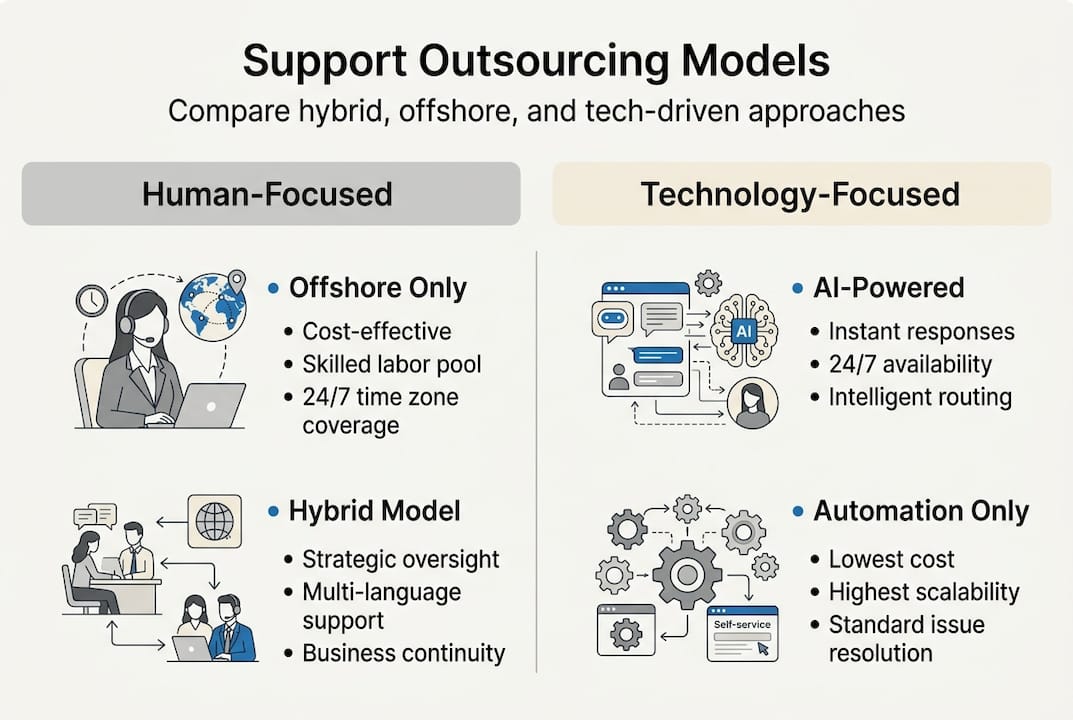
Offshore call center benefits extend well beyond price. You gain access to multilingual talent pools that would take years to build internally, and you can scale up or down based on seasonal demand without the overhead of permanent headcount. For e-commerce businesses managing holiday peaks, or SaaS companies launching in a new European market, that flexibility is a genuine competitive edge.
Key strategic benefits at a glance:
- Operational scalability: Add agents for peak periods without long-term hiring commitments
- Multilingual capacity: Support customers in 15 or more languages without building separate regional teams
- Tech integration: Modern providers connect directly to your CRM, ticketing system, and product APIs
- Compliance support: Experienced partners understand GDPR and regional data regulations
- Churn detection: Trained agents can flag at-risk customers during support interactions
| Model | Best for | Cost level | Complexity handled |
|---|---|---|---|
| Offshore only | High-volume, simple queries | Low | Tier 1 |
| Hybrid | Mixed complexity, growth-stage | Medium | Tier 1 and 2 |
| AI-assisted | Repetitive, structured tasks | Variable | Tier 1 |
| In-house | Highly sensitive, strategic | High | All tiers |
Pro Tip: Before evaluating providers, map your ticket types by complexity. This tells you exactly which model fits your support mix and prevents overpaying for capability you do not need.
It is also worth noting that Gartner predicts AI may be more costly than offshore human agents by 2030, making blended teams a smart long-term strategy rather than a temporary workaround. You can explore the full range of outsourcing methods to find the right fit for your organization.
How outsourcing providers optimize workflows and customer experience
A good outsourcing partner does not just answer tickets. They reshape how support flows through your organization. That starts with onboarding. The best providers invest heavily in product-specific training, meaning agents understand your platform, your terminology, and the typical failure points your customers hit. That depth of knowledge reduces handle time and improves first-contact resolution.

For SaaS support platforms, the integration layer is critical. When agents work directly inside your CRM, they see the customer's full history, account status, and recent activity before they even say hello. That context changes the entire interaction. CRM outsourcing savings come not just from lower labor costs but from fewer repeat contacts and faster resolutions.
SaaS-specific training, API embeds, and churn-risk detection are what separate high-performing outsourced teams from generic call centers. When an agent can see that a customer has logged in zero times this month and is calling with a billing complaint, they can address both the surface issue and the underlying retention risk in one interaction.
How workflow optimization typically unfolds:
- Discovery and mapping: Provider audits your current ticket flows, escalation paths, and resolution times
- Training design: Agents are trained on your product, tone, and escalation protocols
- Tech integration: CRM, ticketing, and communication tools are connected
- Pilot phase: A small team handles live volume while metrics are tracked
- Scale: Headcount and language coverage expand based on performance data
| Metric | Before outsourcing | After outsourcing |
|---|---|---|
| Average handle time | 9.2 minutes | 6.1 minutes |
| First-contact resolution | 61% | 78% |
| Customer satisfaction score | 3.6 / 5 | 4.3 / 5 |
| Cost per ticket | €14.80 | €8.40 |
Pro Tip: Ask any provider you evaluate to show you their onboarding timeline and training curriculum. Vague answers here are a red flag. Strong providers have a documented process, not just a promise.
Multilingual support is another area where outsourcing creates measurable gains. Expanding into Germany, France, or Poland without native-language support is a fast way to lose customers you just paid to acquire. Telecom outsourcing tips consistently point to language-matched support as one of the highest-impact investments for international growth.
Cost efficiency, scalability, and risk management
Let's talk numbers. Outsourced customer support typically starts at around €6.5 per hour for human agents, with AI-assisted options available from €4.5 per hour for structured, repetitive interactions. Compare that to the fully loaded cost of an in-house agent, which includes salary, benefits, management overhead, office space, and training, and the math shifts quickly.
But cost is only one dimension. Scalability is where outsourcing really earns its place in a growth strategy. When your e-commerce platform runs a flash sale or your SaaS product launches a new feature and ticket volume triples overnight, an outsourced team can absorb that spike. An in-house team cannot scale that fast without months of advance hiring.
Why scalability matters more than you might expect:
- Peak periods can generate 3x to 5x normal ticket volume in e-commerce
- Telecom providers often see demand spikes during outages or billing cycles
- SaaS companies face surges after product updates or pricing changes
- Extended coverage (16/7 or 24/7) is achievable without overnight shift premiums
"Hybrid models outperform pure offshore for complex Tier 2 support, delivering better quality outcomes without sacrificing cost efficiency."
Risk management is the part most leaders underestimate. When you outsource to a reputable provider, you transfer significant operational risk. Compliance with GDPR, data handling protocols, and regional consumer protection laws becomes a shared responsibility. You also reduce the risk of quality degradation during growth phases, because experienced providers have quality assurance processes already built in.
Looking at admin outsourcing savings, back-office functions like billing support and subscription management can often be handled at a fraction of in-house costs. If you want to reduce support costs without cutting quality, the combination of human agents and VoIP cost savings through modern communication infrastructure makes a compelling case.
Choosing the right outsourcing partner: What to look for
Not all providers are equal. Choosing the wrong partner can cost you more than staying in-house, through damaged customer relationships, compliance exposure, and wasted transition time. Here is what actually separates strong partners from weak ones.
Essential criteria:
- Industry experience: Look for providers with documented work in your vertical, whether that is SaaS, telecom, or e-commerce
- Multilingual capability: Confirm which languages they support natively, not just through machine translation
- Tech stack compatibility: Can they integrate with your CRM, helpdesk, and product APIs without heavy custom development?
- Transparency: Do they provide real-time reporting and access to quality monitoring?
- Scalability: Can they add 20 agents in two weeks if you need it?
SaaS-specific training and API embeds are non-negotiable for complex support environments. A provider that only offers generic agent training will struggle with your product's nuances and frustrate your customers.
Questions to ask before signing a contract:
- What does your onboarding and training process look like for a new client in our industry?
- How do you handle escalations and what are your SLA commitments?
- What reporting tools do you provide and how often are performance reviews conducted?
- How do you manage data security and GDPR compliance?
- Can you show us references from clients in telecom, SaaS, or e-commerce?
Pro Tip: Run a paid pilot before committing to a long-term contract. A 60 to 90-day pilot with a defined set of ticket types gives you real performance data and reveals any gaps in training or integration before they become expensive problems.
Common pitfalls include choosing a provider based on price alone, skipping the pilot phase, and failing to define escalation paths before go-live. Use a scalable outsourcing guide to build your evaluation framework, and review how cloud contact centers can add flexibility to your setup from day one.
A fresh perspective: Where most outsourcing guides miss the mark
Most outsourcing guides focus almost entirely on cost per hour. That framing leads companies to optimize for the wrong thing. We have seen businesses choose the cheapest provider, watch their customer satisfaction scores drop, and then spend twice as much fixing the damage. The real question is not "how much does it cost?" but "what does it deliver?"
Operational agility and specialized training consistently outperform pure cost savings as drivers of long-term value. A team trained on churn detection and product-specific workflows generates more revenue protection than a cheaper team that just closes tickets.
Blending human and AI teams is likely more cost effective than full automation for complex services, according to Gartner. That insight should shift how you think about AI-assisted support. It is not a replacement strategy. It is an enhancement layer. The companies getting the most from outsourcing in 2026 are the ones treating their provider as a strategic partner, not a vendor. Explore how AI and SaaS support can work together to build that kind of partnership.
Unlock global support and efficiency with CallTech
If you are ready to move beyond the cost-only conversation and build a support operation that actually scales, CallTech Outsourcing has been doing exactly that since 2005. We support clients across telecom, SaaS, and e-commerce in more than 15 European languages, with flexible pricing starting at €6.5 per hour for human agents and AI-assisted options from €4.5 per hour.

Our teams integrate directly with your CRM and product stack, and we offer both hybrid and fully managed models depending on your needs. Whether you need to streamline global support workflows, expand into new European markets, or cover extended hours without building a night shift, we can help. Learn more about our CallTech outsourcing services or explore the multilingual support benefits that drive retention and satisfaction across international markets.
Frequently asked questions
What are the main benefits of partnering with an outsourcing provider?
Outsourcing delivers more than just cost savings, including workflow optimization, multilingual support, and scalable teams that adapt to your growth without the overhead of permanent headcount.
How do outsourcing providers help SaaS and telecom companies?
They provide SaaS-specific training and API embeds that enable agents to handle complex Tier 2 support, detect churn risk, and improve first-contact resolution rates across technical product environments.
Is outsourcing better than relying on AI for customer support?
A blended approach typically wins. AI may be more costly than offshore human agents by 2030 according to Gartner, making hybrid teams the smarter long-term investment for complex support needs.
What should companies look for when choosing an outsourcing partner?
Prioritize industry experience, native multilingual capability, and proven SaaS-specific training and hybrid models alongside transparent reporting and strong tech stack compatibility.
How can outsourcing lower operational risk?
Hybrid models outperform pure offshore for complex support and risk management, and experienced providers bring built-in compliance expertise for GDPR and regional data protection requirements.