

TL;DR:
- Outsourcing customer support should be a strategic, quality-focused decision, not just cost-cutting.
- Effective multilingual support and cultural alignment are crucial for European market success.
- Building strong vendor partnerships with clear KPIs improves customer satisfaction and reduces churn.
Most European telecom and SaaS leaders approach outsourcing with one question: how much can we save? That framing is understandable, but it's also the source of some of the most expensive mistakes we see repeated across the industry. Outsourcing customer support is not a procurement decision. It's a strategic one. When you treat it like a cost line, you end up with a vendor relationship that slowly erodes your NPS, drives up churn, and leaves your multilingual customers feeling like an afterthought. This guide breaks down the real mistakes, why they happen, and what a smarter approach actually looks like.
Table of Contents
- Why outsourcing fails for European companies: The underlying causes
- The multilingual support gap: Overlooked but costly
- Quality vs. cost in outsourcing: Finding the right balance
- From mistakes to mastery: Actionable steps for better outsourcing outcomes
- The uncomfortable truth: Why most outsourcing strategies fail and what few get right
- Ready to transform your customer support outsourcing?
- Frequently asked questions
Key Takeaways
| Point | Details |
|---|---|
| Common outsourcing pitfalls | Most European companies prioritize cost over quality, harming long-term results. |
| Importance of multilingual support | Effective multilingual strategies dramatically boost customer loyalty and market reach. |
| Balance cost with quality | Choosing partners based on value, not just price, leads to higher retention and customer satisfaction. |
| Framework for better outcomes | Systematic approaches and the right questions help companies maximize their outsourcing investment. |
Why outsourcing fails for European companies: The underlying causes
Let's be direct. Most outsourcing arrangements in Europe don't fail because the provider is incompetent. They fail because the buyer set up the relationship to fail from the start. The focus on price, the vague expectations, the absence of a multilingual strategy — these are structural problems that no vendor can fix on their own.
Here are the five most common mistakes we see:
- Choosing a provider based almost entirely on price. This is the most frequent error. A lower hourly rate looks attractive in a spreadsheet, but it rarely accounts for the hidden costs of poor first-contact resolution, high agent turnover, or repeat contacts from frustrated customers.
- Poor provider alignment on brand and values. Your outsourced agents represent your brand. If they don't understand your product, your tone, or your customer expectations, every interaction becomes a liability.
- No multilingual strategy. Covering English and maybe French is not a multilingual strategy. European markets are linguistically complex, and partial language coverage creates real service gaps.
- Failure to define clear KPIs from day one. Without measurable targets tied to customer outcomes, vendors optimize for whatever is easiest to track, which is usually call volume or handle time.
- Internal silos and unclear ownership. When no one inside the company owns the outsourcing relationship, accountability disappears. The vendor drifts, and problems compound quietly.
These mistakes persist because of legacy assumptions. Many executives still think of support as a back-office function rather than a customer retention engine. That mindset leads to underinvestment in vendor management and oversight.
The business impact is real. Poor outsourcing drives customer churn, kills upsell opportunities, and tanks NPS scores. Companies that focus solely on cost savings often experience a measurable decline in customer satisfaction. And once a customer leaves over a bad support experience, winning them back costs far more than the savings you thought you were capturing.
True cost savings in outsourcing come from quality alignment, not from cutting corners on the hourly rate.
If you want to understand what cost-effective outsourcing methods actually look like in practice, the answer always starts with quality. You can also reduce support costs without losing quality when you build the right structure from the beginning.
The multilingual support gap: Overlooked but costly
Beyond basic mistakes, the biggest growth blocker is often hidden in plain sight: inadequate multilingual planning. European markets are not a monolith. A SaaS company expanding from the Netherlands into France, Spain, and Poland is entering three distinct linguistic and cultural environments. Treating them the same way is a costly assumption.
Multilingual support is cited as the single biggest differentiator for European consumer loyalty in the telecom and SaaS sectors, according to Forrester research. Yet most companies still treat language coverage as a checkbox rather than a strategic capability.
Here's a quick comparison of what robust versus weak multilingual support looks like in practice:
| Metric | Strong multilingual support | Weak multilingual support |
|---|---|---|
| CSAT score | 85%+ | Below 70% |
| First-contact resolution | 78%+ | Below 55% |
| Customer retention rate | High, stable | Declining |
| Agent cultural fit | Trained, localized | Generic, translated |
| Scalability | Built-in, flexible | Reactive, fragile |
The gaps show up in specific ways. Partial language coverage means some customers default to English even when it's not their preferred language, which lowers satisfaction immediately. Cultural nuances — how a French customer expects to be addressed versus a Polish customer — are often completely ignored in agent training. And internal translation is not a solution. Asking a bilingual employee to handle overflow calls in German while doing their primary job is neither scalable nor fair to the customer.
Common warning signs your multilingual support is underperforming:
- Customers switching to competitors after a single support interaction in a non-native language
- Agents using literal translations that miss cultural context
- No dedicated training for market-specific expectations
- Language coverage added reactively as markets grow, rather than planned in advance
Understanding the need for multilingual support before you enter a new market is what separates companies that scale smoothly from those that scramble. And when you integrate outsourced multilingual support with your CRM from day one, the efficiency gains compound over time.
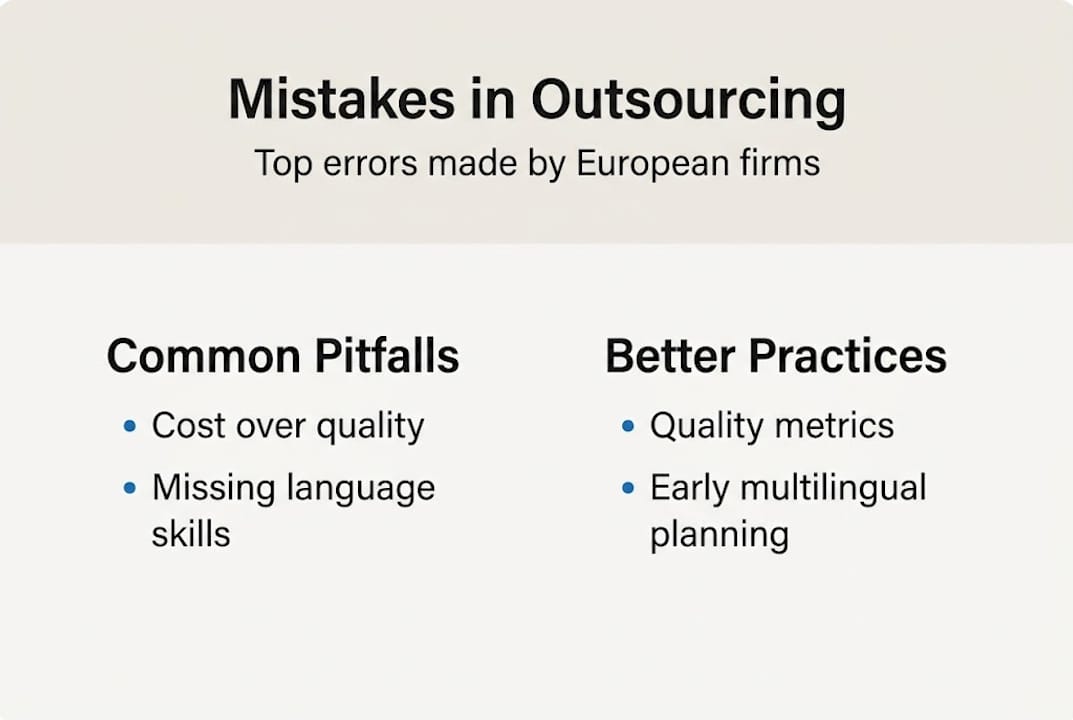
Pro Tip: Treat multilingual outsourcing as an early strategic decision, not a late add-on. The cost of retrofitting language coverage after launch is always higher than building it in from the start.
Quality vs. cost in outsourcing: Finding the right balance
Addressing language is essential, but so is understanding the subtle balance between quality and price. This is where many European companies get stuck. They know that pure cost-cutting is wrong, but they don't have a framework for evaluating quality in a way that connects to business outcomes.

Quality-driven outsourcing strategies can boost customer retention by up to 25% over cost-driven approaches, according to McKinsey research. That's not a marginal improvement. For a telecom company with 100,000 subscribers, a 25% retention improvement is a revenue transformation.
Here's how the tradeoffs look in practice:
| Approach | Projected ROI (12 months) | CSAT score | Churn rate impact |
|---|---|---|---|
| Cost-first outsourcing | Low to moderate | 65-72% | Increases 8-15% |
| Quality-balanced outsourcing | High | 82-90% | Decreases 10-20% |
| Strategic partnership model | Highest | 88-94% | Decreases 20-30% |
To structure vendor selection around value rather than price, follow these four steps:
- Define your customer-centric KPIs first. CSAT, Net Promoter Score, and first-contact resolution should drive your vendor scorecard, not just cost per contact.
- Negotiate SLAs that reflect customer outcomes. If your SLA only measures response time, you're measuring the wrong thing.
- Build quality monitoring into the contract. Regular call audits, customer satisfaction surveys, and agent performance reviews should be contractual obligations, not optional extras.
- Assess cultural fit during vendor selection. A vendor who has never supported your target market will need significant onboarding time. Factor that in.
Pro Tip: When you renegotiate outsourcing contracts, lead with quality metrics, not price. Vendors respond to what you measure. If you only push on cost, that's where they'll optimize.
For telecom-specific guidance, these outsourcing telecom support tips break down the nuances of the sector. And if you're planning for growth, this scalable outsourcing guide is worth reviewing before your next vendor conversation.
From mistakes to mastery: Actionable steps for better outsourcing outcomes
Knowing the pitfalls is only half the battle. The transformation comes from strategic action. Here's a practical framework for turning around an underperforming outsourcing setup or building a strong one from scratch.
Step-by-step action plan:
- Audit your current vendor. Pull your CSAT data, first-contact resolution rates, and churn figures by market. Identify where performance is weakest and whether language gaps or training issues are the root cause.
- Align on multilingual goals. Map your current and planned markets against your language coverage. Identify gaps and set a timeline to close them.
- Redesign your KPIs. Replace or supplement internal cost metrics with customer-facing ones. Resolution time, satisfaction score, and retention rate should all be tracked at the vendor level.
- Implement quality monitoring. Set up regular call reviews, mystery customer programs, and monthly performance reviews with your vendor. Make these contractual.
A systematic review of outsourcing strategy in SaaS reported up to 30% improvement in support resolution times when companies paired the right partner with the right process, according to Gartner. Process matters as much as provider selection.
Before signing with any outsourcing partner, ask these questions:
- What languages do your agents speak natively, and how is cultural training delivered?
- How do you handle quality monitoring and what does your reporting look like?
- Can you show us retention data from clients in our industry?
- How does your technology stack integrate with our CRM?
- What does your onboarding process look like for new accounts?
Tech stack integration is often underestimated. When your outsourced agents work inside your CRM with full customer history, resolution rates improve and repeat contacts drop. Explore the right customer service outsourcing tools and customer support platforms for SaaS to understand what a well-integrated setup looks like.
The uncomfortable truth: Why most outsourcing strategies fail and what few get right
Having mapped the path to better outcomes, let's step back for an unfiltered look at why few companies truly excel at outsourcing. After nearly 20 years working with telecom and SaaS companies across Europe, we've noticed a consistent pattern: the companies that struggle treat outsourcing as a transaction. The ones that thrive treat it as a partnership.
Most European companies limit their outsourcing relationship to a contract review once a year and a monthly invoice. There's no shared roadmap, no joint problem-solving, no alignment on customer experience goals. The vendor executes tasks. The client pays. And both sides wonder why results are mediocre.
The companies that get it right tie their support KPIs directly to revenue and loyalty metrics. They share customer feedback loops with their vendor. They involve their outsourcing partner in product updates and market expansion planning. That's not a typical vendor relationship. That's a growth partnership.
Your competition's biggest gains won't come from incremental savings on handle time. They'll come from rethinking the entire customer journey, from first contact through renewal, and making sure every touchpoint reflects the brand promise. Offshore call centers for global support can be a powerful part of that strategy when used with intention, not just as a budget line.
Ready to transform your customer support outsourcing?
If the mistakes in this article sound familiar, you're not alone. Most companies come to us after a frustrating experience with a provider who promised savings and delivered inconsistency. The good news is that the fix is rarely as complicated as it seems.

At CallTech Outsourcing, we've spent nearly 20 years building multilingual support operations for telecom and SaaS companies across Europe. Our teams cover more than 15 European languages, integrate with your existing CRM, and are measured on the outcomes that matter to your business. Whether you need to outsource call center services from scratch or streamline your support workflow for global scalability, we can help you build a model that actually works. Let's talk.
Frequently asked questions
What is the biggest outsourcing mistake European telecom and SaaS companies make?
Focusing only on cost reduction while underestimating multilingual complexity is the most damaging error. Companies focused solely on cost savings consistently see declining customer satisfaction as a result.
How can companies ensure quality isn't sacrificed when outsourcing support?
Establish KPIs tied to customer outcomes like CSAT and first-contact resolution, and choose vendors who treat the relationship as a long-term partnership. Quality-driven strategies boost retention by up to 25% compared to cost-first models.
Why is multilingual support so critical for European companies?
Without it, companies lose customer loyalty and struggle to scale across markets. Multilingual support is the top differentiator for European consumer loyalty in telecom and SaaS, according to Forrester.
What are the first steps to correct an underperforming outsourced support function?
Start with a performance audit across your key markets, then realign goals around quality and language coverage. Up to 30% improvement in resolution times is achievable with the right partner and process in place, per Gartner.