

TL;DR:
- AI support costs are rising due to infrastructure expenses, making offshore human agents a competitive option.
- Scaling global support quickly favors outsourcing or hybrid models over in-house teams due to speed and flexibility.
- Constant reevaluation and flexible support strategies are essential to manage unpredictable costs and technological changes effectively.
Most executives assume AI-powered customer support is the cheapest option available today. That assumption is increasingly wrong. GenAI resolutions can exceed $3 per interaction due to compute and infrastructure costs, which means offshore human agents are staging an unexpected comeback in the cost conversation. For companies scaling multilingual support across Europe and beyond, the math behind in-house versus outsourced support is more complex than a single line on a budget spreadsheet. This guide breaks down every real cost driver, compares the two models side by side, and gives you a practical framework for making the right call in 2026.
Table of Contents
- Understanding the total cost of ownership for customer support
- How outsourcing and in-house compare for global scalability
- Emerging role of AI and automation in support cost structures
- Making the right customer support choice for 2026 and beyond
- The uncomfortable truth about customer support costs in 2026
- Take your global support strategy further
- Frequently asked questions
Key Takeaways
| Point | Details |
|---|---|
| Total Cost Goes Beyond Wages | Hidden expenses like training, tech, and language support can rival headline staffing costs. |
| AI Savings Are Not Guaranteed | GenAI infrastructure costs can make automation pricier than offshore agents in some cases. |
| Outsourcing Scales Multilingual Fast | Outsourced solutions are still the fastest way to scale multilingual support at predictable costs. |
| Hybrid Models Offer Flexibility | Blending AI, in-house, and outsourced support gives the best balance of cost, quality, and control. |
Understanding the total cost of ownership for customer support
When boards compare in-house and outsourced support, they usually start with salary. That is the wrong place to start. The true cost of running a 50-agent multilingual support team goes well beyond base compensation, and the gap between headline numbers and actual spend can be significant.
In-house cost components include base salaries, employer taxes, benefits, and paid leave. Add to that recruitment fees (typically 15 to 20 percent of first-year salary per hire), onboarding and product training, language-specific training programs, and ongoing coaching. Then layer in your tech stack: CRM licenses, telephony infrastructure, workforce management tools, and quality assurance platforms. Physical office space, IT support, compliance management, and HR overhead round out the picture. Attrition is the silent killer here. Call center turnover rates regularly exceed 30 to 40 percent annually, meaning you are continuously paying to rehire and retrain.
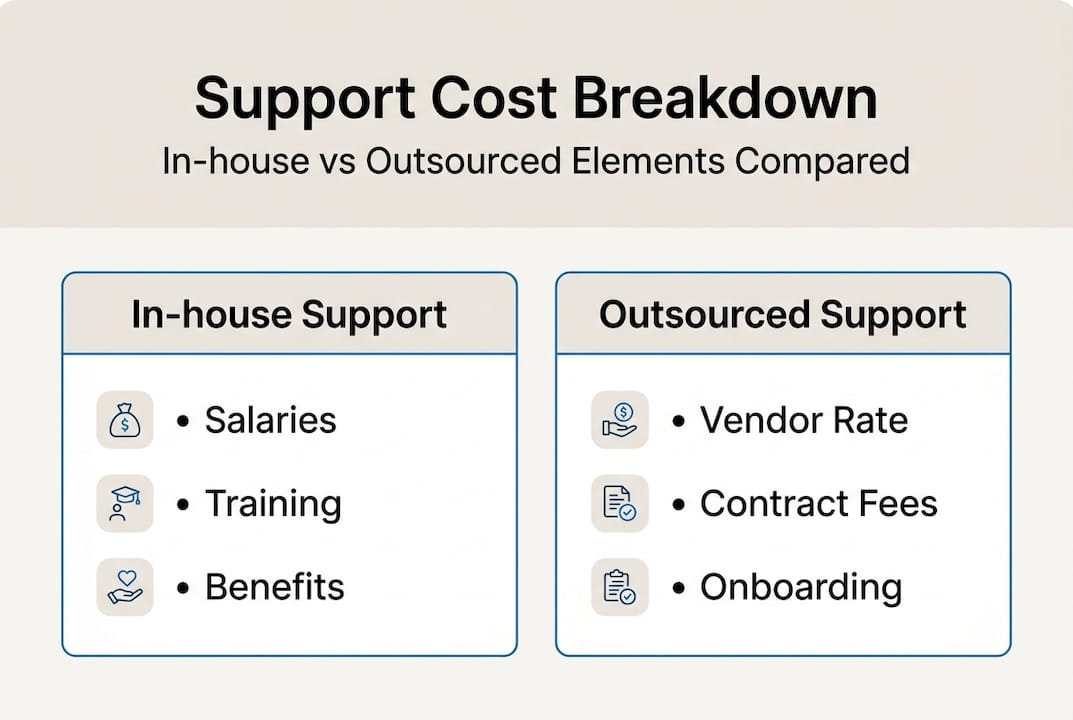
Outsourced cost components look simpler on the surface: a per-agent hourly rate or a per-resolution fee, plus a vendor contract. But ramp-up costs, SLA penalties, integration work to connect your CRM to the vendor's systems, and long-term volume commitments all add up. The key difference is predictability. A well-structured outsourcing contract converts variable, hard-to-forecast costs into a fixed monthly line item.
For context, AI infrastructure costs are now a genuine TCO consideration that did not exist three years ago. Cloud compute, model training, integration engineering, and ongoing fine-tuning for niche languages are real expenses.
Pro Tip: When building your TCO model, always include a line for multilingual readiness. Hiring native speakers, certifying language quality, and covering 16/7 or 24/7 schedules across time zones can add 25 to 40 percent to your in-house cost base. Companies that need multilingual support at scale almost always find outsourcing more cost-efficient once this factor is included.
Cost factors most often underestimated in boardroom projections:
- Multilingual agent premium (native speakers command higher salaries in Western Europe)
- Shift differentials for night and weekend coverage
- Compliance and data protection costs across multiple jurisdictions
- Technology refresh cycles every 2 to 3 years
- Management overhead for a distributed multilingual team
- Productivity loss during onboarding periods (typically 4 to 8 weeks)
If you want a clear methodology for modeling these numbers, the reduce support costs framework is a useful starting point.
| Cost element | In-house (50 agents) | Outsourced (50 agents) |
|---|---|---|
| Agent salaries / vendor rate | High, variable by market | Predictable, contracted |
| Recruitment and onboarding | $75K to $150K annually | Included in vendor rate |
| Tech stack and infrastructure | $120K to $200K annually | Included or low add-on |
| Multilingual training | $30K to $80K annually | Included in vendor rate |
| Attrition and backfill costs | High (30 to 40% turnover) | Managed by vendor |
| Compliance and HR overhead | Significant | Minimal |
How outsourcing and in-house compare for global scalability
Cost structure is only part of the story. The more important question for a growing global business is which model can actually keep up with your expansion.
Scaling an in-house team from 50 to 100 agents in a new language takes months. You need to recruit, hire, train, and integrate. Outsourcing that same expansion can happen in weeks, because a mature BPO already has the language pool, the infrastructure, and the management layer in place. That speed difference has real dollar value when you are entering a new market or managing seasonal demand spikes.
"Pure cost favors outsourcing for globalized scaling, but control and nuance favor in-house and hybrid approaches." CMSWire
Scalability factors that directly affect cost:
- Seasonality: Outsourced models absorb volume spikes without idle-agent costs in slow periods
- Language coverage: Adding a new language in-house requires a full hiring cycle; outsourcing leverages existing pools
- Geographic expansion: New regional compliance requirements are handled by the vendor, not your legal team
- 24/7 coverage: Rotating shifts in-house carry significant overtime and management costs
Switching models mid-growth is operationally risky. Moving from in-house to outsourced means knowledge transfer, system integration, and a period of reduced quality. Planning your model before you scale is far cheaper than correcting it afterward. To streamline support workflow during transitions, having a clear handoff protocol reduces that risk substantially.
Pro Tip: Before signing any outsourcing contract, review the terms for language expansion and volume scaling clauses. Some vendors charge significant premiums for adding languages mid-contract or for exceeding baseline volume thresholds. Negotiate these terms upfront.
| Factor | In-house | Outsourced | Hybrid |
|---|---|---|---|
| Cost per agent (Europe) | €18 to €35/hr all-in | From €6.5/hr | From €4.5/hr (AI-assisted) |
| Language pool flexibility | Low | High | Medium to high |
| Scale-up speed | Slow (months) | Fast (weeks) | Medium |
| Control level | Full | Shared | Adjustable |
| Coverage flexibility | Limited | High | High |
The offshore call centers cost savings data consistently shows that for companies operating in more than three languages or covering extended hours, outsourcing delivers a lower total cost per resolved interaction.

Emerging role of AI and automation in support cost structures
For the past three years, AI automation has been positioned as the ultimate cost-reduction tool for customer support. The reality in 2026 is more nuanced, and in some cases, more expensive.
Gartner forecasts GenAI could exceed $3 per resolution due to infrastructure costs, which puts it on par with or above some offshore human agent rates. That is a striking reversal of expectations. The issue is not the AI itself but the cost of running it at scale: cloud compute, API fees, model fine-tuning for niche European languages, integration engineering, and ongoing monitoring all add up quickly.
For in-house teams, adopting GenAI means absorbing these infrastructure costs directly. For outsourced models, vendors increasingly bundle AI tools into their service rates, spreading the cost across multiple clients and making it more manageable per unit.
Tasks that can be safely automated with current AI tools:
- FAQ responses and knowledge base lookups
- Order status and tracking inquiries
- Basic account management (password resets, plan changes)
- Ticket routing and priority classification
- Post-interaction surveys and CSAT collection
Tasks that still require human expertise:
- Complex billing disputes requiring judgment
- Emotionally sensitive interactions (complaints, cancellations)
- Nuanced multilingual conversations where tone and cultural context matter
- Technical troubleshooting with multiple variables
- High-value customer retention conversations
AI cost forecasting is also difficult because usage spikes, regulatory changes around data processing, and model version updates can all shift your monthly bill without warning. To optimize contact center workflow effectively, most organizations find that AI works best as a layer on top of human agents, not as a replacement. The CRM outsourcing savings case studies show that integrated AI-plus-human models consistently outperform pure automation on both cost and quality metrics.
Making the right customer support choice for 2026 and beyond
With all the variables mapped, the question becomes: how do you actually make this decision? Here is a practical evaluation framework.
- Define your coverage requirements. How many languages do you need? What hours must you cover? What is your peak-to-trough volume ratio across the year?
- Calculate your true in-house TCO. Use the full cost model from Section 1, including attrition, tech, compliance, and multilingual premiums.
- Get comparable outsourcing quotes. Ask vendors for all-in rates that include training, technology, and SLA management. Rates starting from €6.5/hour for human agents and €4.5/hour for AI-assisted hybrid models are available in the current market.
- Assess your control requirements. Some industries and use cases require tight control over agent scripts, data handling, and escalation paths. Quantify how much that control is worth in dollar terms.
- Evaluate vendor AI readiness. Ask potential outsourcing partners how they price AI-assisted interactions and what happens to your rate if AI costs increase.
- Plan for flexibility. Hybrid approaches blending AI and human agents are now the most cost-effective and flexible model for most global organizations.
- Measure ROI beyond cost per ticket. Track NPS, first-contact resolution, customer effort score, and revenue retention. A cheaper model that damages customer experience is not actually cheaper.
Pro Tip: Build flexibility clauses into any long-term support contract or internal team plan. AI pricing is evolving fast, and locking into a rigid structure today could mean overpaying significantly in 18 months. Review your model at least annually.
For a detailed breakdown of cost-effective outsourcing methods and a scalable outsourcing guide tailored to 2026 conditions, both resources offer practical templates you can adapt to your specific situation.
The uncomfortable truth about customer support costs in 2026
Here is something most cost analyses will not tell you: almost every planning model uses best-case assumptions. Vendors quote their standard rates. In-house projections use average attrition, not your actual attrition. AI cost models assume stable compute pricing. None of these assumptions hold reliably.
The real risk is not choosing the wrong model. It is choosing a model and then failing to revisit it. Unexpected cost shifts like sudden wage inflation in a vendor's home market, a language coverage emergency that requires emergency hiring, or an AI infrastructure price increase can erase projected savings within a quarter.
What we have seen over nearly 20 years of running multilingual support operations is that the companies managing support costs best are not the ones who found the cheapest model. They are the ones who built adaptable models. They review their cost structure quarterly, not annually. They maintain optionality by not concentrating all support in a single model or vendor. And they measure the benefits of multilingual support in terms of customer lifetime value, not just cost per ticket.
Skepticism about any single solution, whether AI, pure outsourcing, or in-house, is your most valuable cost management tool right now.
Take your global support strategy further
If this analysis has surfaced gaps in your current support model, the next step is a structured evaluation with a partner who understands the real numbers. At CallTech Outsourcing, we have been helping global companies build cost-effective multilingual support operations since 2005.

Our outsourcing call center services cover more than 15 European languages, with transparent pricing starting from €6.5/hour for dedicated agents and €4.5/hour for AI-assisted hybrid models. Whether you need to reduce support costs without sacrificing quality or want to explore what the best call center services look like for your industry, we can walk you through a tailored cost comparison for your specific language mix, volume, and coverage requirements.
Frequently asked questions
Is outsourcing still cheaper than in-house customer support in 2026?
For large-scale or multilingual support, outsourcing typically delivers lower total cost, but AI is changing the equation by adding new infrastructure expenses that narrow the gap in some scenarios.
How does AI impact support costs in 2026?
AI introduces significant compute and integration costs that can push the price per resolution above offshore human agent rates. GenAI can exceed $3 per resolution, making it more expensive than expected for complex or multilingual use cases.
When should companies choose a hybrid support model?
Hybrid approaches are now recommended when you need to balance cost efficiency, language quality, coverage flexibility, and control across multiple regions simultaneously.
What are the hidden costs of in-house support?
Beyond salaries, in-house support carries significant indirect costs including recruitment fees, multilingual training, technology infrastructure, compliance management, and the ongoing expense of replacing agents lost to high attrition rates.