

TL;DR:
- Multilingual telemarketing enhances trust, conversion rates, and regional market penetration.
- Effective providers combine cultural training, advanced technology, compliance, and continuous improvement.
- Choosing the right partner involves assessing language coverage, regional expertise, technology, and adaptability.
Multilingual telemarketing services that scale global support
Telemarketing has a reputation problem. Most executives still picture a room full of agents reading from a generic script, cold-calling unqualified lists. The reality in 2026 is strikingly different. B2B lead-to-sale conversion can reach 27% when the right multilingual strategy is in play, while telecom sales calls average 12.72%. The gap between companies who treat telemarketing as a precision growth engine and those who treat it as a numbers game is widening fast. This article breaks down exactly what multilingual telemarketing requires, what separates high-performing providers from mediocre ones, and how to choose a partner that actually moves your numbers.
Table of Contents
- Why multilingual telemarketing matters for global companies
- Key components of effective telemarketing services
- Addressing common challenges in multilingual telemarketing
- Evaluating and choosing the right telemarketing partner
- The truth about multilingual telemarketing most executives overlook
- Accelerate your global customer growth with expert telemarketing solutions
- Frequently asked questions
Key Takeaways
| Point | Details |
|---|---|
| Multilingual impact | Language and cultural fluency directly drive better conversion rates and customer retention. |
| Critical features | Effective telemarketing partners combine skilled agents, advanced technology, and real-time data. |
| Common pitfalls | Ignoring cultural nuances or settling for simple translation results in lost leads and higher costs. |
| Strategic selection | A structured partner evaluation leads to scalable, high-performing global support. |
Why multilingual telemarketing matters for global companies
Language is not just a communication tool. It is a trust signal. When a customer in Germany receives a call in fluent German from someone who understands local business norms, the interaction starts from a position of credibility. When that same customer gets a call from an agent who clearly translated a script written in English, the call usually ends in under 90 seconds.
For companies in telecom, SaaS, and e-commerce scaling across European or international markets, the multilingual support benefits are not optional extras. They are core infrastructure. You cannot realistically achieve consistent pipeline growth across five or six markets when every campaign runs in one language through one cultural lens.
Here is what multilingual telemarketing directly affects:
- Customer trust and rapport: Native-language engagement builds confidence from the first sentence, reducing early call drop-offs and making prospects more willing to listen.
- Conversion rates by market: Markets respond differently. A follow-up call strategy that works in Poland may not translate to Spain, where relationship-building takes more time before a buying decision.
- Regional market penetration: Breaking into a new market is dramatically faster when your outreach already speaks the local commercial dialect, not just the local language.
- Retention and upselling: In subscription-based SaaS and telecom, renewal calls handled in the customer's native language show measurably lower churn.
- Brand perception: Multinational companies are judged locally. A poor telemarketing experience in one language can dent your brand across an entire region.
The challenges around multilingual execution are real and worth naming directly. Cultural misalignment is one of the biggest traps. Direct communication styles common in Germany and the Netherlands can feel abrupt or even rude when applied to markets like France or Italy, where indirectness and relationship cues matter more. Translation inaccuracies in scripts can introduce confusion or unintentional humor, both of which destroy conversion potential. Then there are operational layers: time zone gaps, regional public holidays, and the higher cost of sourcing genuinely skilled multilingual agents.
Stat to bookmark: B2B inquiry-to-lead conversion averages 5%, but companies that layer in localized, multilingual follow-up campaigns push lead-to-sale rates to 27%.
The companies that solve these challenges do not just throw budget at translation. They invest in training programs that embed cultural intelligence into every agent interaction, AI tools that flag tonal mismatches in real time, and localized scripts that are written for each market from the ground up. The result is a telemarketing function that feels local, even when it is centrally managed. For executives building multi-market growth strategies, that is the real competitive advantage.
Key components of effective telemarketing services
Not all telemarketing providers operate at the same level. The difference between average and excellent often comes down to a handful of operational and technological factors that executives may not think to ask about during the vendor selection process.
The most capable multilingual providers combine several core elements into a single, integrated delivery model.
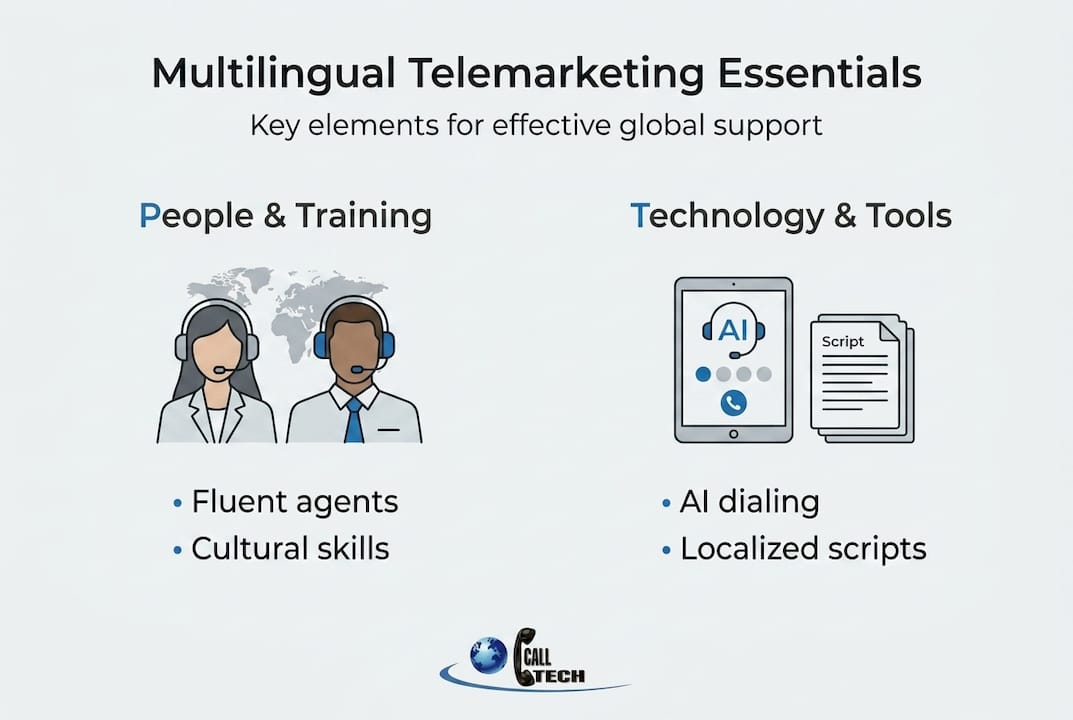
Multilingual agent teams with cultural training. Language fluency is the floor, not the ceiling. Agents need to understand the cultural context behind their assigned markets, including how decisions are made, what objections typically mean, and when to push versus when to listen. A SaaS company we have seen succeed in Central Europe achieved a measurable uplift in demo bookings after switching from translated generic scripts to market-specific call flows delivered by agents who had trained specifically in those countries.

AI-powered dialing and CRM integration. Modern predictive dialers reduce agent idle time and optimize contact windows based on local call patterns. Integrated CRM systems give agents instant access to account history, previous interactions, and buying signals before the call begins. This shifts the conversation from cold outreach to warm, informed engagement.
Real-time script localization tools. Dynamic scripting platforms allow supervisors to update messaging across all markets simultaneously, ensuring consistent campaign positioning while preserving local language nuance. This matters enormously during product launches or pricing changes.
Compliance and analytics infrastructure. International telemarketing must navigate GDPR and local do-not-call regulations across every market simultaneously. Providers without built-in compliance tooling create legal exposure for their clients. Analytics dashboards that track conversion by agent, market, language, and campaign type give operations leaders the visibility to optimize in real time.
Here is a straightforward comparison of how different telemarketing approaches perform:
| Call type | Typical conversion rate | Best use case |
|---|---|---|
| Cold outbound call | ~2% | Top-of-funnel awareness, list qualification |
| Follow-up call | 5% to 27% | Post-inquiry nurturing, upsell, renewals |
| Telecom sales call | ~12.7% | Product upgrade, package switch campaigns |
| Inbound support with upsell | 8% to 15% | Existing customer base, subscription billing |
These figures from conversion rate research confirm what experienced operators already know: follow-up calls and warm outreach in the right language dramatically outperform cold contact. The strategic implication is clear. Build campaigns that move prospects through qualification stages before the high-value call happens.
Pro Tip: Review your multilingual call center strategies before locking in a provider contract. Providers that share their internal playbook for language quality audits and script iteration cycles are almost always more transparent partners over the long term.
Understanding contact center best practices for technology integration helps you ask sharper questions during vendor evaluations, particularly around CRM compatibility and compliance architecture.
Addressing common challenges in multilingual telemarketing
Scaling multilingual telemarketing is genuinely hard. Even companies that solve the language problem often stumble on the operational and cultural layers underneath it. Knowing where the friction points live before you hit them saves both time and conversion losses.
Here are the most common challenges and how top-performing operations solve them:
-
Cultural communication mismatches. A translated script is not a localized script. In markets with indirect communication cultures, leading too aggressively with a pitch triggers immediate resistance. Agents need training on how to read pacing cues, handle silence, and build micro-rapport before transitioning to product conversations. One telecom client we work with saw a 30% improvement in call completion rates after rewriting their Eastern European campaign scripts to match the regional preference for consultative rather than transactional dialogue.
-
Time zone and holiday coverage gaps. A campaign optimized for Western European business hours leaves Eastern European and Middle Eastern prospects unreachable during their peak decision-making windows. Local public holidays compound this. Automated scheduling tools that pull regional calendar data solve part of this problem, but you also need staffing models flexible enough to shift coverage without burning out teams.
-
Translation inaccuracies in live calls. Even trained bilingual agents occasionally reach for a phrase that works in one language but lands awkwardly in another. Solutions that combine training with AI tools that monitor call tone and flag unusual phrasing in real time reduce this risk significantly. Regular call audits by native-speaking supervisors catch patterns before they become habits.
-
Inconsistent quality at scale. Adding new languages to a campaign without adjusting quality monitoring processes is one of the fastest ways to dilute results. Quality scorecards need to be adapted for each language and market, not just translated from the original.
-
Higher agent costs for genuine multilingual talent. Skilled agents who speak two or three languages at a business level and understand the cultural nuance of those markets command higher rates. This is a real cost, but it is also an accurate reflection of the value they deliver.
"The companies that treat multilingual telemarketing as a translation problem will keep getting translation-level results. The ones that treat it as a cultural operations problem see compounding gains."
Pro Tip: Working with dedicated support agents who are assigned to specific accounts and markets rather than rotating through a general pool produces noticeably faster skill development and stronger customer relationships over time.
The most resilient multilingual telemarketing operations build process ownership at the local level. Regional team leads who can adapt scripts, flag issues, and implement micro-improvements without waiting for central approval create faster feedback loops and more consistent execution.
Evaluating and choosing the right telemarketing partner
Choosing a multilingual telemarketing partner is a long-term strategic decision. The wrong choice costs you more than the contract fee. It costs you market trust, pipeline velocity, and months of corrective work.
Here is how to evaluate potential partners objectively:
| Evaluation criterion | What to look for | Red flag |
|---|---|---|
| Language coverage | 10 or more languages, with native-level agents | Relies entirely on translated scripts |
| Quality controls | Regular call audits, NPS tracking per market | No market-specific QA process |
| Technology stack | CRM integration, predictive dialing, analytics | Outdated dialer, no reporting dashboard |
| Cost transparency | Itemized pricing by language and campaign type | Vague bundled pricing with hidden fees |
| Regional expertise | Proven results in your target markets | General claims without client references |
| Compliance readiness | GDPR-compliant, local do-not-call list management | No mention of data handling protocols |
Beyond the scorecard, look at how a potential partner handles your RFP. Providers who respond with templated answers and no market-specific insight are showing you exactly how they will manage your campaign. Those who ask clarifying questions about your customer segments, regional priorities, and existing CRM setup are demonstrating the operational thinking you actually need.
Mulitchannel capability matters more than it did five years ago. A telemarketing partner who can coordinate voice campaigns with email follow-up sequences, SMS confirmations, and digital retargeting gives you a more complete conversion funnel than a voice-only provider. The right outsourcing approach for your organization depends heavily on whether you need pure outbound, blended inbound and outbound, or a fully integrated multi-channel model.
Consider what happened with one e-commerce brand that initially contracted a single-region telemarketing provider for customer reactivation campaigns in one country. When it came time to expand into two additional European markets, that provider had no credible language capability beyond a single translated script. The brand had to rebuild its vendor relationship from scratch, costing them nearly two quarters of campaign momentum. A partner evaluated for multi-region scalability from the start would have made that expansion seamless.
When reviewing IT support comparisons and vendor capability frameworks, the same due diligence principles apply: verify claims with references, test with a pilot campaign before committing to scale, and insist on SLA-level commitments for quality, not just volume.
- Always request call recordings from markets similar to yours during the evaluation phase
- Ask specifically how the provider handles agent turnover in high-demand language pairs
- Confirm that compliance tools cover every market in your target expansion list
- Verify that reporting is available at the market and language level, not just overall campaign level
The conversion data across B2B and telecom sectors confirms that the investment in the right partner pays off in measurable pipeline outcomes. A 27% lead-to-sale rate on follow-up campaigns does not happen by accident. It is the result of pairing the right agent skills with the right process in the right language.
The truth about multilingual telemarketing most executives overlook
Here is the uncomfortable reality: most multilingual telemarketing failures are not language failures. They are cultural intelligence failures dressed up as language problems.
Executives often benchmark providers on language count, agent fluency scores, and script translation quality. These matter. But the real differentiator is whether a provider has built cultural intelligence into its operating model at every layer, from how supervisors coach agents to how QA teams interpret call outcomes in different markets.
The companies we have seen achieve compounding results from multilingual telemarketing share one pattern. They treat their outsourcing partner as a market intelligence asset, not just a call delivery mechanism. They share customer feedback across markets, they iterate scripts based on regional behavioral data, and they run quarterly reviews that go beyond KPIs into conversation quality and cultural fit. Think of market research call centers not as a separate function but as built-in feedback infrastructure for your telemarketing operation.
Static vendor contracts that lock process, pricing, and scope for 12 months are the enemy of this kind of adaptive partnership. The best multilingual telemarketing relationships evolve. They get smarter with each campaign cycle because both sides invest in shared learning.
Accelerate your global customer growth with expert telemarketing solutions
Effective multilingual telemarketing is not a cost center. For telecom, SaaS, and e-commerce companies with real international ambitions, it is the growth infrastructure that makes expansion possible without sacrificing customer experience quality.

CallTech Outsourcing has been delivering multilingual customer support and outbound telemarketing services since 2005, covering more than 15 European languages with proven results across telecom, SaaS, and e-commerce verticals. Whether you are scaling outsourcing multilingual contact centers, looking to enhance engagement support across new regions, or building your first multilingual support for ecommerce strategy, we can build a solution around your specific markets and growth targets. Reach out to our team to schedule a personalized strategy session and see what a performance-focused multilingual telemarketing program looks like in practice.
Frequently asked questions
What is the average telemarketing conversion rate for B2B and telecom?
B2B inquiry-to-lead conversion averages 5%, while lead-to-sale rates reach 27% for well-executed follow-up campaigns, and telecom sales calls specifically average around 12.7% conversion.
How do multilingual telemarketing services address cultural differences?
Top providers use culturally adapted training, market-specific localized scripts, and AI monitoring tools to catch cultural misalignment and translation inaccuracies before they damage conversion rates.
What should executives look for in a telemarketing partner?
Prioritize genuine language coverage with native-level agents, transparent pricing, proven regional expertise, GDPR-compliant data handling, and a technology stack that integrates with your existing CRM and analytics environment.
Do multilingual telemarketing services cost more?
Yes, skilled multilingual agents command higher rates than single-language teams, but the investment reflects higher returns through better conversion, stronger customer relationships, and faster penetration of new international markets.