

TL;DR:
- English-only lead generation is costly for European companies targeting international markets. Localized messaging and multi-channel strategies significantly improve engagement, conversions, and compliance across diverse European audiences. Investing in cultural understanding, measurement, and native-language outreach enhances lead quality and optimizes global growth efforts.
English-only lead generation is one of the most costly assumptions a European company can make when targeting international markets. Localized messaging boosts engagement by roughly 40%, yet many businesses still push the same English copy across French, German, Polish, and Spanish audiences and wonder why conversion rates stay flat. If you are scaling into new markets or struggling to qualify leads across borders, this article covers what multilingual lead generation really involves, which strategies drive results, how to measure and optimize performance, and what compliance looks like in practice across Europe.
Table of Contents
- What are lead generation services for multilingual customer support?
- Multi-channel and localized strategies for better engagement
- How benchmark-driven optimization increases conversions
- Best practices: Compliance, consent, and cultural sensitivity
- Rethinking lead quality: What most companies overlook in multilingual markets
- How CallTech can help: Multilingual lead generation made seamless
- Frequently asked questions
Key Takeaways
| Point | Details |
|---|---|
| Localization is vital | Tailoring messages to native languages and cultures increases lead engagement and conversions. |
| Go multi-channel | Utilize multiple outreach channels to expand reach and leverage diverse lead sources. |
| Triple opt-in raises trust | Combining digital, behavioral, and legal consent improves compliance and relationship quality. |
| Focus on quality leads | Benchmark-driven optimization and personalized messaging outperform sheer volume strategies. |
What are lead generation services for multilingual customer support?
Lead generation services are structured processes designed to attract, engage, and qualify prospective customers so that your sales team focuses only on people who are genuinely ready to buy. In a multilingual context, these services go much further than translation. They shape how your brand speaks to prospects in their own language, through channels they trust, with messaging that fits their market.
Think of it this way. A German procurement officer and a Spanish SME owner may want the same software product, but they respond to very different communication styles, tones, and offers. A generic English email campaign treats both like the same person, and neither feels understood. That gap is exactly where multilingual lead generation closes the deal.
Core lead generation services typically cover:
- Outbound outreach: Cold email campaigns, phone prospecting, and LinkedIn outreach delivered in the prospect's native language
- Inbound qualification: Responding to website inquiries, live chat, and form submissions with native-speaking agents who can assess fit in real time
- Lead scoring and nurturing: Segmenting leads by readiness, then delivering follow-up sequences tailored to each stage of the buying journey
- Multi-channel coordination: Aligning email, paid ads, SEO content, and social outreach so every touchpoint reinforces the same message
The challenges with monolingual approaches are concrete, not theoretical. When prospects receive outreach in a language that is not their native one, they disengage faster, ask fewer questions, and trust the brand less. This directly reduces the quality of leads entering your pipeline.
"Native-language engagement is not a courtesy. It is a commercial advantage. Prospects who receive communications in their mother tongue are significantly more likely to respond, ask questions, and progress through the sales funnel."
This is why global businesses need multilingual support not just for customer service but at every stage of the customer acquisition process, including the very first touchpoint.
Multi-channel lead generation approaches include content marketing, SEO, cold email, LinkedIn, and targeted ads, each requiring a localized version to perform effectively across different European markets.
Multi-channel and localized strategies for better engagement
Understanding the theory is one thing. Knowing exactly which tactics to execute across multiple markets is where most companies stumble. The strongest multilingual lead generation programs combine several channels and localize each one independently rather than translating a single campaign.
Here is how the most effective channels compare in a multilingual context:
| Channel | Best use case | Localization requirement |
|---|---|---|
| SEO content | Long-term organic lead capture | Full translation plus keyword research per market |
| Cold email | Direct B2B outreach | Native copywriting, not word-for-word translation |
| LinkedIn outreach | Senior decision maker engagement | Cultural tone adaptation per country |
| Paid ads | Fast reach in new markets | Creative and copy adapted for local preferences |
| Webinars and events | Relationship building at scale | Language-specific sessions with native hosts |
Localization goes beyond language. It includes cultural tailoring: how direct you are in a message, whether you lead with data or with relationships, and whether you open with a discount or a value statement. A Dutch prospect expects directness. An Italian prospect may respond better to relationship-first language before any offer.

Hreflang tags deserve a special mention. When you create country-specific or language-specific landing pages, hreflang tags tell search engines exactly which version to show each user. Without them, your localized pages compete against each other in search results, and your SEO investment is wasted.
Consent practices also vary across Europe. Under GDPR, you need a lawful basis to contact prospects, and the bar for what counts as consent differs by channel and country. This is where the triple opt-in model becomes important. Triple opt-in combines three forms of verification: digital confirmation (clicking a link in an email), behavioral confirmation (engaging with specific content), and legal consent (agreeing explicitly to be contacted for marketing purposes). Triple opt-in exceeds industry norms for compliance and dramatically reduces the risk of spam complaints and regulatory penalties.
Pro Tip: Build separate email sequences for each language market rather than translating one sequence. The structure, tone, and timing that works in the UK market rarely maps directly onto how prospects engage in Poland or Romania.
Multilingual telemarketing services add a human layer to these digital tactics, especially effective when you need to qualify leads that have shown initial interest but require a conversation before they will commit to a meeting or demo. Pairing telemarketing with multilingual appointment setting is one of the fastest ways to fill your sales calendar with qualified, warm prospects across multiple markets. For a broader framework on how these approaches fit together, the international customer service guide covers how support and lead generation interconnect across markets.
How benchmark-driven optimization increases conversions
Strategy without measurement is guesswork. The companies that consistently outperform in multilingual markets are not necessarily running more campaigns. They are running smarter ones, and they measure the right things.
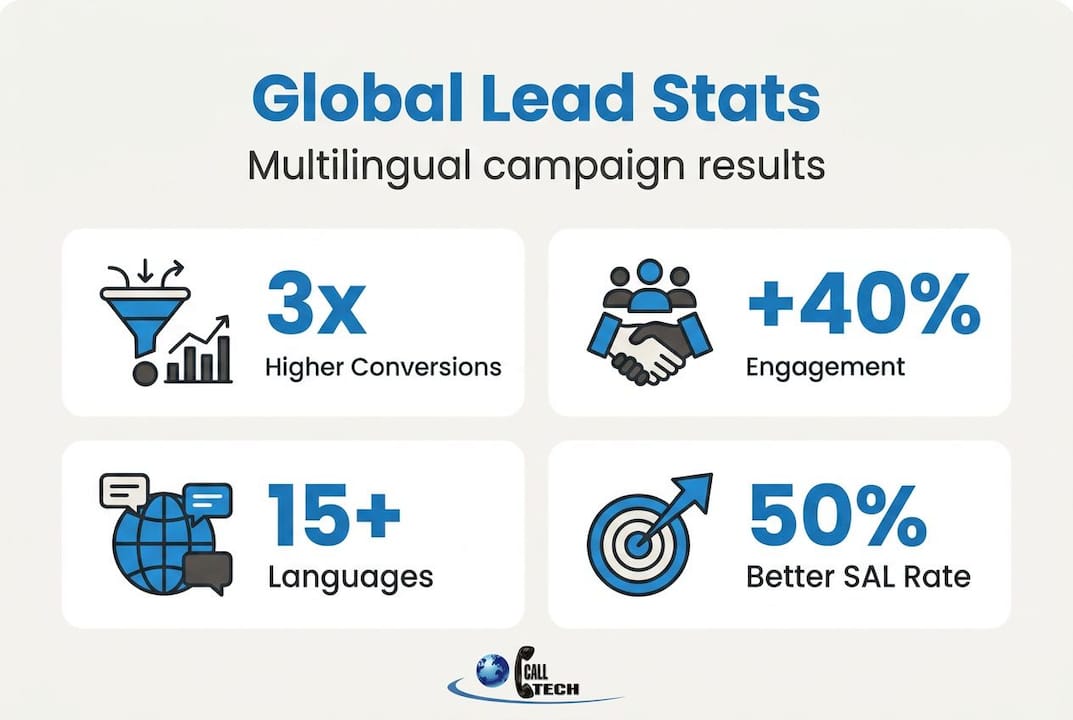
Top-performing companies achieve 3x higher conversions through personalized content rather than volume-driven outreach. This is a critical insight. Sending more emails to more people in more markets without personalization does not scale lead generation. It scales noise.
Here is a practical comparison of a volume-focused approach versus a quality-focused approach:
| Approach | Lead volume | Conversion rate | Sales team time wasted | Revenue impact |
|---|---|---|---|---|
| Volume-first | High | 1 to 2% | Very high | Low per lead |
| Quality-first | Lower | 8 to 15% | Minimal | High per lead |
| Personalized multilingual | Moderate to high | 12 to 20% | Low | Highest |
Two metrics matter most when optimizing multilingual lead generation: the MQL (Marketing Qualified Lead) and the SAL (Sales Accepted Lead). An MQL meets your marketing criteria for engagement. An SAL means your sales team has reviewed that lead and agreed it is worth pursuing. A healthy SAL to MQL ratio tells you whether marketing and sales are aligned on what a good lead looks like. In multilingual markets, this ratio often breaks down because the definition of "qualified" differs by country.
Follow these steps to build a benchmark-driven optimization process:
- Set baseline metrics per market: Track open rates, reply rates, meeting rates, and close rates separately for each language market before combining any data.
- Align MQL and SAL definitions across teams: Make sure marketing and sales agree on what qualifies a lead in each country, because cultural buying behavior affects what "ready" looks like.
- Test personalization at scale: Use CRM segmentation to deliver personalized follow-ups based on the specific content a prospect engaged with, not just their job title.
- Review pipeline velocity: How long does it take a lead in Germany to convert versus a lead in Spain? Understanding velocity helps you allocate outreach effort and budget more accurately.
- Iterate by channel and market: Kill what is not working in each market independently. Do not let strong UK performance mask underperformance in France.
Pro Tip: If your SAL rate drops below 50% of your MQL volume, your lead qualification criteria need to be recalibrated for that specific market. This is common when companies apply one set of qualification rules across all European territories.
B2B lead generation strategies for international markets require this kind of disciplined measurement to scale sustainably. Outsourcing to a team with experience across multiple markets also gives you benchmark data from real campaigns rather than starting cold, which accelerates the optimization cycle significantly. For companies ready to scale beyond internal capacity, global lead generation outsourcing provides the infrastructure and language expertise to execute across multiple markets simultaneously.
Best practices: Compliance, consent, and cultural sensitivity
Compliance is not a checkbox. In European markets, it is a core part of your lead generation strategy, and getting it wrong carries serious financial and reputational consequences under GDPR.
The two most common lawful bases for B2B lead generation in Europe are legitimate interest and explicit consent. Legitimate interest or explicit consent must be documented and defensible. Legitimate interest means you have a genuine business reason to contact someone, and that reason outweighs their right to privacy. Explicit consent means they have actively agreed to receive communications from you. Each comes with different documentation requirements and different risks.
Key compliance practices every European lead generation program should follow:
- Double or triple opt-in: Require prospects to confirm their interest through at least two steps before entering your nurture sequence
- Clear data processing notices: Tell prospects exactly what you will do with their data, in their language, at the point of collection
- Granular consent records: Log the date, time, method, and specific consent given by every contact in your CRM
- Opt-out mechanisms: Make it easy and immediate to unsubscribe, and honor those requests within the timeframes required by law
- Data minimization: Collect only the data you actually need for the campaign, not everything you could theoretically use later
"Compliance is not a barrier to effective lead generation. It is the foundation of trust that makes high-quality lead engagement possible. Companies that treat consent as a genuine relationship principle, not a legal obstacle, consistently outperform those that treat it as friction."
Cultural sensitivity sits alongside compliance as an equally important factor. In markets like France, prospects are highly skeptical of unsolicited outreach and respond poorly to aggressive sales language. In Scandinavian markets, transparency and social proof matter more than any feature list. In Central and Eastern Europe, personal relationship-building often precedes any commercial conversation.
Dedicated multilingual support agents who are native speakers of the target language understand these nuances instinctively. They adjust tone, pacing, and messaging in ways that a translated script cannot replicate. For companies that need to understand how specific markets think and respond before running campaigns, multilingual market research provides the cultural intelligence needed to craft outreach that genuinely lands.
Common mistakes to avoid: Using machine-translated outreach without native review, applying the same consent workflow across all markets regardless of local regulation, ignoring time zones when scheduling calls, and treating cultural differences as minor variations rather than distinct communication requirements.
Rethinking lead quality: What most companies overlook in multilingual markets
After nearly 20 years of working with European companies on multilingual outreach and customer support, one pattern stands out clearly: the companies that struggle most in international markets are the ones obsessed with lead volume. They count entries in the CRM, celebrate big prospect lists, and measure success by how many campaigns they launch rather than how many conversations actually convert.
Here is the uncomfortable truth about multilingual lead generation. Volume feels productive. Quality is harder to see until the revenue numbers come in.
A lead from a German mid-market company that has been nurtured in German, engaged with German-language case studies, and spoken with a native German-speaking agent is worth ten times a lead scraped from a list and emailed in English with a translated subject line. The second lead might enter your pipeline, but it will consume your sales team's time and convert at a fraction of the rate.
The real differentiator in multilingual markets is cultural messaging depth, not linguistic surface-level accuracy. Saying the right words in the right language is the baseline. Understanding how urgency is communicated differently in Poland versus Portugal, or how risk is framed differently in Austria versus Italy, is what separates campaigns that consistently close deals from ones that generate activity without revenue.
We have seen campaigns fail not because the product was wrong or the pricing was off, but because the outreach landed culturally tone-deaf in the target market. A sales email that opened with a discount in a market that views discounting as a trust signal in reverse is one example. Another was using assertive, deadline-driven language in a market where relationship maturity precedes any transactional discussion.
Multilingual support agent success comes from genuine cultural fluency, not just language competency. The same principle applies to lead generation. Invest in people and processes that understand the market deeply, not just superficially, and your conversion metrics will reflect that investment.
How CallTech can help: Multilingual lead generation made seamless
Scaling multilingual lead generation across European markets requires the right team, technology, and cultural knowledge working together. That is exactly what we have built at CallTech Outsourcing over the past two decades.

At CallTech, we provide multilingual lead generation and outbound campaign services in more than 15 European languages, backed by native-speaking agents, CRM integration, and GDPR-compliant processes. Whether you need outbound prospecting in German and French markets, multilingual appointment setting across Eastern Europe, or lead qualification support for your SaaS or telecom product, our teams deliver results that your internal resources cannot replicate at scale. We handle the complexity of multi-market compliance, cultural adaptation, and channel coordination so you can focus on closing the leads we generate. Contact us today to discuss how we can build a multilingual lead generation program tailored to your markets.
Frequently asked questions
How does multilingual lead generation increase conversion rates?
Localized messaging boosts engagement by up to 40%, and prospects who receive outreach in their native language are significantly more likely to respond, qualify, and convert than those contacted in a non-native language.
What is triple opt-in, and why is it important?
Triple opt-in combines digital, behavioral, and legal consent to verify a prospect's genuine interest, exceeding standard compliance requirements and building a more trustworthy foundation for ongoing communication.
Which channels work best for international lead generation?
Multi-channel approaches including content marketing, SEO, cold email, LinkedIn, and targeted ads perform best when each channel is localized independently for each target market rather than translated from a single source campaign.
How can companies ensure compliance in European markets?
Adopt double or triple opt-in processes and rely on legitimate interest or explicit consent as your lawful bases, with full documentation of when, how, and what each prospect agreed to receive.