

TL;DR:
- Well-structured outsourced B2B lead generation campaigns can deliver 3x to 7x ROI.
- Success depends on defining qualification criteria and building strong feedback loops with vendors.
- Multilingual expertise and regulatory compliance are critical for international market expansion.
Most B2B leaders assume outsourcing lead generation means accepting a steady stream of mediocre contacts and wasted sales hours. The numbers tell a very different story. Pipeline ROI multiples on well-structured outsourced campaigns regularly hit 3x to 7x, with qualified meetings booked at $400 to $650 each. For telecom and SaaS companies expanding across multilingual markets, this kind of precision and scale is nearly impossible to replicate purely in-house. This guide shows exactly how outsourced B2B lead generation works, what the benchmarks really mean, and how to avoid the common traps that turn promising programs into expensive disappointments.
Table of Contents
- How B2B lead generation outsourcing works
- ROI and performance benchmarks for outsourced lead generation
- What most companies get wrong: qualification, handoff, and feedback loops
- Choosing the right lead generation outsourcing partner
- Editorial perspective: Why conventional wisdom on outsourcing misses the mark
- How CallTech powers global B2B lead generation and multilingual support
- Frequently asked questions
Key Takeaways
| Point | Details |
|---|---|
| Clear ROI metrics | Successful outsourced B2B lead generation typically delivers $400–$650 per meeting and 3x–7x pipeline ROI multiples. |
| Multilingual value | Native language agents and compliance expertise are crucial for international lead generation success. |
| Avoid qualification pitfalls | Establish strict qualification criteria and closed feedback loops to prevent wasted sales effort. |
| Choose wisely | Select partners with clear language coverage, compliance, transparency, and a proven record. |
| Balanced approach wins | Combining specialist vendors with strong in-house processes achieves the best global growth outcomes. |
How B2B lead generation outsourcing works
Let's start by clearing up what outsourced B2B lead generation really means for modern, global businesses.
At its core, B2B lead generation outsourcing means hiring a third-party provider to find, contact, and qualify potential customers on your behalf. You define the target profile, the value proposition, and the qualifying criteria. The provider then uses its own agents, technology, and processes to move prospects from cold contact to a conversation ready for your sales team.
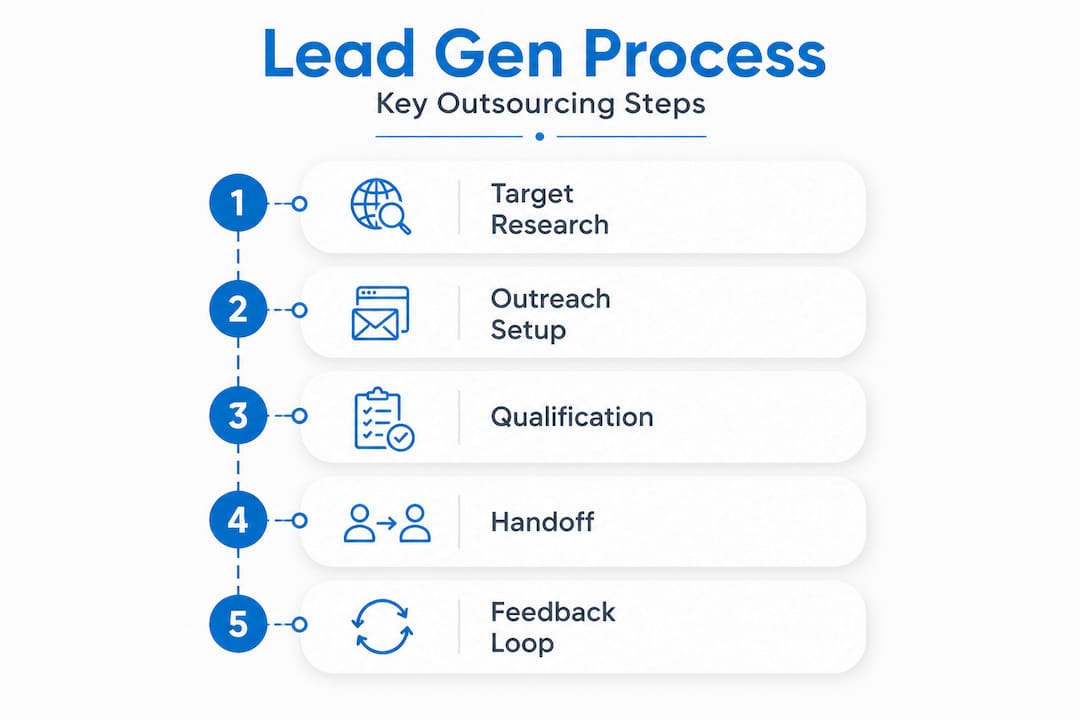
The business case is strongest when you need speed, language coverage, or specialist expertise that your internal team simply cannot build fast enough. A SaaS company launching into the German market, for example, cannot realistically hire and train a team of native German-speaking outbound specialists within a quarter. An outsourced provider with established multilingual teams and B2B lead generation insights on regional buying behavior can fill that gap almost immediately.
The main delivery models you will encounter include:
- Appointment setting: Agents conduct outreach by phone and email, with the sole objective of booking qualified meetings for your sales team.
- Full telemarketing programs: Broader campaigns that combine awareness, qualification, and direct selling, commonly used in telecom for service bundle promotions.
- Digital-only outreach: Primarily LinkedIn and email sequences, often layered on top of phone outreach for higher-value accounts.
- Market research and pipeline development: Structured calling programs to map a new territory before committing to full sales headcount.
Compliance is a real concern, not a formality. Cross-border campaigns in Europe require careful GDPR alignment, and multilingual providers use native agents alongside role-based messaging frameworks specifically designed to handle that regulatory complexity. Getting this wrong costs far more than the campaign itself.
Understanding international customer service operations is directly tied to how well your outsourced lead generation fits into your broader go-to-market structure. The better your provider understands how international prospects think and communicate, the more qualified the pipeline it generates. When you combine those capabilities with multilingual telemarketing services, the result is outreach that feels local even when it is being delivered from a centralized team.
Pro Tip: Before signing any outsourcing contract, ask the provider to walk you through a real example of how they handled GDPR compliance for a cross-border campaign in one of your target languages. Generic answers reveal a generic approach.
ROI and performance benchmarks for outsourced lead generation
With the foundations in place, let's dig into what success really looks like in outsourced lead generation, and how to measure it with real-world numbers.
Understanding what you should expect to pay, and what you should expect to get back, is the single most important step before committing budget. Here are the benchmark ranges that consistently appear across well-run outsourced programs:
| Metric | Benchmark range |
|---|---|
| Cost per qualified meeting | $400 to $650 |
| Cost per qualified opportunity | $1,200 to $2,500 |
| Opportunity-to-close rate | 20% to 35% |
| Pipeline ROI multiple | 3x to 7x |
These numbers shift depending on your industry and average deal size. A SaaS company with a $15,000 annual contract value benefits enormously even from a 20% close rate on meetings at $650 each. A telecom provider with large enterprise deals may spend closer to $2,500 per opportunity but close far fewer, much larger contracts.
The ROI formula is straightforward. Take your total program spend (including provider fees, internal sales time spent on meetings, and any tooling costs). Divide that into the closed-won revenue attributed to the program over a defined period, typically six to twelve months. If your cost per opportunity is $2,000 and your average deal size is $12,000, a 25% close rate means each closed deal cost roughly $8,000 in lead generation investment to produce $12,000 in revenue. That is a 1.5x return at the deal level, but scale that across 30 opportunities per quarter and the program math becomes compelling.
"The companies that get the most from outsourced lead generation are not those with the biggest budgets. They are the ones who define pipeline value clearly before the first call is ever made."
Most companies calculate ROI too early. They measure results at three months when the actual sales cycle runs six to nine months. This is especially common in enterprise telecom and SaaS, where procurement cycles are long. Tracking outsourced appointment setting results over the correct time horizon changes the picture dramatically.
Pro Tip: Calculate your breakeven meeting volume before launch. If your average deal is worth $50,000 and your margin is 40%, you need just one closed deal from every 12 to 15 meetings booked to justify the program at standard benchmark costs. Most programs beat that threshold comfortably.
What most companies get wrong: qualification, handoff, and feedback loops
But hitting benchmark numbers is only half the story. Without the right process, companies can find themselves with lots of activity but little true progress.
The most common failure in outsourced lead generation is what practitioners call the qualification problem. A vendor whose success is measured purely on meetings booked has a built-in incentive to lower the bar. More meetings look like progress on the dashboard. But if those meetings fail to meet your actual sales criteria, your sales team spends its time with the wrong people, pipeline quality collapses, and you blame the vendor while the vendor blames your sales process.
Vendors can prioritize meeting volume over genuine pipeline quality unless both parties take time upfront to define qualification criteria together and build mutual accountability into the handoff process.
Here is a side-by-side look at how the two vendor approaches differ in practice:
| Dimension | Quality-driven vendor | Volume-driven vendor |
|---|---|---|
| Success metric | Qualified pipeline generated | Meetings booked |
| Qualification process | Scored against agreed ICP criteria | Basic contact confirmed |
| Handoff protocol | Detailed notes, intent signals, timing | Calendar invite only |
| Feedback loop | Weekly sync with sales team | Monthly reporting |
| Outcome for client | Predictable pipeline growth | Activity without conversion |
ICP stands for Ideal Customer Profile, the detailed description of exactly which type of company and buyer you want in your pipeline.
To fix this before it becomes a problem, follow these steps:
- Define your ICP in writing before the program starts. Include firmographic filters (industry, company size, revenue), technographic signals (tools they use), and behavioral indicators (recent triggers like funding rounds or product launches).
- Set a lead scoring threshold. Agree with your vendor that only leads meeting a minimum score qualify as bookable meetings. This number should reflect your sales team's real criteria, not a compromise to make the numbers look good.
- Build a structured handoff template. Every meeting hand-off should include company background, the prospect's stated pain points, objections raised during outreach, and timing signals from the conversation.
- Create a closed-loop feedback process. Your sales team should rate every meeting within 48 hours of it happening. That rating feeds directly back to the outsourced team so they can calibrate their qualification in real time.
- Review and revise qualification criteria monthly. Markets change, and what worked as a qualifier in Q1 may not reflect reality in Q3.
Working with dedicated support agents who are embedded long-term in your program makes this kind of feedback loop far more practical. Rotating agents who are new to your product and market every few weeks make consistent quality nearly impossible.
For international campaigns, the lead generation qualifications framework needs to account for regional differences in buying behavior. What constitutes a qualified prospect in a Nordic SaaS market looks different from the equivalent in Southern Europe.
Choosing the right lead generation outsourcing partner
With pitfalls clear, choosing the right partner is the next crucial move for sustainable B2B pipeline growth.

Not every outsourcing provider can handle the complexity that telecom and SaaS companies face when expanding internationally. The selection process needs to go well beyond pricing and case study PDFs.
The core criteria you should evaluate include:
- Language coverage and agent quality: Do they have genuine native speakers for your target markets, or are they relying on near-native agents whose accent and cultural fluency will undermine your brand in-market?
- Regulatory compliance infrastructure: Can they demonstrate specific GDPR compliance processes for each country you are targeting, not just a blanket policy statement?
- Tech stack integration: Will their outreach tools and CRM connect cleanly to your existing systems, or will you be managing a separate data silo?
- Track record in your sector: Have they run successful programs for telecom or SaaS companies specifically? Results from e-commerce campaigns do not transfer directly.
- Reporting transparency: Do they provide raw call data, recording access, and live dashboards, or do they send polished summary reports that hide what is actually happening in the field?
Native and multilingual agents combined with role-based messaging are what separate providers who can genuinely operate in international markets from those who claim they can.
Questions worth asking every vendor before you sign anything:
- Show me a recent qualification scorecard from a campaign in my target market.
- How do you handle a situation where your agents believe a lead qualifies but our sales team disagrees?
- What is your agent turnover rate on dedicated programs?
- Can I speak directly to a reference client in a similar industry?
For SaaS companies, sales and marketing alignment is particularly important when outsourcing lead generation. The vendor is essentially operating inside your go-to-market motion. If they are not integrated into your messaging cadence and content strategy, the outreach will feel disconnected from everything else your prospects experience.
Enhancing customer engagement with multilingual support goes hand in hand with lead generation. Companies that invest in consistent multilingual outreach tend to see higher response rates, better meeting quality, and stronger conversion through the funnel.
When evaluating outsourcing call center services more broadly, look for providers who can grow with you, handling both inbound support and outbound lead generation as your needs evolve. This structural flexibility becomes a genuine competitive advantage as you scale across multiple European markets.
Pro Tip: Ask every prospective vendor what percentage of their revenue comes from clients they have worked with for more than two years. High retention rates are the most honest signal of program quality.
Editorial perspective: Why conventional wisdom on outsourcing misses the mark
The standard debate about outsourced lead generation is framed as in-house versus outsourced, as if companies must choose one or the other permanently. After nearly two decades of working with B2B companies across multilingual markets, we find that framing almost useless.
The real question is what your internal team is genuinely better at, and where a specialist vendor creates advantages that no amount of internal hiring will replicate. Speed to market in a new language is one of those advantages. Deep cultural fluency in a specific European market is another.
The strongest argument for outsourcing is not cost. It is access to capability that would take years and significant capital to build internally. The strongest argument against it is the feedback lag: when your lead generation is running through an external team, the market signals you get back are filtered and delayed. This matters enormously in fast-moving SaaS markets where product positioning shifts quarterly.
Our take is that companies consistently underestimate the complexity of the qualification and feedback loop problem. They solve the outreach problem by hiring a vendor, then discover six months later that their pipeline data is unreliable because the qualification criteria were never properly defined. That is not an outsourcing failure. It is a process failure that outsourcing simply made more visible.
The companies we see succeed with outsourced multilingual lead generation treat the vendor as a genuine extension of their team, not a black box that generates meetings. They invest in onboarding the vendor properly. They share market intelligence. They recognize the need for multilingual support as a strategic capability, not a cost line. And they build feedback loops that make both sides smarter over time.
That is the model that produces 5x to 7x pipeline ROI. Everything else is just activity.
How CallTech powers global B2B lead generation and multilingual support
Ready to see these principles in practice? Here's how CallTech delivers on the promise of global B2B lead generation outsourcing.
CallTech Outsourcing has been running multilingual outbound programs and customer support operations since 2005, across more than 15 European languages, in telecom, SaaS, digital services, and e-commerce. We understand that generating qualified pipeline in a new market requires more than a calling script and a contact list.

Our approach combines native-language agents, transparent reporting, and deep CRM integration to make outsourced lead generation feel like a natural extension of your internal team. Whether you need structured appointment setting in German-speaking markets or a full outbound telemarketing program across multiple European territories, you can explore our proven global support strategies and see how they apply directly to pipeline generation. To understand the full scope of what we offer, including outbound campaigns and back-office support, visit our outsourcing contact center services page. And if you are evaluating whether multilingual outsourcing is the right move for your expansion plans, our guide on the benefits of multilingual support is a practical starting point.
Frequently asked questions
What is the average cost per qualified lead in outsourced B2B lead generation?
Qualified meetings from outsourced programs typically cost between $400 and $650 each, based on widely reported provider benchmarks. Actual costs vary depending on target market complexity, language requirements, and deal size.
How do outsourcing vendors ensure lead quality instead of just high meeting volume?
Quality is maintained by jointly defining lead scoring thresholds and qualification criteria before the program launches, then building structured handoff protocols and closed-loop feedback between the vendor and your sales team. Agreeing on scoring criteria upfront is the single most effective safeguard against volume-focused behavior.
Why is multilingual capability important in lead generation outsourcing?
Native multilingual agents enable personalized, culturally appropriate outreach that meets GDPR requirements across different European markets. For telecom and SaaS companies expanding internationally, this capability is the difference between outreach that converts and outreach that gets ignored.
Which performance metrics matter most when evaluating an outsourced B2B lead generation campaign?
The four metrics that matter most are cost per qualified meeting, cost per qualified opportunity, opportunity-to-close rate, and pipeline ROI multiple. Tracking these benchmarks over the full sales cycle, not just the first 90 days, gives you an accurate picture of program performance.
What types of companies benefit most from outsourcing lead generation?
Telecom and SaaS companies expanding into new international markets benefit most, particularly when they need rapid access to native-language outreach capability and specialist compliance knowledge. Multilingual expansion across European markets is a specific use case where outsourcing delivers speed and quality that internal teams rarely match.
Recommended
- Why partner with outsourcing providers for global support
- What is business process outsourcing? A complete leader's guide
- Multilingual telemarketing services that scale global support
- What is scalable outsourcing? A 2026 guide for leaders
- LinkedIn outreach tips to boost your B2B lead generation - The Lead Lab
- B2B outbound workflow: a complete guide for 2026