

TL;DR:
- European companies must balance customer demands for multilingual support with strict GDPR compliance, which is complex and costly to implement. Properly assessing language needs, technical requirements, and legal obligations is essential before hiring or outsourcing to ensure operational efficiency and legal adherence. Building a compliant, scalable multilingual call center provides a competitive advantage, fosters customer trust, and minimizes operational risks.
European companies face a real tension: customers expect instant, fluent support in their native language, but putting together a reliable multilingual team that meets strict GDPR requirements is far harder than posting a job ad. GDPR and data-security controls are baseline requirements for every Europe-based call center agent, and getting them wrong carries serious financial and operational consequences. This guide walks you through every step of the process, from mapping your language needs to measuring agent performance, so you can build or outsource a compliant, high-quality multilingual team with confidence.
Table of Contents
- Assessing your call center agent requirements
- Preparing for compliance: GDPR and European labor regulations
- Choosing your hiring and outsourcing model
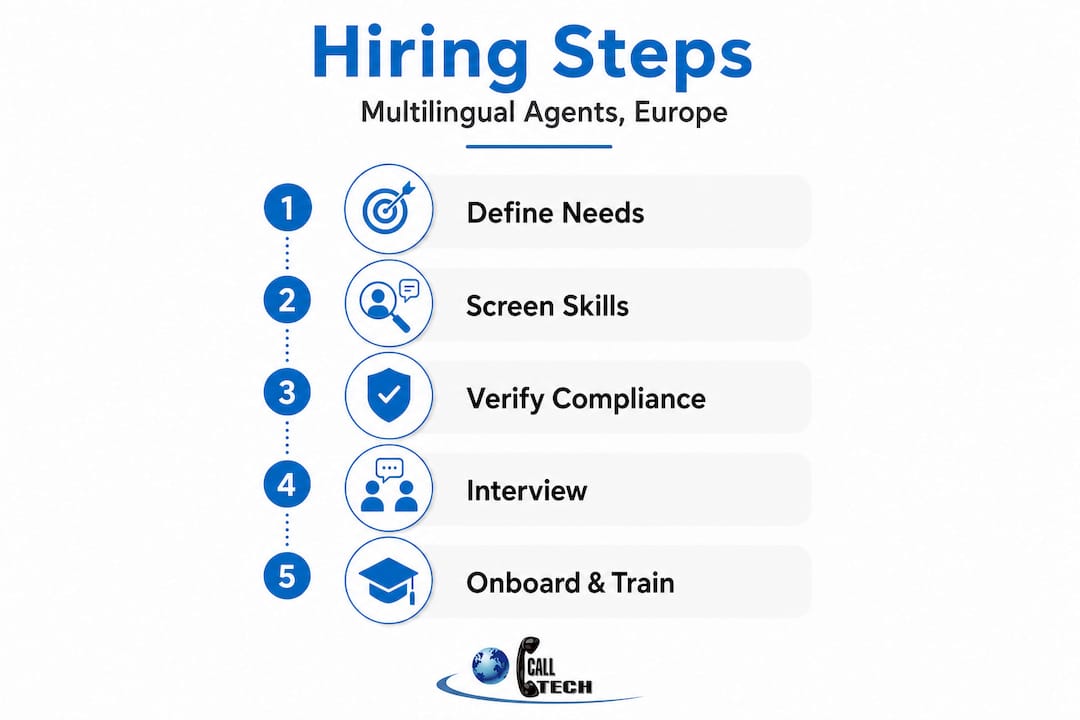
- Step-by-step process to hire call center agents in Europe
- Verifying success: Metrics and troubleshooting tips
- Why compliance is your competitive advantage—not just a risk
- How CallTech can help you hire compliant, multilingual call center agents
- Frequently asked questions
Key Takeaways
| Point | Details |
|---|---|
| Define clear requirements | Start with specific language, technical, and compliance needs for your call center agents. |
| Prioritize GDPR compliance | Integrate data residency, security, and proper documentation from the start to avoid major risks. |
| Choose the right hiring model | Weigh in-house, outsourcing, and hybrid options for efficiency and scale. |
| Follow a step-by-step hiring process | Use structured vetting, onboarding, and ongoing checks for best results. |
| Treat compliance as an asset | Strong compliance improves brand reputation and opens doors for international business. |
Assessing your call center agent requirements
Now that you see the stakes, let's start by clarifying exactly who and what you'll need for an exceptional multilingual call center operation. Rushing into hiring before you have a clear requirements profile is one of the most expensive mistakes a growing business can make.
Define your language and market coverage
Start by mapping the markets you serve or plan to enter. A SaaS company expanding into Scandinavia needs Swedish, Danish, and Norwegian fluency, not just English. An e-commerce brand moving into Southern Europe needs Italian, Spanish, and Portuguese speakers. Be specific about the dialect too: a customer in Mexico expects a different register than one in Spain, even if they share a language.
Beyond language, think about interaction complexity. Tier-1 support (simple FAQs, order status) is very different from Tier-2 support (billing disputes, technical troubleshooting). The complexity of your customer interactions directly affects how many agents you need, what seniority level they should be, and how much training investment is required.
| Requirement area | Questions to answer |
|---|---|
| Languages | Which markets? Which dialects or regional variants? |
| Volume | Peak and off-peak call volumes per market |
| Interaction type | Inbound, outbound, chat, email, or blended |
| Compliance | GDPR data residency, encryption, contract terms |
| Technology | CRM, ticketing, VOIP systems already in use |
| Model | In-house, outsourced, or hybrid |
Technical and compliance requirements
GDPR compliance demands specific data residency within the EU or EEA, a lawful basis for processing customer data, active encryption, and clearly written contracts. This is not optional. Every agent who handles customer data is a data processor under GDPR, whether they work for you directly or for an outsourcing partner.

Understanding the types of contact center services available will also help you match your technical stack and channel mix to the right agent profile. Some businesses need blended voice and chat agents; others need pure outbound campaign specialists.
Key requirements to document before posting a single job ad:
- Languages: List every market-facing language with desired proficiency level (B2, C1, native speaker)
- Compliance: Data residency country, encryption standard, required contracts
- Hours: Time zones and shift coverage requirements per market
- Tech stack: CRM, ticketing software, VOIP platform agents must operate
- Escalation paths: How complex issues get routed beyond the agent tier you're hiring
Pro Tip: Build your requirements document as a shared spreadsheet that your legal, IT, and customer experience teams all review together. This single step prevents contradictory requirements from derailing your hiring process later.
Preparing for compliance: GDPR and European labor regulations
Once your requirements are defined, the next step is understanding and preparing for strict European compliance obligations. This is the phase most hiring managers underestimate, and it shows.
Understanding GDPR basics for call center agents
Every call center agent who accesses, processes, or stores customer personal data is operating inside a GDPR-regulated framework. The regulation requires that data is processed with a clear lawful basis, that customers are informed about how their data is used, and that technical controls like encryption and access logging are in place. Failure to comply with data protection and labor regulations can halt operations entirely or trigger fines of up to 4% of global annual revenue.
Transparency is not just good practice; it is legally required. Agents must be trained to explain to customers what data is being collected and why, especially in regulated sectors like telecom and financial services.
"A compliant call center agent is not just technically capable. They are trained, contracted, and monitored to process personal data exactly as GDPR requires, every single interaction."
Data residency and technical controls
For European operations, customer data must remain within the EU or EEA unless specific cross-border data transfer agreements (like Standard Contractual Clauses) are in place. This affects which cloud platforms you can use, where call recordings are stored, and how your outsourcing partner hosts its systems.
Review common outsourcing mistakes that European companies make, especially around data residency, before signing any vendor contract. Discovering a partner stores call recordings in a non-EEA data center after the contract is signed is a very expensive lesson.
Essential compliance preparation steps:
- Draft or review your Data Processing Agreement (DPA) before onboarding any agent or partner
- Confirm EU/EEA data residency for all call recordings, CRM records, and chat logs
- Establish role-based access control so agents only access data relevant to their work
- Create an internal audit trail process that generates logs for compliance reviews
Pro Tip: Require any outsourcing partner to share their most recent data protection audit report before you sign. Legitimate partners will have this ready. If a vendor hesitates or cannot produce documentation, that is a serious red flag.
Labor law compliance across European countries
Europe is not one labor market. Employment law differs significantly between Germany, France, the Netherlands, Poland, and every other country where you might hire agents. Fixed-term contracts, working hours limits, paid leave entitlements, and termination procedures all vary. If you are hiring directly across multiple countries, you either need a legal entity in each country or an Employer of Record (EOR) service to manage local employment contracts on your behalf.
Choosing your hiring and outsourcing model
With compliance front and center, you are now ready to pick the best hiring model for your business's goals and budget. The choice you make here will affect your speed to market, your cost structure, and your ability to scale.
Comparing your options
| Factor | In-house team | Outsourced partner | Hybrid model |
|---|---|---|---|
| Setup speed | Slow (3 to 6 months) | Fast (2 to 8 weeks) | Medium |
| Cost | High fixed cost | Variable, often lower | Balanced |
| GDPR control | Full direct control | Shared via DPA | Shared with oversight |
| Language coverage | Limited by hiring market | Broad, immediate | Flexible |
| Scalability | Slow to scale | Fast | Fast for outsourced tier |
In-house hiring gives you maximum control over agent quality and company culture, but it carries significant fixed costs, long ramp-up times, and the full burden of compliance documentation. BPO regulatory compliance covers both data protection and labor regulations, and a vetted outsourcing partner will already have these frameworks in place, saving you months of preparation work.
Outsourcing to a specialist multilingual provider is often the fastest path for companies scaling with multilingual call centers across several markets simultaneously. Hybrid models work well for businesses that want core brand-facing roles in-house while routing overflow, after-hours, or low-complexity volume to an outsourced team.
Partner due diligence checklist
When evaluating outsourcing partners, use this numbered process:
- Request a compliance dossier including their DPA template, data residency documentation, and most recent GDPR audit
- Verify language coverage with live test calls or structured assessments in each required language
- Review SLA terms for first response time, resolution rate, and escalation paths
- Assess technology compatibility by checking CRM and VOIP integration capabilities
- Check references from clients in your industry or a comparable vertical
Companies adding multilingual appointment setting or outbound campaign services should also verify that the partner has specific experience in their language pairs and industry, not just general call center capability.
Step-by-step process to hire call center agents in Europe
Having selected your model, you can now follow these concrete steps to make your hiring process both efficient and fully compliant.
The hiring process, step by step
-
Write a GDPR-aware job description. Include the data handling responsibilities clearly. A GDPR-compliant agent processes personal data lawfully, transparently, and securely, with appropriate contracts and technical controls. Your job ad should signal this standard.
-
Choose your sourcing channels. Specialist agencies for multilingual talent, European job boards like StepStone or LinkedIn, and outsourcing providers all serve different needs. For outsourced models, formal RFP (Request for Proposal) processes bring more structure and comparability.
-
Screen for language fluency and compliance awareness. Fluency checks should include live customer role-play in the target language, not just a CV claim. Ask directly about GDPR experience: "How would you handle a customer request to delete their personal data?" A blank stare is informative.
-
Structure your contracts correctly. Employment contracts for in-house agents must comply with local labor law. For outsourced agents, your DPA must define controller and processor roles, retention periods, and security obligations clearly.
-
Onboard with a compliance-first approach. Before agents touch live customer data, complete GDPR training, system access setup with role-based permissions, and a review of your call recording and storage policies.
-
Integrate your CRM and support tools. Streamlined CRM integration for call centers reduces agent errors and creates consistent audit trails. Agents who can see full customer context resolve issues faster and with fewer compliance risks.
-
Establish quality monitoring from day one. Set up call listening schedules, language accuracy scoring, and regular compliance spot checks. Optimizing your contact center workflow from the start prevents bad habits from becoming ingrained.
Ongoing management essentials:
- Schedule monthly compliance reviews covering data access logs and contract status
- Run quarterly language accuracy assessments, especially for agents handling technical or legal content
- Create a clear escalation path for agents who identify potential data breaches during calls
- Review and update agent contracts whenever your data processing activities change significantly
Verifying success: Metrics and troubleshooting tips
After hiring, it's vital to continually verify results and fix issues before they impact customer loyalty or compliance standing.
Performance metrics to track
The most reliable top call center services operate on a foundation of clearly defined KPIs (key performance indicators). Track these consistently:
- Customer Satisfaction Score (CSAT): Post-interaction survey results per language and market
- First Call Resolution (FCR): Percentage of issues resolved in a single interaction, broken down by agent and language
- Average Handle Time (AHT): Efficiency indicator, but read it alongside CSAT to avoid speed-for-quality tradeoffs
- Language accuracy score: Assessed through supervisor call reviews and customer feedback
- Compliance audit pass rate: Percentage of interactions that pass GDPR-process spot checks
Compliance verification
GDPR compliance is operational as well as legal: check cross-border cloud usage, encryption status, contracts, and audit trails on a scheduled basis, not just when a problem surfaces. Build a compliance calendar with monthly and quarterly checkpoints.
Pro Tip: Use mystery-caller audits in each language at least twice per year. They surface both language quality gaps and compliance process failures that routine monitoring can miss.
Common issues and troubleshooting steps
Language mismatch: A candidate passed their language test but customers report difficulty understanding them. Solution: move to more rigorous live role-play assessments using realistic customer scenarios before hire, not a static grammar test.
Compliance gap discovered post-onboarding: An agent has been routing call recordings to a non-EEA server. Solution: immediately restrict access, notify your DPO (Data Protection Officer), review all affected interactions, and update your onboarding checklist to catch this configuration issue earlier.
Tech integration failures: CRM and VOIP systems are not syncing, creating duplicate records. Solution: run a full integration test with real call scenarios before going live, and establish a named technical contact at your outsourcing partner for rapid issue resolution.
Why compliance is your competitive advantage—not just a risk
Most corporate decision-makers treat GDPR and labor law compliance as overhead: a necessary cost with no return. After nearly 20 years in multilingual outsourcing, we see it very differently, and the evidence supports a contrarian view.
Companies that build compliance into the core of their call center operations consistently win contracts that less-prepared competitors lose. Procurement teams at large European enterprises routinely disqualify outsourcing vendors who cannot produce a GDPR-clean audit in the first meeting. Compliance is a gating criterion, not an afterthought.
Strong compliance frameworks also accelerate scaling. When your data processing agreements, access controls, and agent training are already systematized, adding a new language or a new market takes weeks instead of months. The cost-saving strategies in call center operations are not just about lower wages in certain geographies. They come from having scalable, repeatable compliance processes that do not require rebuilding from scratch every time you expand.
The real cost of non-compliance is rarely a fine. It is the lost contract when a prospective enterprise client audits you and walks away. It is the operational freeze while you scramble to fix a data residency problem. It is the reputational hit when a data breach becomes public. Treating compliance as a brand credibility asset changes how you invest in it, and the return is measurable.
How CallTech can help you hire compliant, multilingual call center agents
If you're ready to take the next step, here's how CallTech can help you build a future-proof, customer-focused call center team.
Building a multilingual call center team that is both excellent and compliant across European markets is a significant operational undertaking. CallTech Outsourcing has been doing exactly this since 2005, covering more than 15 European languages with teams that are trained to GDPR standards from day one.

Our outsourcing multilingual contact center services include full compliance documentation, EU/EEA data residency, and CRM integration as standard, not as expensive add-ons. Whether you need a dedicated multilingual support agent team for ongoing customer care or a scalable model that grows with your market expansion, we design solutions around your actual requirements. We also help companies enhance customer engagement through structured quality monitoring and language-specific performance programs. Contact us to discuss your requirements and explore a pilot engagement with zero long-term commitment.
Frequently asked questions
What are the key compliance steps for hiring call center agents in Europe?
Ensure lawful data processing, EU/EEA data residency, encryption, and proper GDPR contracts with agents or outsourcing partners before any live customer interactions begin.
How do I evaluate language proficiency in call center candidates?
Use structured live role-play scenarios in each required language rather than written tests, as these better reflect how agents will perform in real customer interactions.
What are common pitfalls when outsourcing call center agents in Europe?
Typical pitfalls include neglecting GDPR compliance, vague SLAs, and selecting partners without verified multilingual coverage; compliance failures in BPO engagements can halt operations entirely.
Should I hire in-house agents or outsource?
Outsourcing delivers faster multilingual coverage and built-in compliance frameworks, while in-house hiring gives more direct quality control; most scaling businesses find a hybrid model offers the best balance.
Which metrics best indicate success for multilingual call center agents?
Track CSAT scores, first-call resolution rates, compliance audit pass rates, and language accuracy scores regularly to get a complete, honest picture of agent performance across all markets.