

TL;DR:
- Effective multilingual support requires analyzing performance metrics by language and shift, not just overall ratings.
- Centralized systems and proper scheduling aligned with customer peak times enhance support quality and efficiency.
- Continuous, granular measurement and tailored training are essential for maintaining high quality across all languages.
Running customer support across multiple languages and time zones is harder than it looks. Most managers assume the main challenge is finding agents who speak the right languages. But the real problems show up later: slower response times in Polish than in German, lower satisfaction scores on the night shift, and quality that silently erodes in languages nobody tracks closely. This guide walks you through the practical steps to staff, schedule, measure, and improve remote multilingual support teams that actually perform, not just exist, across all your markets.
Table of Contents
- Why global remote customer support requires more than just language coverage
- Staffing and scheduling best practices for remote multilingual support
- Centralizing remote support: Key to telecom and SaaS efficiency
- Avoiding performance drift: Tracking and improving quality in every language
- What most leaders miss about remote multilingual support quality
- Ready to scale your multilingual support? Explore proven solutions
- Frequently asked questions
Key Takeaways
| Point | Details |
|---|---|
| Language-specific KPIs | Track customer satisfaction and response times for each language and shift to reveal hidden performance gaps. |
| Centralized support boosts efficiency | Unified remote-assistance tools streamline global operations and improve resolution times. |
| Recruiting for rare languages | Invest in targeted recruiting and training for less common languages to maintain high quality. |
| Scheduling for success | Match agent shifts to customer time zones for optimal coverage and satisfaction. |
Why global remote customer support requires more than just language coverage
The most common mistake global companies make is treating multilingual support as a staffing checklist. You need French? Hire a French speaker. You need Dutch? Find someone who speaks Dutch. Box checked. But fluency is only one layer of the problem.
The deeper issue is that performance varies by time zone and shift, not just by language. A Spanish-speaking agent based in Eastern Europe working a 6 AM shift is covering a completely different customer reality than one working a 2 PM shift. Peak call volumes, customer urgency levels, and issue complexity all shift throughout the day. If your scheduling doesn't account for where your Spanish-speaking customers actually are when they reach out, you'll have agents sitting idle during peak hours and overwhelmed during off-peak ones.
There's also what we call hidden drift, a gradual, unnoticed decline in service quality that affects less common languages first. Think Norwegian, Slovak, or Croatian compared to English or Spanish. These language queues tend to be smaller, which means fewer eyes on the data and fewer red flags raised when something starts slipping. Managers focused on overall CSAT (customer satisfaction) scores miss the signal because it's buried in the average.
The key metrics that cut through this noise are FRT (first response time) and CSAT tracked by language and by shift. As language-specific KPIs like FRT and CSAT make clear, measuring at this granular level is what separates teams that maintain quality from those that assume it.
Here are the main performance gaps that show up when global companies overlook these details:
- Shift misalignment: Agents working hours that don't match customer peak times, leading to long wait times or rushed interactions
- Language queue neglect: Less common language queues getting low priority in quality reviews
- Inconsistent training: Native-language training materials that don't exist for smaller language groups
- KPI averaging: Rolling up all metrics into one number that masks underperforming languages
"Staffing remote multilingual support effectively means selecting languages and coverage windows by time zone, then measuring quality with language-specific KPIs like FRT and CSAT, not overall averages."
Strong customer engagement in multilingual support depends on building these foundations right. The language is the entry point. The shift structure and KPI framework are what keep the quality consistent over time.
Staffing and scheduling best practices for remote multilingual support
Once you understand the performance gaps, the next question is how to fix them. The answer involves two overlapping decisions: which languages to staff and when to staff them.
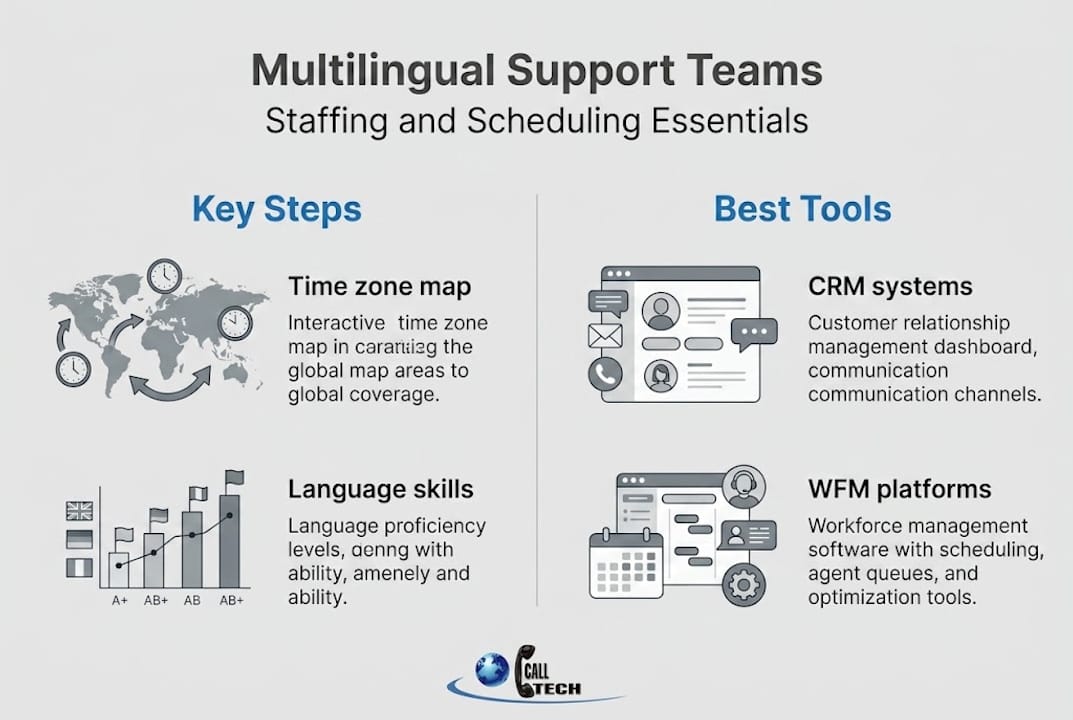
Start by mapping your customer base against time zones. If 60% of your Dutch-speaking customers contact you between 9 AM and 1 PM CET, you need Dutch-speaking agents available and sharp during that window, not just technically scheduled. This sounds obvious, but many companies build schedules around agent availability rather than customer behavior, and the difference in CSAT shows up fast.
Time zone vs. language segmentation approaches:
| Approach | Best for | Tradeoff |
|---|---|---|
| Time zone first | Teams covering multiple languages in one region | Simpler scheduling, but may force bilingual agents to cover too many queues |
| Language first | High-volume markets with dedicated queues | Better quality control, higher staffing cost |
| Hybrid model | Most global companies | Balances coverage and cost, requires tighter KPI tracking |
For most telecom, SaaS, and e-commerce operations, the hybrid model works best. Dedicate agents to major languages during peak hours, and allow flexible language support during off-peak periods. But here's the catch: without strong tooling, hybrid scheduling creates blind spots.
The tools that matter most are CRM systems with language-tagging capabilities, workforce management platforms that let you filter scheduling data by language and shift, and quality assurance dashboards that surface per-language metrics. Platforms like Zendesk, Freshdesk, and Salesforce Service Cloud all support this level of segmentation when configured properly. To get the most from these tools, it helps to optimize your contact center workflow before adding multilingual layers on top.
Tracking FRT and CSAT by language and shift is particularly revealing because less common languages consistently underperform when recruiting and training aren't adjusted to account for their specific challenges.
This is also where a well-designed multilingual call center process becomes a competitive advantage rather than just a cost center.
Pro Tip: Set up automated weekly reports that surface FRT and CSAT broken down by each language and each shift. If you only look at this data monthly, you'll miss performance drops that compound quickly in smaller language queues.
Centralizing remote support: Key to telecom and SaaS efficiency
Staffing and scheduling create the foundation. Centralized tools and processes are what multiply the efficiency gains across that foundation.
Centralization in remote support means giving all agents, regardless of location or language, access to the same information, the same escalation paths, and the same remote-assistance capabilities. Without this, you end up with fragmented support experiences where a customer in Finland gets a different quality of technical help than a customer in Spain, not because of the agents but because of the systems underneath them.
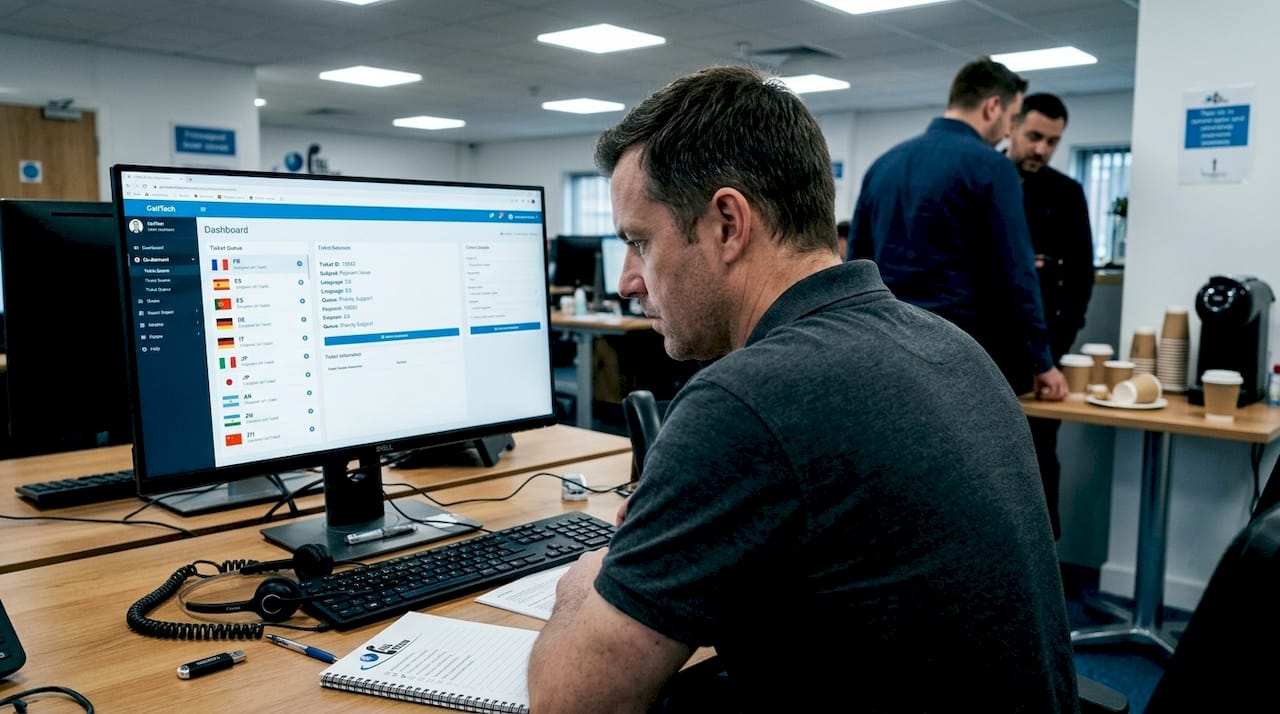
The benefits of centralization are measurable. Centralized remote-assistance capabilities help telecom companies improve resolution times and customer satisfaction by giving support agents instant access to device diagnostics and troubleshooting tools, regardless of where the agent or the customer is located. This is especially powerful in telecom, where technical issues often require real-time device interaction.
For SaaS companies, centralization solves a different problem: knowledge fragmentation. When your product evolves rapidly, agents in different markets end up working with outdated information unless there's a single source of truth. A centralized knowledge base with multilingual tagging ensures that a Romanian agent and a Portuguese agent are solving the same problem with the same solution, reducing resolution time and improving consistency.
Key benefits of centralizing remote support operations:
- Faster resolution times through shared tooling and escalation paths
- Consistent customer experience regardless of language or region
- Easier quality assurance because everything runs through the same system
- Lower training costs since onboarding is standardized, not reinvented per language team
- Better data because all interactions feed into one reporting environment
For e-commerce companies, centralized support also enables better handling of peak seasons. When volume spikes across multiple markets simultaneously, a centralized operation can flex resources between language queues more fluidly than siloed teams.
One practical integration tip: connect your CRM to your multilingual support system early in the process. Late-stage CRM integration is one of the most common and expensive mistakes we see. The data silos that form in the first six months are very hard to undo.
If you're evaluating remote support solutions for your tech stack, prioritize platforms that support multi-language ticketing, time-zone-aware SLA (service level agreement) tracking, and agent-level performance dashboards.
Performance impact of centralized vs. siloed remote support:
| Metric | Siloed teams | Centralized teams |
|---|---|---|
| Average resolution time | Higher, varies by team | Lower, more consistent |
| CSAT variance across languages | Wide gap | Narrower gap |
| Training time for new agents | Longer, inconsistent | Shorter, standardized |
| Quality audit effort | High | Lower with shared tools |
Avoiding performance drift: Tracking and improving quality in every language
Performance drift is quiet. It doesn't announce itself in your dashboard. It accumulates in the gap between what you measure and what's actually happening in your less-watched language queues.
Language segmentation can create hidden performance drift when CSAT and FRT aren't tracked at the language and shift level. Less common languages tend to underperform over time if recruiting and training aren't adjusted specifically for those queues.
Here's a practical framework to prevent this from happening:
-
Segment your KPI reporting by language from day one. Don't wait until a problem surfaces. Set up your dashboards so that FRT and CSAT for Croatian, Norwegian, or Greek are visible on the same screen as English and Spanish.
-
Establish language-specific benchmarks. A 2-minute FRT in English may be achievable. The same benchmark for Finnish might not be, depending on issue complexity and agent availability. Set realistic baselines and measure improvement against those.
-
Run monthly quality audits on a random sample of interactions per language. Call recordings, chat transcripts, and ticket notes all tell a story. If you only audit the languages your QA team speaks fluently, you're leaving blind spots open.
-
Tie recruiting criteria to language-specific gaps. If your Greek CSAT scores are consistently 10% below your overall average, that's a recruiting and training signal, not just a performance signal. Review whether your hiring process for Greek-speaking agents screens for the same competencies as your process for English-speaking agents.
-
Create language-specific training supplements. General onboarding covers product knowledge and tone. Language-specific training covers cultural nuances, common customer pain points in that market, and escalation paths that are relevant to local regulations or service norms.
-
Set up alerts for language-level anomalies. If FRT for Romanian tickets spikes by 30% over a two-week period, you want to know before the third week starts.
Avoiding common outsourcing mistakes in European markets often comes down to this: measuring what matters at a granular level before problems become visible at the aggregate level.
Pro Tip: Assign a named quality owner for each language group. Even if it's a part-time responsibility, having one person accountable for monitoring Croatian or Slovak metrics creates the accountability that prevents drift from going unnoticed.
For teams looking to build this kind of structure at scale, a scalable outsourcing guide can help you map out the governance and tooling needed to manage quality across many languages without creating operational overhead that kills efficiency.
What most leaders miss about remote multilingual support quality
After nearly 20 years of working with telecom, SaaS, and e-commerce companies on multilingual support, we've seen one pattern repeat itself more than any other: leaders focus on the wrong level of measurement and then wonder why quality problems keep coming back.
The instinct is to look at overall CSAT. It's clean, it rolls up nicely into a board slide, and it gives everyone a comfortable sense of control. But overall CSAT is almost always fine, right up until a major customer segment leaves for a competitor who happened to offer better support in their language.
The uncomfortable truth is that great multilingual support isn't the result of one-off optimizations. It's not about finding the right technology platform or running a training program. It's about building a continuous improvement loop that operates at the language and shift level, permanently. That means language-specific KPI reviews every week, not every quarter. It means recruiting processes that treat Norwegian or Slovak as seriously as English. It means quality auditors who are actually fluent in the languages they're reviewing.
We've also seen the "easy fix" trap: companies that respond to a CSAT dip by adding agents without fixing the underlying training or scheduling issue. The score bounces back temporarily, then dips again. The fix wasn't a fix. It was noise reduction.
Cost-effective scalable support methods are built on sustained process discipline, not periodic interventions. The managers who get this right are the ones who treat multilingual quality as an ongoing operational commitment, not a project with a finish line.
Ready to scale your multilingual support? Explore proven solutions
Building a remote multilingual support team that performs consistently across languages and time zones takes the right structure, the right metrics, and the right partner. If the frameworks in this article resonate with you, the next step is finding an outsourcing provider who already has this infrastructure in place.

At CallTech Outsourcing, we've spent nearly 20 years helping telecom, SaaS, and e-commerce companies run multilingual customer support across more than 15 European languages. Our outsourcing call center services are built around the language-specific KPI frameworks and shift-based scheduling strategies described in this article. If you want to see how we improve customer engagement across multilingual markets or need support with multilingual e-commerce conversion strategies, we're ready to help you build something that actually scales.
Frequently asked questions
What are the best KPIs for measuring remote multilingual support agent performance?
First response time and CSAT tracked by language and shift are the most effective KPIs for remote multilingual support, because they reveal performance gaps that aggregate metrics hide.
How can managers cover less common languages without compromising quality?
Managers should recruit specifically for less common languages and track CSAT and FRT by language to catch hidden performance drift before it compounds into a customer retention problem.
What technologies help centralize and improve remote support for telecom or SaaS?
Centralized remote-assistance platforms like TeamViewer Tensor with Tele2 improve resolution times and customer satisfaction by giving distributed support teams unified access to diagnostics, knowledge bases, and escalation tools.
How should managers schedule remote support agents across time zones?
Align agent schedules with actual customer peak hours in each target time zone, then use shift-level FRT and CSAT data to validate that coverage is working and adjust when it isn't.