

TL;DR:
- Supporting customers in their native language significantly increases retention and satisfaction.
- Building a multilingual support system requires native agents, localized knowledge bases, and cultural training.
- Outsourcing and AI tools enable scalable, culturally nuanced support across multiple languages.
Language is the fastest path to trust, and 76% of consumers prefer brands that offer support in their native language, leading to measurably higher retention rates. For customer support managers running international operations, that number should feel urgent. Every interaction in the wrong language is a quiet signal to your customer that they are not quite a priority. This article walks you through a practical blueprint for building, scaling, and optimizing multilingual customer engagement, from diagnosing your current gaps to deploying AI-powered tools and choosing the right outsourcing model for your team.
Table of Contents
- Assessing your customer engagement landscape
- Building a multilingual support foundation
- Leveraging outsourcing for scalable engagement
- Optimizing engagement with AI and data-driven tools
- The uncomfortable truth about customer engagement strategies
- Scale global engagement with expert support
- Frequently asked questions
Key Takeaways
| Point | Details |
|---|---|
| Native-language support is essential | Supporting customers in their language greatly improves retention and satisfaction globally. |
| Outsourcing drives global scalability | Trusted partners add native talent and 24/7 coverage without inflating costs or complexity. |
| Blend AI with human empathy | Hybrid AI-human workflows increase efficiency while preserving authentic cultural connection. |
| Track outcomes by language | Monitor CSAT, NPS, and support metrics by language to verify and continuously improve engagement. |
Assessing your customer engagement landscape
Before you can improve engagement, you need to know where it is breaking down. Most support managers have access to more data than they realize. Start by pulling your support ticket volume, website traffic, and CSAT or NPS scores and segmenting them by region and language. The patterns you find will tell you exactly which markets are underserved and where customers are most likely to churn.
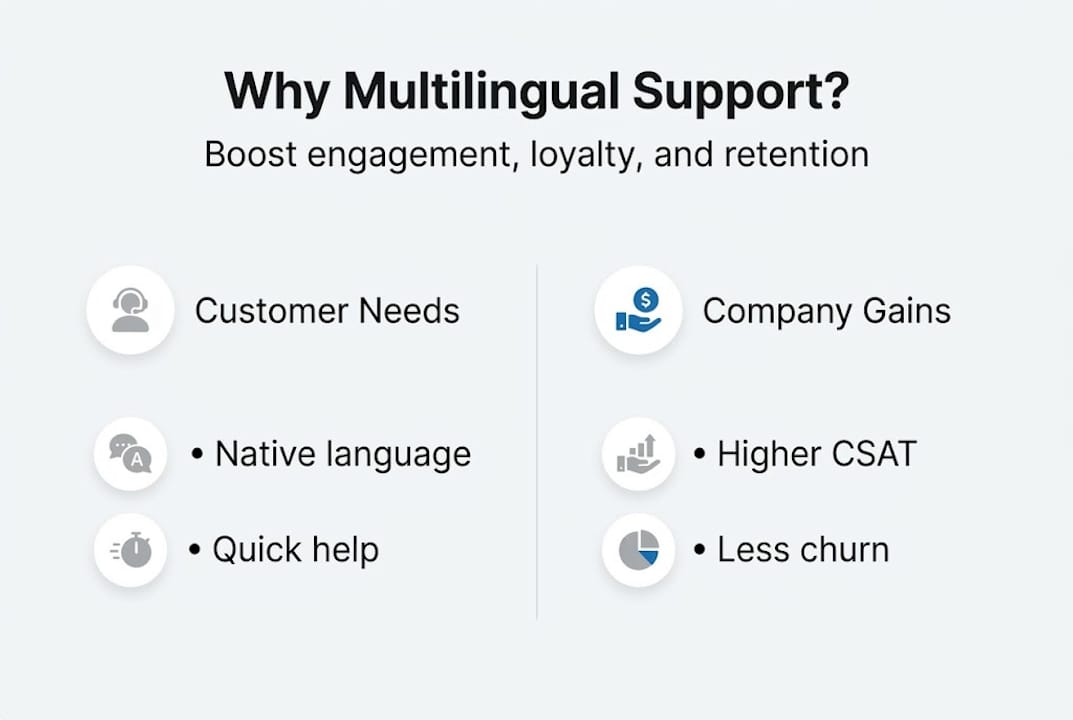
Nearly 70% of global consumers would switch to a competitor if a brand does not support them in their language. That is not a minor inconvenience for customers. It is a dealbreaker. Understanding why multilingual support matters at a strategic level helps you frame the business case internally when pushing for resources.
Here is a sample framework for tracking engagement metrics by language and region:
| Region | Primary language | Monthly tickets | Avg. CSAT | Avg. NPS | Language coverage |
|---|---|---|---|---|---|
| Germany | German | 1,200 | 3.8/5 | 32 | Full |
| France | French | 980 | 3.5/5 | 24 | Partial |
| Poland | Polish | 640 | 3.1/5 | 11 | None |
| Netherlands | Dutch | 510 | 3.3/5 | 18 | Partial |
A table like this makes the gap visible. Poland in this example has zero language coverage and the lowest NPS. That is your first priority.
When prioritizing which languages to support, focus on these signals:
- Regions with high ticket volume and low CSAT scores
- Markets where churn or escalation rates are above your baseline
- Countries where you are actively growing revenue or running campaigns
- Languages where customers frequently switch to English mid-conversation
Once you have a ranked list, resist the urge to tackle everything at once. A focused rollout beats a scattered one every time. Understanding the full multilingual call center process before you scale helps you avoid costly rework later.
Pro Tip: Start with your top two or three languages by ticket volume and low satisfaction score. Nail those before expanding. Spreading too thin too early leads to inconsistent quality across the board.
Building a multilingual support foundation
Once you have identified your critical needs, it is time to lay the groundwork for effective multilingual customer support. This is where most teams either build something durable or create a patchwork that breaks under pressure.

A solid foundation requires four core elements: native-speaking agents, localized knowledge bases, cultural training, and scalable contact infrastructure. Hybrid human-AI models that use chatbots for routine queries and humans for complex issues are now considered best practice, alongside follow-the-sun routing and localized self-service resources.
Here is how the three main setup models compare:
| Factor | In-house | Outsourced | Hybrid |
|---|---|---|---|
| Setup cost | High | Low to medium | Medium |
| Speed to launch | Slow (months) | Fast (weeks) | Moderate |
| Brand control | Full | Shared | High with oversight |
| Language flexibility | Limited | High (15+ languages) | High |
| Scalability | Low | High | High |
Outsourcing and hybrid models consistently outperform in-house setups for speed and language range, especially for teams supporting more than three or four languages.
To set up your multilingual support operation step by step:
- Source native-speaking talent. Whether in-house or through a partner, fluency alone is not enough. Agents need to understand regional dialects, cultural norms, and emotional cues.
- Integrate language technology. Real-time translation tools, multilingual CRM tagging, and AI-assisted routing help agents work faster and more accurately.
- Onboard cultural norms. Train agents on communication styles, formality expectations, and common friction points for each market you serve.
- Build localized knowledge bases. Self-service content in each language reduces ticket volume and improves first-contact resolution.
- Test and refine before scaling. Run a pilot in your highest-priority language before rolling out across all markets.
Exploring proven global support strategies from companies that have already navigated this process can save you significant time during setup.
Pro Tip: Use native reviewers to audit your translated content and build empathy libraries, collections of phrases that reflect how real customers in each market express frustration, satisfaction, or confusion. These make agent responses feel genuinely local, not just translated.
Leveraging outsourcing for scalable engagement
With your foundation in place, consider how strategic outsourcing expands your capabilities without the complexity of direct hiring across multiple countries. The business case is strong. Outsourcing multilingual support reduces costs, delivers 24/7 follow-the-sun coverage, and gives you access to native speakers across dozens of languages without building local teams from scratch.
For support managers dealing with seasonal spikes, new market launches, or rapid headcount growth, this flexibility is hard to replicate internally. You can scale up for a product launch in Germany and scale back after the campaign without the overhead of permanent hires.
Strategic outsourcing is not just a cost decision. It is a capability decision. The right partner brings language depth, cultural fluency, and operational infrastructure that would take years to build internally.
When evaluating outsourcing providers for global support, ask these questions before signing anything:
- Which languages do your agents speak natively, not just conversationally?
- How do you handle quality assurance across different language teams?
- What CRM and ticketing systems can you integrate with?
- How do you report on CSAT, NPS, and resolution rates per language?
- What is your escalation process for sensitive or complex interactions?
- How quickly can you scale up or down based on volume changes?
One area where companies consistently make mistakes is treating all customer touchpoints the same. High-value interactions, such as enterprise renewals, billing disputes, or technical escalations, often benefit from in-house handling where brand voice and relationship continuity matter most. Understanding cost-effective outsourcing methods helps you draw that line intelligently rather than arbitrarily.
The goal is not to outsource everything. It is to outsource the right things to the right partner and keep strategic control where it counts.
Optimizing engagement with AI and data-driven tools
To maximize the impact of your multilingual and outsourced support, leverage data and AI to personalize engagement and scale quality across every market. AI is no longer optional for teams managing multiple languages at volume.
The results from real deployments are striking. Google's AI tools improved customer value by 23.5% and boosted rep satisfaction by 90%. Those are not incremental gains. They represent a fundamental shift in how support teams operate when AI is integrated thoughtfully.
Here is a step-by-step approach for deploying a hybrid AI-human support model:
- Select tools that support multilingual input. Not all AI chatbots handle non-English languages equally. Prioritize platforms trained on diverse language data.
- Train your AI with localized data. Generic training sets produce generic responses. Feed your AI real ticket data from each language market to improve accuracy and tone.
- Define clear escalation triggers. Set rules for when AI hands off to a human agent, such as negative sentiment detection, billing issues, or repeated contact.
- Monitor performance by language. CSAT and resolution rates can vary significantly between language markets even with the same AI model.
- Refine continuously. Update knowledge bases and self-service content quarterly based on ticket trends and customer feedback.
Integrating CRM systems for multilingual support creates a unified view of each customer across languages and channels, which is essential for personalization at scale.
Pro Tip: Track CSAT and NPS separately for each language market, not just globally. A strong overall score can mask serious underperformance in one region. Language-level data is where the real insights live.
The uncomfortable truth about customer engagement strategies
After nearly 20 years of working with international companies on multilingual support, we have seen the same pattern repeat. A company invests in the right tools, hires a capable outsourcing partner, and builds what looks like a solid engagement program. Six months later, scores plateau or dip. The culprit is almost always the same: technology without enough human or cultural nuance.
Metrics obsession is a real trap. Teams that optimize relentlessly for CSAT and NPS scores can lose sight of what those numbers actually represent. A customer who rates you a 4 out of 5 may still be quietly frustrated by a response that felt translated rather than understood. That friction does not always show up in the numbers until it is too late.
Real engagement comes from blending operational efficiency with genuine local empathy. That means investing in cultural training, not just language training. It means listening to what customers say between the lines, not just what they score on a survey. And it means treating your outsourcing partner as an extension of your team, not a vendor you check in with quarterly.
The comparison between outsourced vs. in-house support is often framed as a cost question. The smarter question is: which model gives us the most consistent, culturally intelligent engagement at scale? Regular audits, local feedback loops, and hands-on ownership of the customer experience are what separate programs that grow from those that stagnate.
Scale global engagement with expert support
If you are ready to elevate customer engagement while reducing operational complexity, CallTech Outsourcing has been helping international companies do exactly that since 2005. We provide native-speaking agents across more than 15 European languages, with the infrastructure, CRM integration, and quality processes to support your customers at every touchpoint.

Whether you need to launch outsourcing call center services in a new market, strengthen multilingual support for global businesses, or streamline support workflow across your existing operations, we can build a solution that fits your scale and budget. Talk to our team and get personalized recommendations for your markets and languages.
Frequently asked questions
What are the most critical languages to support for global customer engagement?
Start with the top two or three languages based on your customer data, specifically traffic volume, ticket count, and regions where CSAT and NPS scores are lowest. Those gaps signal where language barriers are actively hurting retention.
How does outsourcing improve customer engagement?
Outsourcing gives you access to native speakers and 24/7 coverage through a follow-the-sun model, along with cost savings and the flexibility to scale quickly without building local teams from scratch.
Can AI really boost customer engagement in multilingual support?
Yes. When deployed correctly, AI tools have improved customer value by over 23% and rep satisfaction significantly, but human oversight remains essential for handling complex or emotionally sensitive interactions.
What is a 'follow-the-sun' support model?
It is a global staffing strategy where support shifts across time zones continuously, ensuring customers receive live assistance at any hour without requiring overnight shifts from a single location.
How do you measure engagement improvements after deploying multilingual support?
Track CSAT, NPS, and retention rates separately for each language and region. Comparing pre- and post-deployment scores at the language level gives you the clearest picture of where multilingual support is driving real impact.