

TL;DR:
- Dedicated support agents provide deeper product knowledge, cultural fluency, and brand consistency.
- They achieve higher first-contact resolution, reduce churn, and offer up to 70% cost savings.
- Scaling internationally requires standardizing processes, localizing content, and integrating CRM systems.
Most companies assume that adding more agents to a support queue solves their international growth problems. It rarely does. Specialized multilingual dedicated agents consistently outperform general staff on NPS and first-contact resolution rates, yet most support leaders still rely on shared pools to cover new markets. The result is a painful gap between the support experience customers expect and what they actually receive. This article breaks down what dedicated support agents actually are, why they matter for telecom, SaaS, and e-commerce companies operating across languages, and how you can build, select, and scale dedicated teams that deliver measurable results.
Table of Contents
- What are dedicated support agents?
- Benefits of dedicated agents for multilingual support
- Selecting the right dedicated support agents: skills and qualities
- Integrating and scaling dedicated support teams for global growth
- Our perspective: Why dedicated support is essential (and what most overlook)
- How CallTech can help you unlock dedicated customer support
- Frequently asked questions
Key Takeaways
| Point | Details |
|---|---|
| Higher customer satisfaction | Dedicated agents consistently drive better resolution rates and customer experiences. |
| Cultural and language fluency | Specialized agents are vital for multilingual and regionally diverse markets. |
| Efficient global scaling | Integrating dedicated support teams with smart tools enables cost-effective international growth. |
| Strategic hiring matters | Selecting agents for empathy and technical skill is key to support success. |
What are dedicated support agents?
A dedicated support agent is fully assigned to your business, your products, and your customer base. That is the core difference from a shared agent model, where the same person handles tickets for five different clients before lunch. With dedicated agents, there is no context switching, no warm-up time on every call, and no confusion about which brand's policies apply.
Shared agent pools work fine for low-volume or highly transactional interactions. But for companies in telecom, SaaS, or e-commerce operating across multiple countries and languages, shared resources create friction that compounds over time. An agent jumping between brands cannot develop genuine product familiarity, cultural awareness, or the kind of conversational fluency that makes customers feel understood.
Dedicated agents, by contrast, become true extensions of your team. They learn your escalation paths, recognize recurring customer pain points, and build the instincts needed to resolve issues efficiently. The payoff is measurable: customer-focused teams deliver 32% faster resolution than general support pools.
Here is what dedicated agents actually handle in multilingual environments:
- Language coverage: Communicating fluently in the customer's native language, not just functionally
- Product expertise: Building genuine knowledge of your service, pricing tiers, and technical architecture
- Cultural context: Recognizing regional norms around directness, complaint expression, and service expectations
- Brand voice consistency: Applying your tone and messaging rules the same way in German as in English
- Customer history familiarity: Recognizing patterns and personas over time, not starting from zero on every contact
"Dedicated agents are not just a staffing choice. They are a strategic decision about how deeply you want to understand and serve your customer base across markets."
A common misconception is that any trained agent can cover any language or market with a quick briefing. The reality is that language proficiency is the baseline, not the ceiling. Cultural fluency, product depth, and brand alignment are what separate average support from genuinely effective multilingual service. If you want a thorough overview of how this applies operationally, the help desk outsourcing guide covers the structural mechanics in detail.
Benefits of dedicated agents for multilingual support
Once you distinguish dedicated agents from shared resources, the operational value becomes concrete and quantifiable. The benefits stack across three dimensions: customer experience, internal efficiency, and long-term cost structure.
Start with first-contact resolution (FCR). When agents know your product inside out and speak the customer's language without hesitation, they close more cases on the first attempt. Fewer escalations, fewer callbacks, fewer frustrated customers leaving reviews. FCR improvements translate directly into reduced support costs and higher retention.
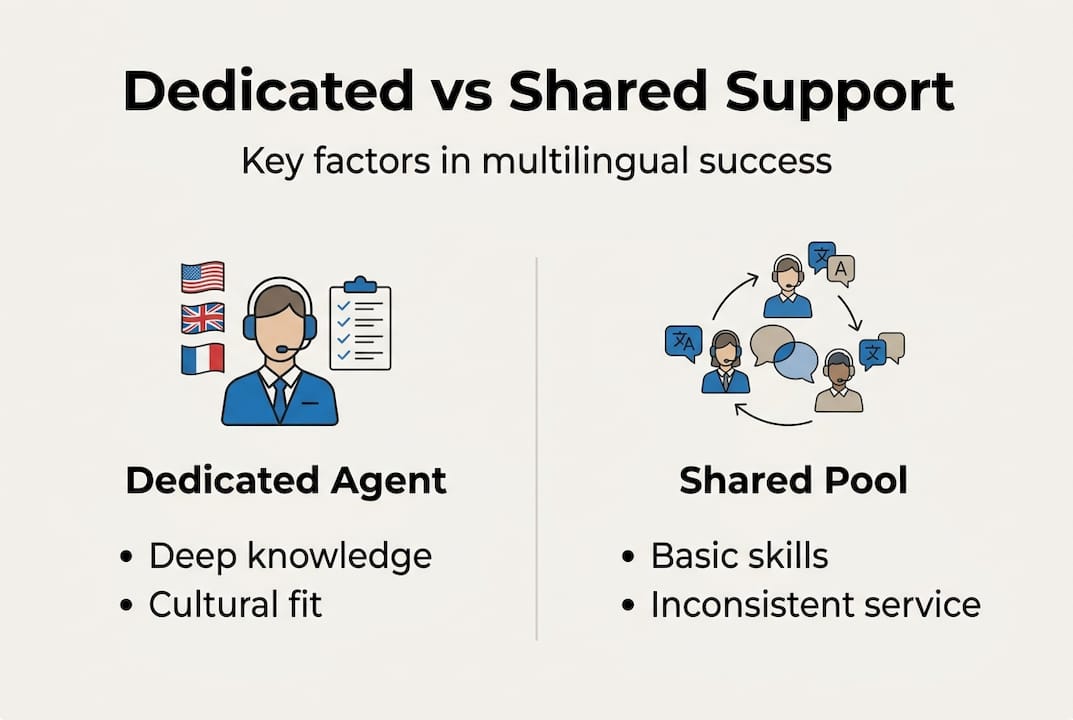
Consistency across languages is the second major win. A shared agent rotating between accounts cannot maintain your brand voice in French, Polish, and Dutch simultaneously. A dedicated multilingual team, trained together and aligned on your standards, delivers the same experience regardless of the language channel. That consistency matters enormously in regulated industries like telecom and SaaS, where compliance language and customer communications must meet specific standards.
Cultural fluency is harder to measure but equally important. A Dutch customer who feels dismissed because an agent used the wrong level of formality may not complain. They simply churn. Dedicated agents, embedded in your customer's regional context, catch these nuances before they become retention problems.
On cost, the numbers challenge the conventional assumption that dedicated teams are a premium you can skip:
| Support model | Cost per resolution | FCR rate | Customer churn risk |
|---|---|---|---|
| Shared agent pool | Low upfront | 55-65% | High |
| Freelance/transactional | Variable | 50-60% | Very high |
| Dedicated multilingual team | Moderate upfront | 75-85% | Low |
Businesses report up to 70% cost savings and increased customer engagement when leveraging specialized multilingual teams with the right CRM setup.
Here are the top benefits in ranked order:
- Higher first-contact resolution rates, reducing repeat contacts
- Consistent brand voice across all language markets
- Stronger cultural alignment, reducing silent churn
- Lower total cost of service when viewed across the customer lifecycle
- Faster onboarding of new language markets through replicable processes
Pro Tip: When evaluating outsourcing providers for global support, ask specifically how agents are assigned. "Multilingual capability" and "dedicated multilingual agents" are not the same thing. Push for clarity on exclusivity.
For companies using CRM for multilingual support, the efficiency gains compound when agents who know your customers also have full visibility into their interaction history across every channel.

Selecting the right dedicated support agents: skills and qualities
Knowing you need dedicated agents is one thing. Knowing what to look for when building or sourcing that team is another.
Top-performing companies rank communication skills, troubleshooting expertise, and adaptability as the most vital agent attributes. But what does that actually mean in a hiring or vendor selection context?
Start with these core attributes:
- Native or C1-level language proficiency: Functional language is not enough for nuanced customer conversations
- Domain familiarity: Candidates with background in telecom, SaaS, or e-commerce environments ramp faster and ask better questions
- Empathy and active listening: These are trainable but easier to screen for early using scenario-based interviews
- Adaptability: Products change. Policies change. Markets change. Agents who learn quickly protect your quality during transitions
- Technical aptitude: Basic CRM navigation, ticketing systems, and communication tools are non-negotiable minimums
When screening candidates or vetting outsourcing partners, use real-world scenarios rather than hypotheticals. Give an agent a mock billing dispute in their target language and watch how they handle ambiguity. That tells you more than any resume.
Cultural fit and ongoing learning are where most companies underinvest. An agent hired for their German fluency who has never interacted with German-speaking customers in a service context will miss cues that experienced agents catch instantly.
Here is a direct comparison to clarify your options:
| Attribute | Dedicated agent | Transactional/freelance agent |
|---|---|---|
| Product knowledge depth | High | Low |
| Brand voice consistency | High | Inconsistent |
| Cultural alignment | Developed over time | Minimal |
| Ramp-up investment | Moderate | Low |
| Long-term value | High | Limited |
For teams managing customer service outsourcing tools, agent selection should factor in tool proficiency as well. An agent who struggles with your CRM creates process bottlenecks that undermine every other quality metric.
If cost is a concern, know that reducing support costs does not require sacrificing agent quality. The right outsourcing model structures dedicated teams in a way that keeps unit economics competitive without compromising expertise.
Integrating and scaling dedicated support teams for global growth
Building a strong dedicated team is only half the challenge. The other half is integrating them into your operations and scaling without losing the quality that made them valuable in the first place.
Companies that standardize support processes see 35% faster ramp-up for new markets. That statistic reflects a practical truth: the more documented and repeatable your support model is, the easier it is to replicate across languages, time zones, and customer segments.
Here is a practical sequence for scaling dedicated support internationally:
- Document core workflows first: Before adding markets, codify your escalation paths, response templates, and resolution standards
- Align CRM access and data permissions: Agents in new regions need the same visibility into customer history as your existing team
- Build language-specific knowledge bases: Generic FAQ documents do not account for regional product variations or regulatory requirements
- Run parallel quality checks during onboarding: New agents should shadow experienced ones before going live independently
- Set market-specific KPIs: Resolution times and satisfaction benchmarks vary by region. Measure accordingly
- Review and iterate monthly: Markets evolve, and your processes need to keep pace
Pro Tip: The most common mistake in scaling support internationally is copying domestic processes wholesale into new markets without localizing for regional customer behavior. Take the time to adapt, not just translate.
Tech integration is the backbone of sustainable scaling. CRM systems that unify customer data across channels give dedicated agents the context they need to deliver consistent service at volume. Automation handles the repetitive layer, freeing agents for complex, high-value interactions. For a detailed framework on streamlining support workflow across global teams, the operational steps map directly to what leadership needs to implement.
For companies exploring outsourcing for scalability, the outsourcing model adds an additional layer of flexibility. You can scale headcount up or down by market demand without the overhead of managing direct hires across multiple countries.
Our perspective: Why dedicated support is essential (and what most overlook)
After nearly 20 years of working with telecom, SaaS, and e-commerce companies across European markets, we have seen one pattern repeat itself consistently. Companies treat dedicated support as a cost upgrade instead of recognizing it as the structural foundation of sustainable growth.
The conventional wisdom says: cover the language, hit your SLAs, and you are compliant. That thinking is outdated. Today's customers do not compare you to your competitor's support team. They compare you to every excellent service experience they have ever had. That bar is rising every year.
Brands that cut corners with shared agent pools often see it in their NPS scores before they see it in their churn data. By the time the numbers surface, the damage is already done. Trust erodes quietly.
The fastest-growing global companies invest in dedicated support teams, not just language skills. The distinction matters. Language is a prerequisite. Dedication, alignment, and expertise are what produce the outcomes that compound.
If you are serious about international growth, dedicated support is not a line item to optimize away. It is the mechanism through which your brand promise reaches customers in every market you serve. Global support partnerships built on this principle consistently outperform those built on cost minimization alone.
How CallTech can help you unlock dedicated customer support
If the frameworks above resonate, the next step is straightforward: find a partner who already operates this way at scale.

CallTech Outsourcing has delivered dedicated multilingual support across telecom, SaaS, and e-commerce for nearly 20 years. Our agents are fully assigned to your account, trained on your products, and aligned with your brand voice across more than 15 European languages. We handle onboarding, CRM integration, and quality management so your team can focus on growth rather than support logistics. Whether you are exploring outsourcing call center services for the first time or looking to upgrade your existing model, our multilingual engagement solutions are built to scale with you. Review our customer support strategies to see how we approach global growth.
Frequently asked questions
How do dedicated support agents differ from shared agents?
Dedicated support agents focus exclusively on your business, building deeper product knowledge and cultural alignment than shared or pooled resources ever can. Dedicated teams outperform shared models on both NPS and first-contact resolution.
What should I look for when hiring dedicated multilingual agents?
Prioritize communication skills, product domain familiarity, adaptability, and cultural fluency during recruiting and onboarding. Top-performing companies treat cultural fit as a competitive advantage, not a secondary consideration.
Are dedicated agents more expensive than shared agents?
The upfront investment is often higher, but well-managed dedicated teams drive efficiency and retention gains that more than offset the cost. Businesses report up to 70% savings when specialized teams are paired with the right technology.
How can I scale my dedicated support operation internationally?
Standardize your core workflows, integrate CRM tools across regions, and localize your knowledge bases before expanding. Streamlined workflows enable rapid, consistent scaling into new markets without sacrificing quality.