

Managing multilingual customer support and back-office operations in-house drains budgets and limits growth for mid-sized tech companies. Rising labor costs, complex hiring across languages, and infrastructure overhead create bottlenecks that slow market expansion. Strategic outsourcing delivers immediate cost relief while enabling rapid scaling across international markets. This guide reveals proven methods to achieve 45-60% cost savings through smart vendor selection, hybrid AI-human models, and location-based strategies that maintain quality while cutting expenses. You'll learn how to assess functions for outsourcing, select vendors using clear performance metrics, and implement scalable solutions that grow with your business.
Table of Contents
- Key takeaways
- Understanding cost-effective outsourcing options
- Preparing for successful outsourcing: assessment and vendor selection
- Executing and scaling cost-effective multilingual outsourcing
- Verifying success and optimizing your outsourcing strategy
Key Takeaways
| Point | Details |
|---|---|
| Cost savings potential | Outsourcing back office and multilingual support can deliver roughly forty five to sixty percent cost savings versus in house operations. |
| Hybrid AI human models | Hybrid AI human models enable scalable multilingual support while maintaining quality. |
| Location based strategies | Nearshore and offshore outsourcing provide strong multilingual coverage while reducing overall costs. |
| Clear SLAs and KPIs | Vendor contracts should specify SLAs and KPIs to govern performance and mitigate security and quality risks. |
| Stepwise implementation | Adopt a stepwise approach by assessing functions, piloting with limited scope, and monitoring results to ensure outsourcing success. |
Understanding cost-effective outsourcing options
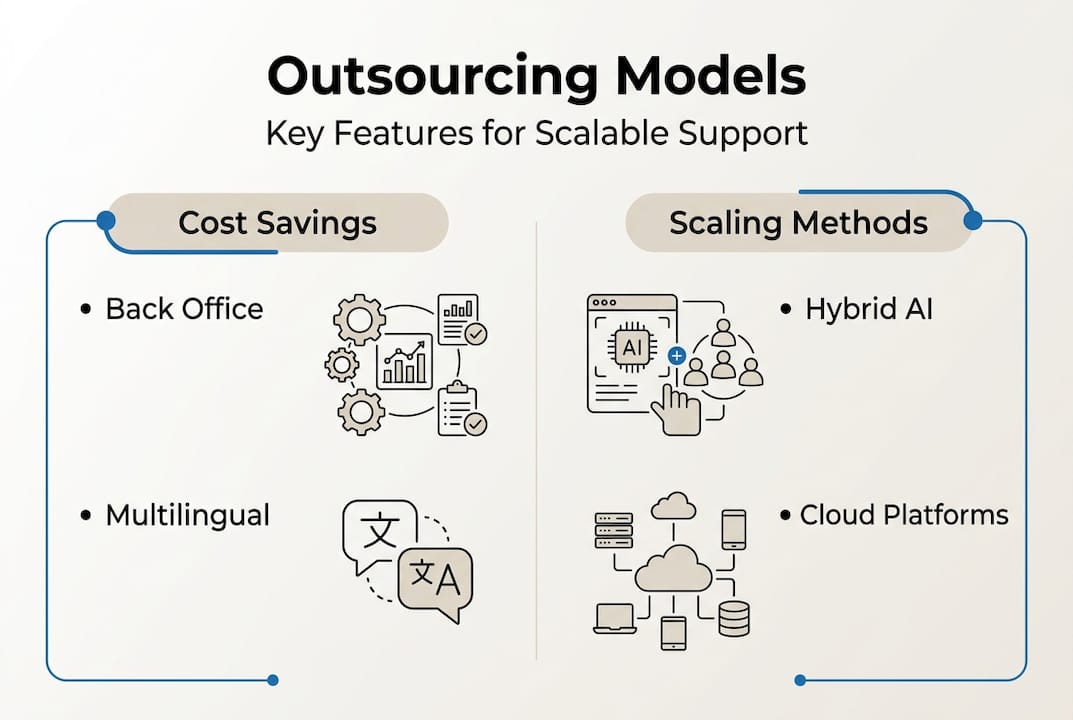
Back-office outsourcing transfers non-customer-facing operations like accounting, data entry, and data management to external providers. Multilingual customer support outsourcing moves contact center functions including technical support, billing inquiries, and customer care to specialized teams. Both approaches target the same goal: reducing fixed costs while maintaining or improving service quality.
The financial impact proves substantial. Back-office outsourcing achieves 45-60% savings, dropping hourly rates from $45 for US-based staff to approximately $15 for outsourced teams. Contact centers see similar reductions, with non-voice BPO averaging 45% cost cuts compared to internal operations.
| Function | In-House Cost (Annual) | Outsourced Cost (Annual) | Savings |
|---|---|---|---|
| Accounting/Bookkeeping | $65,000 | $22,000 | 66% |
| Data Entry Team (3 FTE) | $135,000 | $54,000 | 60% |
| Customer Support (5 agents) | $225,000 | $90,000 | 60% |
| Technical Support (multilingual) | $280,000 | $126,000 | 55% |
Back-office processes that benefit most from outsourcing include:
- Accounts payable and receivable processing
- Payroll administration and tax filing
- Data entry and database management
- Document processing and digitization
- Inventory tracking and order fulfillment support
Multilingual call center outsourcing through outsourcing call center services provides additional advantages beyond cost reduction. Teams operate across time zones, delivering 24/7 coverage without night-shift premiums. Language capabilities expand instantly, supporting customer bases in 10-15 languages without recruiting specialized staff. Infrastructure costs disappear as vendors provide VOIP systems, CRM platforms, and quality monitoring tools.
Pro Tip: Calculate true outsourcing costs by adding vendor management time, transition expenses, and knowledge transfer overhead to quoted rates. This realistic assessment prevents budget surprises and helps you compare options accurately.
Preparing for successful outsourcing: assessment and vendor selection
Successful outsourcing starts with systematic preparation that identifies the right functions, selects qualified vendors, and establishes performance frameworks. Follow this proven four-step process:
- Assess which functions to outsource by analyzing cost, complexity, and strategic value
- Select vendors using service level agreements and performance metrics
- Launch pilot projects with limited scope to validate capabilities
- Monitor performance continuously using established KPIs
Vendor selection determines outsourcing success or failure. Service level agreements (SLAs) must specify response times, quality thresholds, security protocols, and escalation procedures. Key performance indicators (KPIs) should measure first-call resolution rates, customer satisfaction scores, average handle time, and compliance adherence. These metrics create accountability and provide early warning signals when performance slips.
Common outsourcing risks threaten both cost savings and service quality:
- Data breaches exposing customer information
- Vendor lock-in limiting flexibility
- Quality decline as vendors cut corners
- Communication gaps causing misalignment
- Hidden costs eroding projected savings
Effective risk mitigation requires multiple layers of protection:
- Regular security audits and compliance checks
- Hybrid AI-human models balancing efficiency with quality
- Clear exit clauses preventing vendor dependency
- Documented processes ensuring knowledge retention
- Weekly performance reviews catching issues early
"Without strong vendor governance frameworks, outsourcing partnerships drift toward quality decline and cost overruns. Establish clear SLAs, monitor KPIs weekly, and maintain direct communication channels with offshore teams to preserve service standards while capturing cost benefits."
Strategic location choices amplify multilingual capabilities. Nearshore options like Portugal offer European language expertise, cultural alignment, and manageable time zone differences for companies serving EU markets. Offshore locations including the Philippines and Latin America provide cost advantages, 24/7 coverage, and strong English proficiency alongside regional languages.
Location selection depends on your specific requirements. European markets benefit from nearshore partnerships that simplify travel, align business hours, and navigate GDPR compliance naturally. Global operations gain from offshore hubs delivering round-the-clock support at lower rates. Many companies blend both approaches, using nearshore teams for complex escalations and offshore centers for high-volume tier-one support.
Applying lessons from outsourcing telecom support reveals that technical capability matters as much as cost. Evaluate vendors on their technology stack, training programs, quality assurance processes, and client retention rates. Request case studies from similar industries and speak directly with current clients about their experience.
Executing and scaling cost-effective multilingual outsourcing
Implementation strategy determines whether outsourcing delivers promised benefits or creates new problems. Start with pilot projects that test vendor capabilities without risking core operations. Define clear scope boundaries, establish success metrics, and set a 60-90 day evaluation period. This approach validates performance before committing to full-scale transitions.
Hybrid AI-human models revolutionize multilingual support economics. Artificial intelligence handles routine inquiries like password resets, order status checks, and basic troubleshooting across multiple languages simultaneously. Human agents focus on complex cases requiring judgment, empathy, and problem-solving. This division maximizes efficiency while maintaining quality standards.

| Approach | Cost per Interaction | Scalability | Quality Score | Best Use Case |
|---|---|---|---|---|
| Fully Human | $6-8 | Limited by hiring | 85-90% | Complex B2B support |
| Hybrid AI-Human | $2-4 | Highly scalable | 80-88% | Mixed complexity volumes |
| Fully AI | $0.50-1 | Unlimited | 65-75% | Simple, repetitive queries |
Real-world scaling examples demonstrate hybrid model effectiveness. An e-commerce company managing 13 languages processed 35,000 tickets weekly using AI for initial triage and routing, with human agents handling 30% of interactions requiring personalized responses. This structure maintained 87% customer satisfaction while reducing per-ticket costs by 52%.
Multilingual support strategies through multilingual call center processes require careful language pairing and cultural training. Group languages by regional similarity to optimize agent utilization. Spanish and Portuguese agents often handle both languages effectively. Germanic language speakers (German, Dutch, Swedish) share enough commonality for efficient cross-training. Slavic languages benefit from similar grouping strategies.
Execution steps for scaling multilingual operations:
- Map current ticket volume by language and complexity
- Identify which languages justify dedicated agents vs. on-demand coverage
- Implement AI translation for low-volume languages
- Train hybrid teams on escalation protocols
- Monitor quality scores by language to catch training gaps
Savings compound as operations mature. Personio reduced translation costs by 40% implementing neural machine translation within their outsourced content operations. Initial translations happen automatically, with human linguists reviewing only customer-facing materials and complex technical documentation. This tiered approach maintains accuracy while slashing costs.
Pro Tip: Build continuous feedback loops between your product team and outsourced support agents. Frontline teams spot usability issues, common confusion points, and feature requests that internal teams miss. Monthly feedback sessions turn support costs into product intelligence investments.
Scaling requires infrastructure that grows with demand. Cloud-based contact center platforms eliminate capacity constraints, adding agent seats in hours rather than weeks. CRM integration ensures outsourced teams access the same customer data as internal staff, preventing the disconnected experience that frustrates customers. Quality monitoring tools provide real-time coaching opportunities, maintaining standards as teams expand.
Verifying success and optimizing your outsourcing strategy
Performance measurement separates successful outsourcing from expensive mistakes. Track these critical indicators monthly:
- Cost per ticket compared to baseline
- Customer satisfaction scores by channel and language
- First-contact resolution rates
- Average handle time trends
- Compliance audit results
- Agent attrition rates at vendor
Common pitfalls derail even well-planned outsourcing initiatives. Failure to monitor vendor performance allows quality erosion. Poor communication creates misalignment between business goals and daily operations. Scope creep adds services without adjusting budgets or SLAs. Each issue compounds over time, eventually eliminating cost advantages.
Optimization requires systematic improvement cycles:
- Conduct quarterly business reviews analyzing all KPIs and trends
- Perform random quality audits beyond vendor self-reporting
- Adjust processes based on customer feedback and agent input
- Renegotiate SLAs annually to reflect changing needs
- Benchmark performance against industry standards
- Test new technologies like AI assistants in controlled pilots
Exit clauses preserve flexibility as business needs evolve. Contracts should specify termination procedures, knowledge transfer requirements, and data return protocols. This protection prevents vendor lock-in that forces you to accept declining service or inflated pricing. Even excellent partnerships benefit from clear exit terms that keep relationships balanced.
Continuous improvement depends on feedback loops connecting decision-makers, vendors, and internal teams. Monthly steering committee meetings review performance data, discuss challenges, and align on priorities. Weekly operational calls between team leads address immediate issues before they impact customers. Quarterly strategy sessions explore new capabilities, market changes, and optimization opportunities.
Vendor partnerships mature through stages. Initial implementations focus on process transfer and quality stabilization. Mature relationships shift toward innovation, with vendors proposing improvements based on their cross-client experience. The best partnerships feel collaborative rather than transactional, with both sides invested in long-term success.
Regular audits catch issues early. Security reviews verify data handling practices match contractual obligations. Quality audits sample interactions across agents, languages, and complexity levels. Compliance checks ensure adherence to industry regulations like GDPR, PCI-DSS, or HIPAA depending on your sector. These verification steps protect your brand while confirming that cost savings don't come at the expense of standards.
Insights from outsourcing strategy resources reveal that top performers treat vendors as extensions of their team rather than separate entities. They share product roadmaps, involve outsourced managers in planning discussions, and celebrate successes together. This integration builds institutional knowledge and reduces the