

TL;DR:
- Multilingual call centers enhance data accuracy and depth through native speakers and cultural understanding.
- Combining human probing with AI improves reliability and compliance in global market research.
- Selecting experienced, compliant partners with proven quotas and research focus ensures high-quality international insights.
Online surveys seem like the obvious choice for global market research. They're fast, scalable, and cheap. But if you're running research across multiple countries and languages, relying on online surveys alone is a significant blind spot. Low response rates, cultural misinterpretation, and rampant fraud can quietly corrupt your data before you even realize it. Multilingual call center solutions, specifically CATI (computer-assisted telephone interviewing), fill these critical gaps by putting trained human interviewers in front of respondents in their native language, in their cultural context, with the skills to probe for meaning.
Table of Contents
- Why multilingual call centers matter for international market research
- CATI versus online surveys: Benefits of call centers for data quality
- Combining human skills and AI: The modern multilingual call center
- Choosing the right call center partner: Criteria for global market research success
- Our perspective: Why empathy, not just efficiency, sets leaders apart
- Advance your research with proven multilingual call center solutions
- Frequently asked questions
Key Takeaways
| Point | Details |
|---|---|
| Multilingual CATI advantage | Human-led, multilingual call centers produce higher quality data for global surveys than online methods alone. |
| AI plus empathy wins | The most effective market research blends advanced AI with human empathy for accurate, nuanced insights. |
| Vetting your partner | Always choose call center partners with proven multilingual talent, compliance record, and global experience. |
| Cultural context matters | Understanding local languages and customs is key to capturing honest, actionable customer insights in international research. |
Why multilingual call centers matter for international market research
Global market research is not simply a translation problem. It's a representation problem, a trust problem, and a cultural fluency problem all at once. When respondents answer surveys in a second language, they often default to simpler, less nuanced answers. They underreport sensitive topics. They interpret questions differently based on local context. You end up with data that looks clean but reflects language limitations, not actual consumer reality.
Multilingual call centers solve this at the source. When a native German speaker interviews a respondent in Berlin, or a Polish-speaking agent conducts a survey in Warsaw, the interaction changes entirely. Respondents open up. They clarify. They elaborate. That's the kind of depth you simply cannot replicate with a digital form.
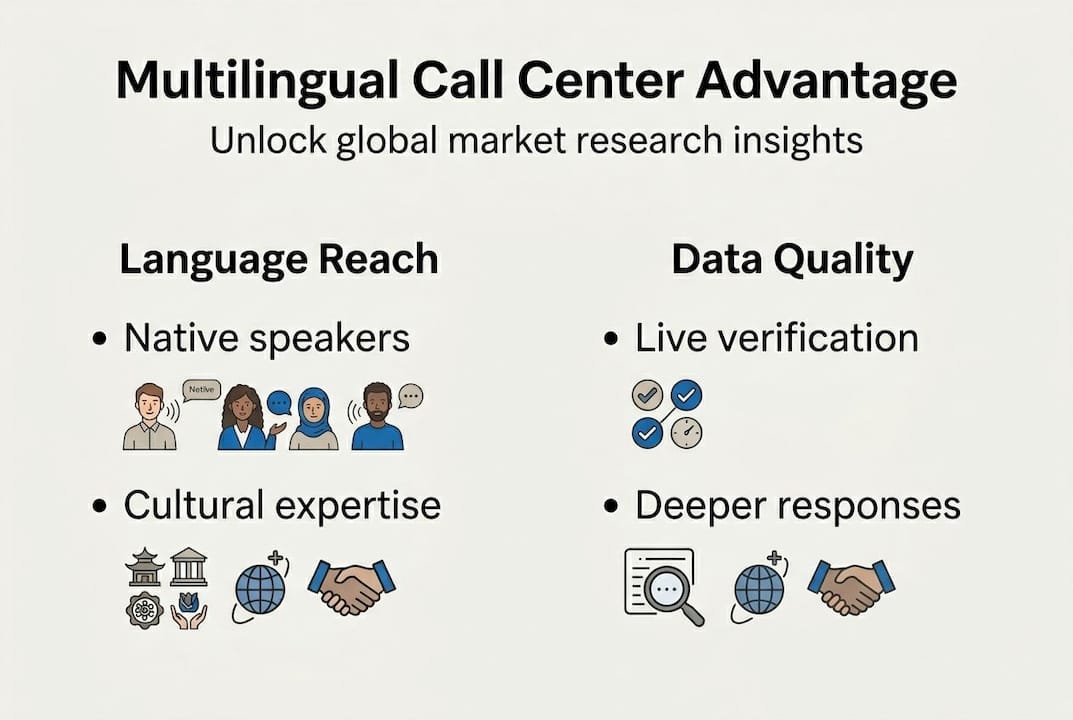
Beyond language, there's the question of cultural sensitivity. A question phrased perfectly in American English might carry a completely different connotation in a Portuguese or Romanian context. Dedicated multilingual agents trained in regional norms don't just translate words, they translate intent, which protects the integrity of your research design.
There's also the regulatory layer. Data collection across European markets means navigating GDPR, local telecommunications laws, and varying consent requirements. A reliable multilingual call center process should already have compliance frameworks built in, not bolted on as an afterthought.
Here's what multilingual call centers bring to international research:
- Native language interviewing that increases respondent engagement and response accuracy
- Cultural context awareness that prevents question misinterpretation
- Regulatory compliance across multiple jurisdictions simultaneously
- Human probing capability that surfaces insights beyond the scripted question
- Fraud reduction through real-time verification during live interviews
As the survey methodologies guide from Tremendous confirms, reliable multilingual CATI call centers enable global market research by combining human probing with AI efficiency. That combination is what separates usable data from misleading data.
Pro Tip: When evaluating outsourcing call center services for research, ask specifically about their multilingual quota management and agent calibration process. Partners who can't demonstrate this clearly are likely to produce inconsistent data across markets.
CATI versus online surveys: Benefits of call centers for data quality
The online survey versus CATI debate is often framed as old versus new. That framing misses the point. The real question is: which method produces the most reliable data for your specific research context?
For regulated industries, hard-to-reach populations, or research where data quality is non-negotiable, CATI wins consistently. Here's a direct comparison:
| Factor | CATI (phone interview) | Online survey |
|---|---|---|
| Fraud risk | Low (live verification) | High (bots, duplicate entries) |
| Depth of response | High (probing possible) | Low to moderate |
| Hard-to-reach groups | Excellent | Poor |
| Respondent representation | Strong with quotas | Often skewed to online-savvy |
| Cost per interview | Higher | Lower |
| Speed at scale | Moderate | Fast |
| Cultural nuance | High (trained agents) | Low |
Online surveys are fast and cheap, but those advantages disappear when you factor in data cleaning costs, low completion rates, and the hidden cost of acting on bad research. According to telephone market research analysis, CATI reduces fraud compared to online methods and outperforms for depth and representation, though it remains critical in specific scenarios where telephone reach is essential.
There's another angle worth considering. Online surveys inherently exclude populations that are less digitally active: older adults, rural communities, lower-income demographics. If your research claims to represent a full market but your method systematically excludes a segment of that market, your findings are flawed from the start.
"Human interviewers don't just collect answers. They build momentary trust, navigate confusion, and unlock the kind of candid responses that drive real business decisions. No algorithm replicates that in real time."
CATI also enables branching conversations. If a respondent gives an unexpected answer, a skilled interviewer can follow that thread. An online form cannot. The best call center services for research are designed around this probing capability, with agents trained specifically to explore rather than just record.
For global research managers, the bottom line is simple: use online surveys where scale and speed matter most, and use CATI where data quality and representation are the priority. In most international research projects, both have a role. But CATI is the anchor.
Combining human skills and AI: The modern multilingual call center
The modern CATI environment is not a room full of agents reading from paper scripts. It's a hybrid operation where technology handles the repetitive, compliance-heavy tasks while trained human interviewers focus on engagement, rapport, and nuanced response capture.

Here's how AI and human roles divide in practice:
| Task | AI handles | Human handles |
|---|---|---|
| Call routing and scheduling | Yes | No |
| Compliance monitoring | Yes | Oversight |
| Script delivery and branching | Yes (CATI system) | Guided |
| Probing follow-up questions | No | Yes |
| Emotional tone reading | No | Yes |
| Fraud detection during call | Supported | Final judgment |
| Language and cultural context | No | Yes |
As telephone market research analysis notes, AI augments the process, but humans remain essential for nuance and empathy in survey interviews. This is especially true in multilingual contexts where a slight tonal shift or regional phrase can change the meaning of a response entirely.
Building a high-performing hybrid CATI team for international research requires a structured approach:
- Define language and regional requirements before recruiting agents, not after
- Train agents on both the survey instrument and the cultural context of each target market
- Implement AI-assisted call routing to match agents to respondent profiles efficiently
- Run regular calibration sessions where agents listen to recordings and align on interpretation standards
- Integrate CRM and data tools for real-time quality checks and supervisor oversight
- Review AI-flagged anomalies with human supervisors to catch edge cases before they skew results
Pro Tip: Don't assume your call center partner's AI tools are current. Ask about their update cycle and how they incorporate new compliance requirements. Outdated AI in a live research environment creates more problems than it solves. Reviewing contact center best practices and workflow optimization frameworks before you sign a contract will save significant headaches later.
Choosing the right call center partner: Criteria for global market research success
Not every call center that claims multilingual capability is built for international research. Customer service multilingualism and research-grade multilingualism are different skill sets entirely. One handles routine queries. The other must maintain methodological consistency across languages, cultures, and compliance frameworks simultaneously.
When vetting partners, these criteria are non-negotiable:
- Proven language coverage: Can they demonstrate native speaker capacity in each required language, not just translation-level fluency? Ask for sample recordings if needed.
- Respondent quota management: Do they have a system for ensuring representative samples across age, gender, region, and income level within each market?
- Data privacy compliance: Are they GDPR-ready, and can they provide documentation of local compliance practices in each target country?
- Scalability without quality loss: Can they ramp up for a large project wave while maintaining the same agent calibration standards?
- Technology integration: Do their CATI platforms integrate with your data analysis tools, and what does their quality assurance process look like?
- Sector experience: Have they delivered research projects in your industry vertical before? Generic BPO experience is not the same as research-specific expertise.
As the survey methodologies guide outlines, establishing proven quotas, advanced training, and compliance infrastructure is foundational to generating high-quality international insights. Partners who cannot demonstrate all three are a liability, not an asset.
Understanding why global businesses need multilingual support at the research level is the first step. The second is applying the same rigor to partner selection that you apply to your research design itself. Your global customer support strategies should inform how you evaluate operational partners, since the same standards of consistency and cultural fluency apply.
Pro Tip: Always ask for case studies from international research projects, not just customer service work. If a potential partner cannot show you research-specific examples with measurable outcomes, that's a signal to keep looking.
Our perspective: Why empathy, not just efficiency, sets leaders apart
After nearly 20 years of supporting multilingual research and customer engagement projects, we've seen the same pattern repeat. Companies invest heavily in technology, build sophisticated survey instruments, and then watch the quality of their international data fall short. The culprit is almost always the same: a gap in empathy at the point of contact.
We worked with a client expanding into three new European markets. Their online survey results showed lukewarm sentiment across all three. When we ran CATI alongside it, trained native-speaking agents surfaced a completely different picture in one market: strong purchase intent masked by cultural reluctance to express enthusiasm to a screen. That insight changed their go-to-market strategy entirely.
Conventional wisdom says scale and efficiency are the goals. We think the real goal is depth. One well-executed interview in a respondent's native language, guided by an agent who understands the value of multilingual support at a cultural level, can reveal what months of online surveys missed. Efficiency matters, but it cannot replace the moment a respondent actually trusts the person asking the question.
Advance your research with proven multilingual call center solutions
If your international research depends on data quality, representation, and cultural accuracy, it's time to move beyond a one-size-fits-all survey approach.

At CallTech Outsourcing, we've been supporting multilingual research and outbound programs across Europe for nearly 20 years. Our multilingual call center solutions cover more than 15 European languages, with native-speaking agents trained in both research methodology and regional cultural context. Whether you need a single-market CATI campaign or a coordinated multilingual research program, we build the team around your specific quotas and compliance requirements. Explore our multilingual customer engagement capabilities or compare what the best global call centers offer before making your next research investment.
Frequently asked questions
What makes CATI better than online surveys for global market research?
CATI delivers deeper, more reliable data by allowing human interviewers to clarify responses, reduce fraud, and better represent hard-to-reach groups. As telephone market research analysis confirms, CATI reduces fraud compared to online methods and consistently outperforms for depth and demographic representation.
How do multilingual call centers ensure data quality for international surveys?
They employ native speakers with cultural expertise and rigorous training, ensuring accurate responses and high data integrity. The survey methodologies guide confirms that reliable multilingual CATI operations combine skilled interviewers with structured training and compliance standards.
Can AI completely replace humans in market research call centers?
No. AI helps streamline routing, compliance, and data capture, but humans are essential for empathy, probing, and navigating nuanced responses. Telephone market research analysis is clear: AI augments but cannot replace the human judgment required for accurate survey interviewing.
What criteria should I use to select a multilingual call center for global research?
Look for proven language coverage, compliance documentation, advanced agent training, scalability, and case studies demonstrating successful international research projects. The survey methodologies guide emphasizes that prioritizing providers with established quotas, training, and compliance infrastructure is the foundation of reliable global insights.