

TL;DR:
- Business process outsourcing is a strategic tool for scaling, efficiency, and customer experience improvement.
Business process outsourcing is widely misunderstood as a simple cost-cutting exercise. In reality, it is one of the most powerful strategic tools available to technology, telecom, and e-commerce leaders who need to scale fast, serve customers across multiple languages, and stay operationally lean. BPO delivers more than cost savings; it powers modern customer support, drives competitive differentiation, and frees your internal teams to focus on what actually grows the business. This guide covers what BPO is, how it works, what results you can expect, where the real risks lie, and what the smartest leaders are doing with it in 2026.
Table of Contents
- What is business process outsourcing? Core concepts explained
- How business process outsourcing works: The BPO lifecycle
- The business impact of BPO: Scalability, efficiency, and customer experience
- Understanding the risks and challenges of BPO
- Modern trends and best practices in BPO for 2026
- Perspective: Why BPO success requires more than cost savings
- Next steps: Connect with BPO experts for scalable results
- Frequently asked questions
Key Takeaways
| Point | Details |
|---|---|
| BPO is strategic | Business process outsourcing is a flexible, efficiency-boosting tool for modern companies, not just a way to cut costs. |
| Lifecycle matters | Successful BPO depends on careful vendor selection, strong governance, and clear performance metrics. |
| Trends for 2026 | AI, industry expertise, and CX-focused BPO solutions will drive the next wave of competitive advantage. |
| Risks are manageable | Risks like security and quality can be controlled with due diligence and transparent contracts. |
What is business process outsourcing? Core concepts explained
At its core, BPO is contracting an external provider to run business functions like accounting, HR, IT, or customer support, focused on reducing costs, boosting efficiency, and enabling focus on core competencies. That definition is clean, but the practice is more nuanced.
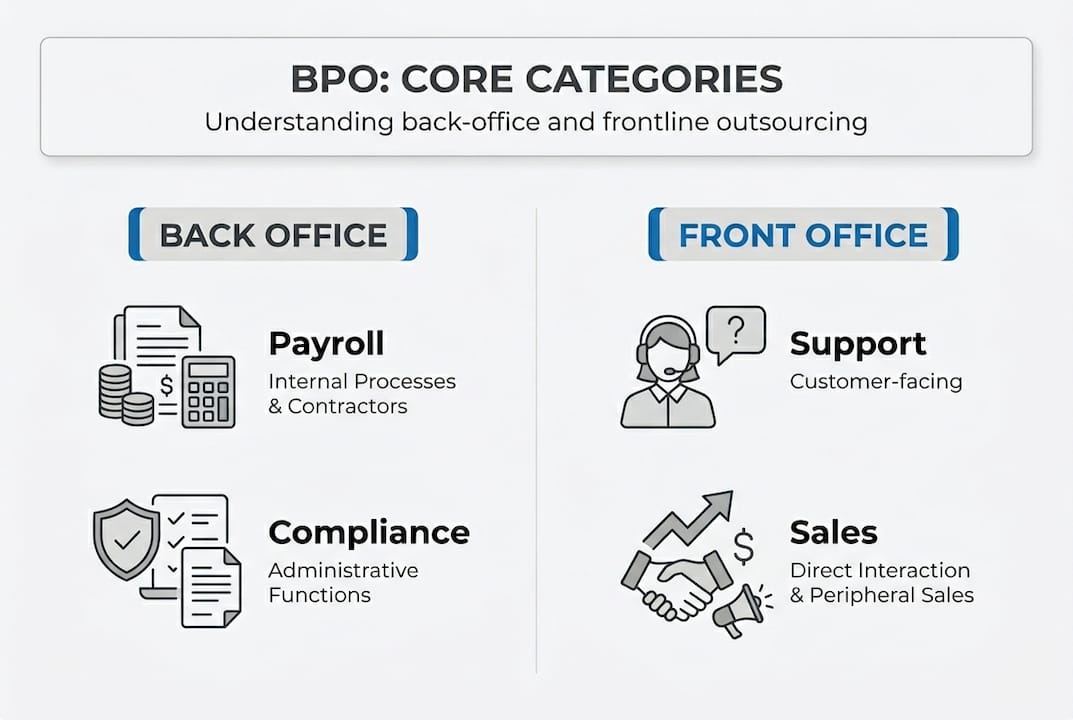
BPO splits into two broad categories. Back-office BPO covers internal operations: billing, data entry, compliance, payroll, and order processing. Front-office BPO covers customer-facing work: call center support, live chat, technical helpdesks, and outbound sales campaigns. Most tech, telecom, and e-commerce companies outsource a mix of both.
There is also a useful distinction between horizontal BPO (services that apply across industries, like HR or finance) and vertical BPO (services built for a specific sector, like telecom billing support or SaaS onboarding). Vertical BPO tends to deliver faster results because the vendor already understands your workflows.
Common functions outsourced in tech and e-commerce include:
- Customer care and multilingual support
- Technical troubleshooting and tier-1 helpdesk
- Subscription and billing management
- Outbound lead generation and market research
- Outsourcing admin services such as data processing and back-office tasks
One common misconception is that BPO and shared services are the same thing. They are not. Shared services use an internal team or subsidiary, while BPO uses an external vendor. Captive centers are also internal, just located offshore. According to Gartner's BPO definition, BPO specifically refers to third-party providers, which changes the risk and governance picture entirely.
The customer care BPO market is projected to reach $34.6 billion by 2028, growing at a 7% CAGR. That number reflects how seriously businesses across every sector are betting on outsourced operations.
How business process outsourcing works: The BPO lifecycle
Understanding the lifecycle is what separates leaders who get great results from those who get frustrated. BPO mechanics involve identifying non-core processes, choosing vendors, contracting, transitioning operations, and setting SLAs with performance metrics. Here is what each stage looks like in practice.
- Discovery. Map your current processes. Identify which tasks are non-core, repetitive, or resource-heavy. Customer support volume spikes, multilingual coverage gaps, and billing backlogs are classic triggers.
- Vendor selection. Evaluate providers on sector expertise, language coverage, tech stack, and pricing model. Flexible scalable outsourcing models matter here, especially if your volume fluctuates seasonally.
- Contract and SLA definition. Lock in service level agreements, KPIs, data security protocols, and escalation paths. Vague contracts are the root cause of most BPO failures.
- Transition. Hand over processes, train vendor agents on your brand voice and systems, and run a parallel period where both internal and external teams operate together.
- Ongoing management. Monitor KPIs weekly, hold regular governance reviews, and adjust scope as your business evolves.
| KPI | Typical target |
|---|---|
| Cost savings vs. internal | 30 to 60% |
| SLA compliance rate | 95%+ |
| CSAT score improvement | +10 to +20 points |
| Average handle time reduction | 30 to 50% |
| FTE flexibility (scale up/down) | Within 2 to 4 weeks |
For cost-effective outsourcing to deliver on these numbers, governance cannot be an afterthought.
Pro Tip: Assign a dedicated internal BPO governance lead from day one. This person owns the vendor relationship, tracks KPIs, and flags issues before they become problems. Without this role, even well-structured contracts drift.
The business impact of BPO: Scalability, efficiency, and customer experience
With process mechanics in mind, let's look at what BPO actually delivers. The numbers are striking. BPO delivers up to 70% reduction in call diversion costs, reduces average handle time from 7 to 3.2 minutes, and can boost CSAT to 84% via AI integration. Those are not theoretical gains. They come from real deployments.
"BPO with AI saw 41% fewer human calls and 15-second tier-1 query resolution, fundamentally changing what customer support costs and delivers."
| Setup | Cost | Flexibility | CX quality |
|---|---|---|---|
| Internal team | High fixed cost | Low | Consistent but limited hours |
| Captive center | Medium to high | Medium | Good but slow to scale |
| AI-only | Low per interaction | High | Limited for complex queries |
| BPO (hybrid) | Low to medium variable | Very high | High with right vendor |
The hybrid BPO model, combining human agents with AI-assisted tools, consistently outperforms the alternatives for companies handling high-volume, multilingual, or technically complex customer interactions.
Here is where BPO creates tangible growth advantages:
- 24/7 and 16/7 coverage without building night-shift teams internally
- Multilingual support across 15+ languages without hiring specialists in each market
- Cost predictability through per-hour or per-interaction pricing models, with flexible support cost management replacing unpredictable headcount costs
- Faster market entry when expanding to new geographies
- Access to outsourcing tools like CRM integrations, VOIP infrastructure, and quality monitoring systems that would cost significantly more to build in-house
For e-commerce companies managing seasonal spikes, or telecom providers handling high churn periods, this flexibility is not a nice-to-have. It is a competitive requirement.

Understanding the risks and challenges of BPO
BPO is not risk-free. Leaders who go in with unrealistic expectations tend to encounter the same set of problems. Key BPO risks include data breaches, hidden costs, communication failures, agent turnover, and process misalignment, all of which are mitigated by careful due diligence, strong governance, and clear SLAs.
Here are the five risks worth taking seriously:
- Data security. Customer data handled by a third party creates exposure. GDPR compliance, data handling agreements, and vendor security audits are non-negotiable.
- Quality drift. Without regular reviews, agent quality can slip. This is especially common when vendors are managing multiple clients at once.
- Hidden costs. Setup fees, technology licensing, training costs, and scope creep can erode projected savings quickly.
- Vendor dependency. Over-reliance on a single provider without exit clauses or backup plans is a real operational risk.
- Agent turnover. BPO providers can have high staff turnover, which disrupts service continuity and brand consistency.
The AI-BPO model introduces additional complexity. Custom process design is required upfront, and the integration between AI tools and human agents needs active management. It is more powerful, but it demands more from both sides of the relationship.
For telecom leaders specifically, reviewing BPO tips for telecom before vendor selection can save significant time and money.
Pro Tip: Always insist on transparent KPIs, shared dashboards, and quarterly business reviews written into your contract. If a vendor resists this level of visibility, that tells you everything you need to know.
Modern trends and best practices in BPO for 2026
The BPO landscape is shifting fast. AI-powered, personalized BPO is on the rise, and leaders should seek industry expertise and robust data security, because the wrong vendor can lead to failed outcomes.
The trends shaping BPO strategy in 2026 include:
- AI and automation integration. Intelligent routing, sentiment analysis, and automated tier-1 resolution are now standard in leading BPO setups. AI-assisted solutions starting from €4.5/hour are making automation accessible even for mid-market companies.
- Vertical specialization. Generic BPO providers are losing ground to sector-specific partners who understand telecom billing cycles, SaaS onboarding flows, or e-commerce return processes.
- Data security as a differentiator. With stricter regulations and higher breach costs, vendors with certified security practices command a premium and deserve it.
- CX as a competitive edge. Customer experience is now the primary reason companies choose BPO, not just cost. Personalization, empathy training, and language quality are being measured more rigorously.
- Flexible pricing models. Hourly models starting from €6.5/hour give growing companies the ability to scale support without committing to large fixed teams.
Success in BPO hinges on governance, hybrid models, and ongoing quality monitoring. Leaders who treat BPO as a set-and-forget contract consistently underperform those who treat it as an active partnership. Pairing your vendor with CRM-powered BPO solutions accelerates results significantly.
Perspective: Why BPO success requires more than cost savings
Here is something most BPO guides will not tell you directly: the companies that get the most from outsourcing are not the ones who negotiated the lowest hourly rate. They are the ones who built a real operating partnership with their vendor.
We have seen this pattern consistently across tech, telecom, and e-commerce clients. Leaders who enter BPO with a pure cost mandate tend to cut corners on governance, skip the transition phase, and then blame the vendor when quality slips. The vendor is rarely the only problem.
The actual strategic value of BPO is agility. It lets you enter a new market in weeks instead of months. It lets you absorb a 300% volume spike without a hiring freeze. It lets you offer native-language support in six countries without six separate HR pipelines.
Fast-moving markets reward flexibility. Companies that use scalable BPO methods as a growth tool, rather than a cost line item, consistently outperform those that treat it as a necessary expense. The mindset shift is small, but the operational difference is enormous.
Next steps: Connect with BPO experts for scalable results
Ready to turn BPO theory into ROI? The gap between knowing what BPO can do and actually building a setup that delivers is where most leaders stall. That is where working with an experienced partner makes the difference.

CallTech Outsourcing has been helping technology, telecom, and e-commerce companies build scalable, multilingual support operations since 2005. Whether you are exploring outsourcing call center services for the first time or looking to optimize an existing setup, our team brings nearly 20 years of sector-specific expertise. From streamlined support workflows to fully managed multilingual teams, we offer cost-effective outsourcing solutions built around your growth stage and market needs. Let's talk about what the right BPO model looks like for your business.
Frequently asked questions
What types of business processes are typically outsourced?
Commonly outsourced processes include customer support, IT services, finance, HR, payroll, and sales operations, selected for their potential to reduce cost and improve scalability without affecting core business strategy.
How does BPO differ from shared services or captives?
BPO uses external vendors for business tasks, while shared services and captives rely on internal teams or subsidiaries, which means more direct control but typically higher fixed costs and less flexibility.
What are the main risks of BPO?
Key BPO risks include data security breaches, hidden costs, quality control issues, and communication gaps, all of which can be managed effectively with robust governance frameworks and clear SLA terms.
Is BPO only for large enterprises?
No. Tech, e-commerce, and telecom companies of all sizes use BPO to improve efficiency, with flexible hourly pricing models making it accessible even for growth-stage businesses that cannot yet justify large internal teams.
What trends will shape BPO in 2026?
AI-powered, industry-tailored BPO, stronger data security practices, and a sharper focus on customer experience quality will define which BPO partnerships deliver real competitive advantage in 2026 and beyond.