

TL;DR:
- Ticket support outsourcing has evolved from cost-cutting to a strategic performance enhancer, with AI significantly boosting agent productivity and reducing costs. It offers multilingual, scalable, and specialized support that accelerates market entry, improves customer experience, and lowers infrastructure expenses. Selecting a vendor with proper certifications, integrated AI tools, and robust management practices ensures successful, future-ready outsourcing partnerships.
Ticket support outsourcing is no longer just a cost-cutting tactic for companies that want to trim headcount. It is evolving into a performance strategy, and the numbers are hard to ignore. 64% of service leaders report higher agent productivity with AI, and 43% believe agentic AI will cut contact center costs by 30% or more within three years. For telecom providers, SaaS companies, and e-commerce businesses expanding into multilingual markets, this shift redefines what outsourcing can actually deliver. This article breaks down pricing models, technology decisions, compliance requirements, and vendor selection so you can make the right call for your business.
Table of Contents
- Understanding ticket support outsourcing and its benefits
- Pricing models and cost drivers in ticket support outsourcing
- Technology and process optimization: AI and automated ticket routing
- Vendor selection and compliance considerations for outsourcing ticket support
- Best practices to implement and manage outsourced ticket support
- Why embracing AI-enhanced ticket support outsourcing is essential for future-ready businesses
- How CallTech supports your ticket support outsourcing needs
- Frequently asked questions
Key Takeaways
| Point | Details |
|---|---|
| AI reduces outsourcing costs | Agentic AI can help reduce ticket support expenses by 30% while boosting agent productivity significantly. |
| Pricing varies by geography | Offshore agents usually cost $8–$18/hour, while onshore support ranges from $35 to $60/hour depending on skills and hours. |
| Automated ticket routing aids speed | Automating ticket routing and categorization can cut response times by up to 40%, enhancing overall support efficiency. |
| Compliance is critical | Ensure your outsourcing partner holds SOC 2 or ISO 27001 certifications with documented audits to protect data and meet regulations. |
| Vendor management drives success | Effective onboarding, KPIs, and continuous coordination with your vendor ensure quality and customer satisfaction in outsourced support. |
Understanding ticket support outsourcing and its benefits
Ticket support outsourcing means delegating your incoming customer support queries, managed through a help desk ticketing system, to an external team of specialists. Those specialists handle everything from first contact through resolution, often across multiple languages, time zones, and channels. Your internal team stays focused on product, operations, or growth. The outsourced team handles the volume.
The core appeal is financial. Outsourcing eliminates fixed costs like salaries, benefits, and infrastructure that make in-house support expensive to scale. But cost is only part of the picture. For telecom and SaaS businesses operating across European or international markets, the real advantage is immediate access to help desk outsourcing benefits that would take years to build internally, particularly multilingual agent teams.
Key benefits for telecom, SaaS, and e-commerce businesses include:
- Multilingual coverage across 15 or more languages without hiring locally in every market
- Flexible capacity that scales up during product launches or seasonal peaks and scales down without penalty
- Specialized agents trained in technical support, billing queries, or subscription management specific to your industry
- Faster time to market when entering new regions, since your support infrastructure is already in place
- 24/7 availability without the overhead of running night shifts internally
The difference between a generic call center and a true IT ticket support services partner is specialization. A vendor that understands SaaS billing workflows or telecom churn patterns will resolve tickets faster and flag issues earlier than a generalist team.
Pricing models and cost drivers in ticket support outsourcing
Now that you know the benefits, understanding how pricing works lets you plan your budget and avoid surprises. There is no single pricing model that fits every company. The right choice depends on your ticket volume, complexity, and coverage hours.
The three most common models are:
| Pricing model | Best for | Typical cost range |
|---|---|---|
| Hourly (offshore) | High-volume, consistent demand | $8 to $25 per hour |
| Hourly (onshore) | Native language, premium quality | $35 to $60 per hour |
| Per-ticket | Variable or seasonal volume | $1 to $20 per resolved ticket |
| Dedicated agent (FTE) | Long-term, full-time coverage | Fixed monthly rate |
Offshore agents start around $8/hour while onshore agents commonly run $35 to $60/hour. Per-ticket pricing, which charges for each resolved ticket rather than agent time, ranges from $1 to $20 depending on ticket complexity and resolution depth. These ranges matter because a per-ticket model that costs $3 per simple password reset looks very different from a $15 per-ticket charge for a billing dispute that requires CRM access and account research.
Several factors push costs up beyond the base rate. Support hours matter enormously. 24/7 coverage costs more than business-hours-only support because it requires more agents and shift management. Tier level is another variable. Tier 1 support handles basic queries. Tier 2 and Tier 3 require technical expertise and command higher rates. Channel mix, meaning whether you need email-only or email plus live chat plus phone, affects staffing and therefore cost.

Hidden costs deserve attention. Onboarding, knowledge base development, tooling integration, compliance documentation, and ongoing training are rarely included in base rates. You can explore how different call center pricing models stack up in practice, or get a granular look at cost per hour pricing before signing any contract. Reviewing outsourcing cost strategies from markets like Portugal also gives you a sense of how nearshore European options balance cost and quality.
Pro Tip: Do not evaluate pricing on hourly rate alone. Calculate your true cost per resolved ticket by factoring in average handling time, escalation rate, and rework. A cheaper hourly rate with a 30% escalation rate often costs more than a higher-rate vendor with a 10% escalation rate.
Technology and process optimization: AI and automated ticket routing
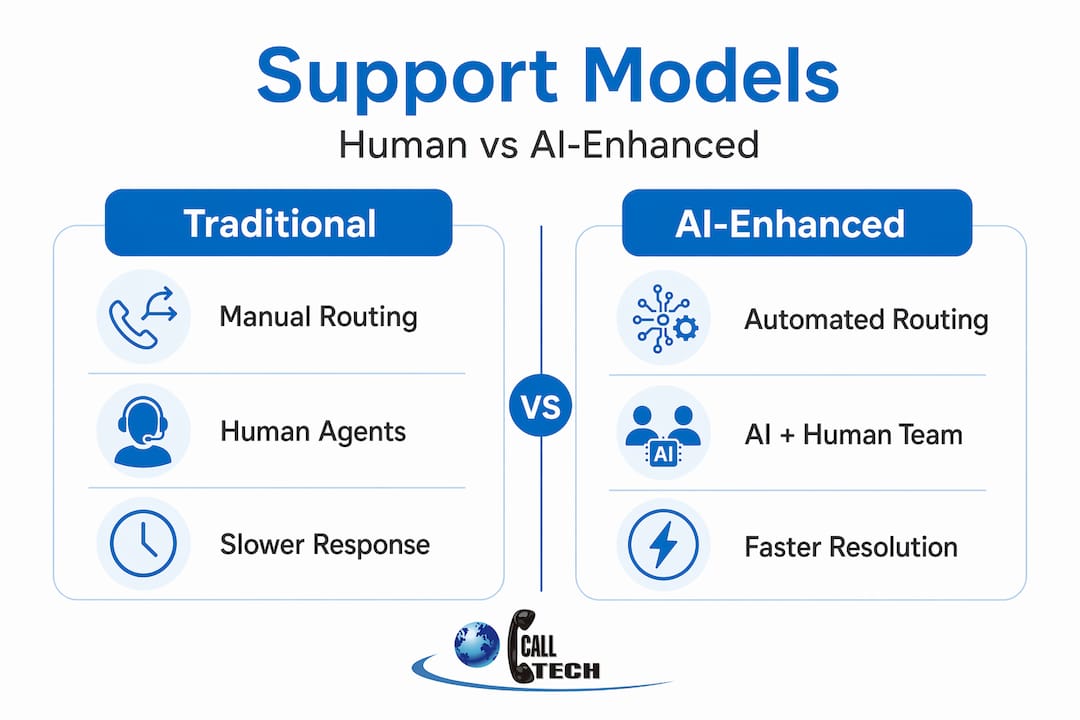
Beyond pricing, AI is the factor that is genuinely changing what outsourced ticket support can deliver. This is not about replacing agents. It is about making every agent significantly more effective.
Automated ticket routing reduces response times by up to 40% and improves accuracy in ticket categorization. That matters because misdirected tickets, ones sent to the wrong team or tagged incorrectly, create compounding delays. When a billing issue gets routed to technical support and then bounced back, the customer waits twice and the handling cost doubles.
Here is what AI-enabled ticket support actually looks like in practice:
- Automated classification reads incoming tickets and assigns them to the correct tier and team instantly
- Sentiment analysis flags tickets from frustrated customers for priority handling before they escalate
- Suggested responses give agents a starting point for common queries, cutting average handling time
- Knowledge base surfacing pulls the relevant article or procedure during a live ticket so agents do not need to search manually
- Agentic AI handles entire ticket flows autonomously for routine queries, freeing agents for complex cases
The Deloitte future of service insights describe the outcome as creating "super agents" through AI orchestration where human capability is amplified rather than replaced. For e-commerce companies handling thousands of order status and return queries daily, this is the difference between a 4-hour resolution window and a 45-minute one.
When you evaluate remote support efficiency gains from AI integration, make sure your outsourcing vendor can actually deploy these tools within your existing CRM and ticketing platform. Compatibility with Zendesk, Freshdesk, Salesforce, or your proprietary system is not a nice-to-have. It is a baseline requirement. Review contact center best practices to understand what a well-integrated operation looks like before you commit.
Vendor selection and compliance considerations for outsourcing ticket support
Technology insights are useful only if you choose a vendor capable of executing them. Vendor selection is where most outsourcing projects succeed or fail, and the due diligence process is more technical than most buyers expect.
Start with certifications. SOC 2 and ISO 27001 compliance verified through current audit reports is essential for SaaS businesses handling user data. These are not just checkboxes. They tell you whether a vendor has built data security into their operations or simply claims to. Ask for the actual audit report, not just a logo on their website.
Language proficiency is a different kind of compliance. For telecom and e-commerce businesses with European customer bases, claimed language coverage and actual quality are not always the same thing. Ask for language test results, sample interactions, and customer satisfaction scores broken down by language team. A vendor offering 15 languages with inconsistent quality in six of them is not actually offering 15 languages.
Evaluate vendors across these dimensions before you sign anything:
- SLA specifics: first response time, resolution time, and escalation triggers with defined penalties
- Data handling: where data is stored, who has access, and how breaches are handled
- Cultural alignment: do agents understand your customers' expectations, not just the language
- Escalation protocols: how quickly issues reach your internal team when the vendor cannot resolve them
- Reporting access: do you get real-time dashboards or weekly summary emails? The former is non-negotiable.
Pro Tip: Request a shadow period before full contract signing. Run a batch of real tickets through the vendor's team while your internal team handles the same tickets in parallel. Compare resolution quality, accuracy, and time. Nothing reveals capability faster than live tickets.
Understand the scalable outsourcing methods that support growth across international markets when assessing whether a vendor can expand with you over 12 to 24 months.
Best practices to implement and manage outsourced ticket support
After selecting your vendor, implementation quality determines whether outsourcing delivers on its promise. Most failed outsourcing relationships trace back to poor onboarding, not poor vendor selection.
Follow these steps for a strong launch:
- Build a knowledge base before day one. Document your most common ticket types, resolution paths, and escalation triggers. The vendor's agents should have this on their first day, not their thirtieth.
- Run a parallel period. Handle tickets internally and externally simultaneously for the first two to four weeks. Use the comparison data to calibrate quality expectations.
- Set KPIs immediately. Define first-contact resolution rate, average handling time, customer satisfaction score, and escalation rate before go-live, not after problems surface.
- Schedule weekly reviews for the first three months. Patterns that need correction show up early. Catching them in week two is far cheaper than fixing them in month five.
- Create a joint feedback loop. Share product updates, policy changes, and complaint trends with your vendor regularly. Agents working with outdated information deliver outdated support.
Designing multi-agent AI service platforms that coordinate AI with human workflows is what separates high-performing outsourced operations from average ones. This means your vendor should actively update AI models with new ticket data, not just deploy them once and leave them static.
Ongoing management requires tracking customer retention support outcomes, not just ticket closure rates. A ticket closed in four minutes that leaves the customer confused is worse than a ticket closed in twelve minutes that fully resolves the issue. Build satisfaction scores into every KPI review. Explore global support strategies to see how companies managing multilingual escalation paths keep quality consistent across markets.
Pro Tip: Assign a dedicated internal liaison to your outsourcing partner. This person attends vendor review calls, relays product updates, and escalates internal blockers. Companies without this role consistently report communication breakdown within six months.
Why embracing AI-enhanced ticket support outsourcing is essential for future-ready businesses
Here is the view we have developed after working with telecom, SaaS, and e-commerce clients across European markets for nearly two decades: most businesses still think about outsourcing as a staffing decision. It is actually a technology architecture decision now.
The companies that will win on customer experience in the next three to five years are not the ones with the most agents. They are the ones with the best-designed human and AI workflows. Service is no longer just about digital tools but intelligence, fundamentally reshaping how enterprises connect with customers and generate business. Treating your outsourcing partner as a headcount provider misses the point entirely.
Agentic AI, the kind that can handle multi-step ticket resolution without human input, is already reducing costs for early adopters. Companies that delay integration because they are waiting for the technology to mature will not find a more convenient entry point. The gap between AI-integrated operations and traditional ones is growing every quarter.
What this means practically: when you evaluate vendors, ask specifically about their AI roadmap. Ask how they incorporate new model capabilities into existing workflows. Ask whether their pricing model rewards resolution quality or just ticket closure volume. A vendor incentivized to close tickets fast is not the same as a vendor incentivized to resolve issues correctly. Learn how remote support teams use AI augmentation to deliver measurably better outcomes and use that as your benchmark for every vendor conversation.
The businesses that treat outsourced ticket support as an intelligence-driven service function will build customer loyalty at a cost their competitors cannot match. The ones that treat it as a cheap headcount alternative will find themselves explaining rising churn to their board in two years.
How CallTech supports your ticket support outsourcing needs
Applying the frameworks in this article is straightforward when your outsourcing partner is built for the job. CallTech Outsourcing has spent nearly 20 years working with telecom, SaaS, and e-commerce businesses that need multilingual, technically competent support across international markets.

Our multilingual outsourcing services cover more than 15 European languages, with agents trained specifically in technical support, subscription and billing management, and customer care workflows. We integrate with the CRM and ticketing platforms you already use, and we offer both hourly and per-ticket pricing structures based on your volume and coverage needs. Our teams are built around the global support strategies that consistently improve customer satisfaction and reduce handling costs. Whether you need dedicated agent teams or flexible capacity for seasonal peaks, our call center platforms for telecom and adjacent sectors are ready to scale with you.
Frequently asked questions
What is ticket support outsourcing?
Ticket support outsourcing involves delegating customer support queries, typically managed through help desk tickets, to external service providers who handle triage, resolution, and escalation on your behalf.
How does AI improve outsourced ticket support?
AI automates ticket routing and categorization, assists agents with real-time guidance, and handles routine queries autonomously, which is why 43% of organizations expect it to cut contact center costs by 30% or more within three years.
How are outsourcing pricing models structured?
Pricing typically follows three models: hourly rates that vary by agent geography, per-ticket fees based on resolution complexity, and dedicated agent contracts. Offshore rates start around $8/hour while onshore rates reach $60/hour, and per-ticket fees run from $1 to $20.
What compliance certifications should I look for in a ticket support vendor?
Prioritize vendors with current SOC 2 and ISO 27001 certifications verified through actual audit reports, not just self-reported claims, to ensure data security and regulatory compliance are operational realities.
How do I ensure quality when outsourcing ticket support?
Quality depends on clear SLAs, dedicated agent teams familiar with your product, regular performance reviews against defined KPIs, and AI integration that supports agents rather than just accelerating ticket closure volume.