

TL;DR:
- Outsourced technical support call centers provide scalable, multilingual, expert assistance for international businesses.
- They improve key metrics like response time, satisfaction scores, and customer retention across industries.
- Choosing the right provider involves assessing technical scope, language coverage, integration, and ongoing management practices.
Many business leaders assume that keeping technical support in-house guarantees better quality and control. The reality is more complicated. As your customer base grows across borders, in-house teams often buckle under volume, language gaps, and the sheer complexity of international technical issues. A dedicated technical support call center solves these problems at scale, delivering consistent, expert assistance in the languages your customers actually speak. This guide walks you through what these centers do, why they matter for telecom, SaaS, and e-commerce businesses, how to choose the right provider, and how to manage one for lasting results.
Table of Contents
- What is a technical support call center?
- Why technical support call centers matter: Key benefits for telecom, SaaS, and e-commerce
- How to choose the right technical support call center solution
- Best practices for implementing and managing a technical support call center
- Beyond the basics: What most businesses miss about technical support call center success
- Take the next step with professional technical support call center solutions
- Frequently asked questions
Key Takeaways
| Point | Details |
|---|---|
| Boost customer satisfaction | A specialized technical support call center delivers faster, more reliable service for global customers. |
| Multilingual support drives results | Providing technical support in multiple languages increases resolution rates and customer loyalty. |
| Choose with care | Evaluate providers based on expertise, language capabilities, and alignment with your business needs. |
| Measure and optimize | Track key metrics like first response time and customer satisfaction to ensure ongoing improvement. |
What is a technical support call center?
A technical support call center is a specialized team, either outsourced or in-house, focused entirely on resolving customer technical inquiries. Unlike a general customer service team, these agents are trained to handle complex issues: software errors, hardware failures, network outages, account access problems, and integration breakdowns. The depth of knowledge required is significantly higher, and the protocols are more structured.
Core services typically include:
- Tier 1 support: First-line troubleshooting for common issues (password resets, basic configuration)
- Tier 2 support: Escalated problems requiring deeper technical knowledge
- Tier 3 support: Expert-level resolution, often involving engineers or developers
- Knowledge base management: Building and maintaining self-service resources
- Software and hardware diagnostics: Guided troubleshooting across platforms and devices
- Account and billing support: Resolving access issues tied to subscriptions or payments
For companies operating internationally, the multilingual dimension changes everything. Specialized technical assistance across global markets enables companies to maintain high customer satisfaction without building parallel in-house teams for every region.
The operational benefits are substantial. Outsourced technical support call centers offer 24/7 availability, consistent service quality, and the ability to scale up or down based on demand, without the overhead of permanent staff. For a SaaS company launching in Germany, a telecom provider expanding into Poland, or an e-commerce brand serving French-speaking markets, this flexibility is not a luxury. It is a competitive necessity.
For a deeper look at how these operations are structured, the help desk outsourcing guide covers the operational and strategic layers in detail.
Pro Tip: When evaluating providers, prioritize those with documented experience in your specific industry and language markets. A provider with generic multilingual claims is not the same as one with proven SaaS or telecom deployments in your target regions.
With the basics out of the way, let's explore how different industries use these centers.
Why technical support call centers matter: Key benefits for telecom, SaaS, and e-commerce
The business case for outsourced technical support is not just about cost savings. It is about performance outcomes that directly affect revenue and retention.
Industry-specific needs vary significantly:
- Telecom: Uptime is everything. Customers expect immediate help with network issues, device configuration, and service outages. Delays erode trust fast.
- SaaS: Integration problems and real-time support requests require agents who understand APIs, user permissions, and platform-specific workflows.
- E-commerce: Order tracking, payment failures, and multilingual queries from international shoppers demand fast, accurate, and culturally aware responses.
The performance data backs this up. Multilingual support boosts first-contact resolution rates by up to 30% in global SaaS deployments. That single metric has a cascading effect on customer satisfaction scores, churn rates, and support costs.
Telecom is equally compelling. Dedicated call centers help top telecom companies maintain NPS scores 20% higher than industry averages. That gap translates directly into subscriber retention and reduced acquisition costs.

Here is how key metrics typically shift when businesses move to a specialized technical support call center:
| Metric | Telecom | SaaS | E-commerce |
|---|---|---|---|
| First response time (FRT) | Reduced by 35% | Reduced by 28% | Reduced by 30% |
| Net Promoter Score (NPS) | +20 points | +15 points | +12 points |
| Customer retention rate | +18% | +22% | +16% |
| Average handle time | Down 25% | Down 20% | Down 22% |
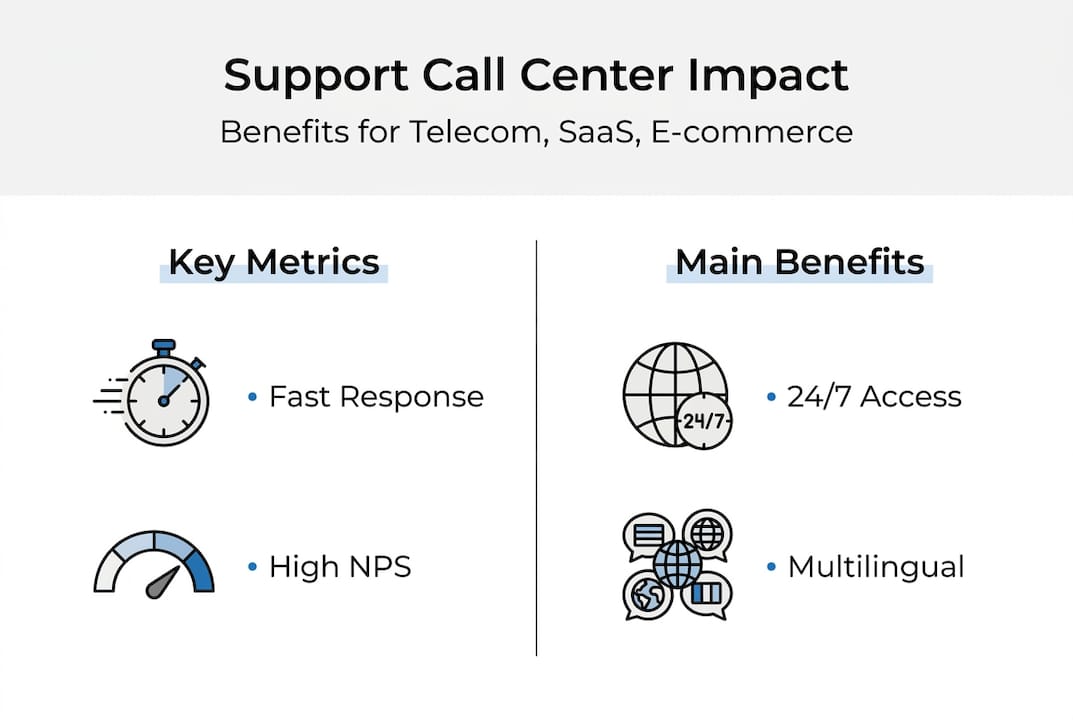
Beyond the numbers, there is a productivity argument. Building an in-house multilingual technical support team for three or four languages requires recruiting, training, managing, and retaining specialized staff across time zones. Outsourcing converts that fixed cost into a variable one, letting you scale support capacity during product launches or seasonal peaks without long-term hiring commitments.
For a broader look at how to apply contact center efficiency strategies across your operations, there are proven frameworks worth reviewing.
Knowing these benefits, how do business leaders choose the right solution?
How to choose the right technical support call center solution
Selecting a provider is where many companies make costly mistakes. The most common one is prioritizing price over fit. A cheaper provider with gaps in language coverage or technical depth will cost you far more in customer churn and escalations.
Here is a structured framework for evaluating your options:
- Define your technical scope. What issues will agents handle? What systems must they know? Tier 1 only, or full Tier 1 through 3?
- Assess language coverage. Which markets do you serve now, and which do you plan to enter in the next 12 to 24 months?
- Evaluate 24/7 availability. Does the provider offer true round-the-clock support, or just extended hours?
- Check integration capabilities. Can they connect with your CRM, ticketing system, and VOIP infrastructure without friction?
- Review SLA commitments. What are the guaranteed response and resolution times, and what happens when they are missed?
- Request case studies. Specifically ask for multilingual technical support examples in your industry.
Comparing costs, service levels, and response quality is essential before signing any contract. Hidden costs in per-minute billing models or setup fees can erode the expected savings quickly.
Here is how the three main models compare:
| Model | Cost | Flexibility | Technical depth | Language coverage |
|---|---|---|---|---|
| In-house | High fixed cost | Low | High (if staffed well) | Limited |
| Outsourced | Variable, lower | High | High (specialist providers) | Broad |
| Hybrid | Moderate | Moderate | High | Moderate to broad |
For most telecom, SaaS, and e-commerce companies scaling internationally, outsourced or hybrid models offer the best balance. Explore best call center services to see what leading providers offer across these models.
Pro Tip: Ask potential providers for a live demonstration using scenarios from your actual support queue. Generic demos reveal very little. Real-case walkthroughs reveal everything.
After choosing a provider, successfully onboarding and managing support operations is essential.
Best practices for implementing and managing a technical support call center
A great provider selection means nothing without a disciplined implementation. Here is how to get it right from day one.
Step-by-step rollout:
- Onboarding: Share product documentation, known issue logs, escalation paths, and brand voice guidelines before go-live.
- Training: Run joint sessions between your internal team and the provider's agents. Cover both technical content and customer communication style.
- Integration: Connect the provider's systems to your CRM and ticketing platform. Test every workflow before launch.
- Workflow setup: Define routing rules, escalation thresholds, and SLA triggers clearly. Ambiguity here causes delays later.
- Pilot phase: Start with a limited scope (one language, one product line) before full rollout.
Call centers that adopt workflow optimization best practices can reduce average resolution time by 40%. That kind of improvement does not happen by accident. It comes from structured implementation and continuous measurement.
Do's and don'ts for smooth operations:
- Do set up weekly performance reviews with your provider during the first 90 days
- Do create a shared feedback loop where agents can flag recurring issues to your product team
- Don't assume the provider knows your product as well as your internal team does
- Don't skip the pilot phase to save time. It always costs more to fix problems post-launch
- Do invest in global contact center workflow optimization as your operations scale
"The companies that get the most from outsourced technical support are the ones that treat their provider as an extension of their own team, not as a vendor at arm's length."
Monitor KPIs consistently: resolution time, first-contact resolution rate, customer satisfaction scores, and escalation rates. Use these to drive global support efficiency strategies and keep improving over time.
Let's look at an editorial perspective on what makes a technical support call center truly exceptional.
Beyond the basics: What most businesses miss about technical support call center success
After nearly 20 years of working with telecom, SaaS, and e-commerce companies across Europe and international markets, we have seen a consistent pattern. The businesses that get the most from their technical support call centers are not the ones with the most sophisticated technology. They are the ones that invest equally in culture and communication.
Most leaders focus on SLAs, dashboards, and cost-per-ticket. Those things matter. But the real differentiator is whether your agents feel empowered to make decisions in the moment, with enough contextual knowledge to resolve issues without escalating every edge case. That autonomy requires trust, training, and ongoing communication between your team and the provider.
Frontline agents also see patterns before management does. A recurring error message, a confusing onboarding step, a billing question that keeps coming up. These signals are gold for product and process improvement. Companies that build feedback channels from support agents to internal teams innovate faster and reduce repeat contacts.
For global businesses needing multilingual support, cultural sensitivity is just as important as language fluency. An agent who speaks French but does not understand regional communication norms will still frustrate customers. The best providers train for both.
Take the next step with professional technical support call center solutions
If you are managing growing support volumes across multiple markets, the gap between what your current setup delivers and what a specialized provider can offer is likely wider than you think.

CallTech Outsourcing has been helping telecom, SaaS, and e-commerce companies scale their outsourcing call center services since 2005, covering more than 15 European languages with modern VOIP infrastructure and CRM integration. Whether you need to apply contact center best practices or draw on proven customer support strategies from companies like yours, we can help you build a support operation that actually scales. Reach out to explore what a tailored outsourcing partnership looks like for your business.
Frequently asked questions
What does a technical support call center do?
A technical support call center assists customers with complex technology or service issues, providing rapid troubleshooting and expert guidance across tiers of support. Specialized technical assistance covers everything from basic configuration to advanced system diagnostics.
How does multilingual support improve customer satisfaction?
Multilingual support solves problems faster and makes customers feel understood, which directly increases satisfaction and long-term loyalty. First-contact resolution rates improve by up to 30% when customers receive help in their native language.
What are the key metrics to measure call center success?
Important metrics include first response time, resolution time, customer satisfaction scores, and customer retention rates. NPS scores and retention are especially telling for telecom and SaaS businesses operating across multiple markets.
Is outsourcing technical support more cost-effective than managing it in-house?
Outsourcing technical support often reduces costs and optimizes resources, particularly for global or multilingual operations with variable demand. Comparing pricing models before committing to a provider helps avoid hidden costs that can offset expected savings.