

TL;DR:
- Shared call centers pool agents across multiple clients to reduce costs and increase flexibility.
- Modern shared models match dedicated support in quality with faster deployment and multilingual coverage.
- Success depends on clear SLAs, strong data integration, and building a true partnership with providers.
Most enterprise decision-makers assume that if you want premium customer support, you need a fully dedicated team. That assumption is costing companies millions in unnecessary overhead. Shared call center services challenge that logic directly, and the numbers back it up. By pooling agents across multiple clients, shared models deliver professional, multilingual coverage at a fraction of the cost of dedicated setups. In this article, you'll discover how the shared agent model works, why it outperforms expectations for telecom, SaaS, and e-commerce businesses, and how to implement it without sacrificing quality or customer experience.
Table of Contents
- What are shared call center services?
- Key benefits of shared call center solutions
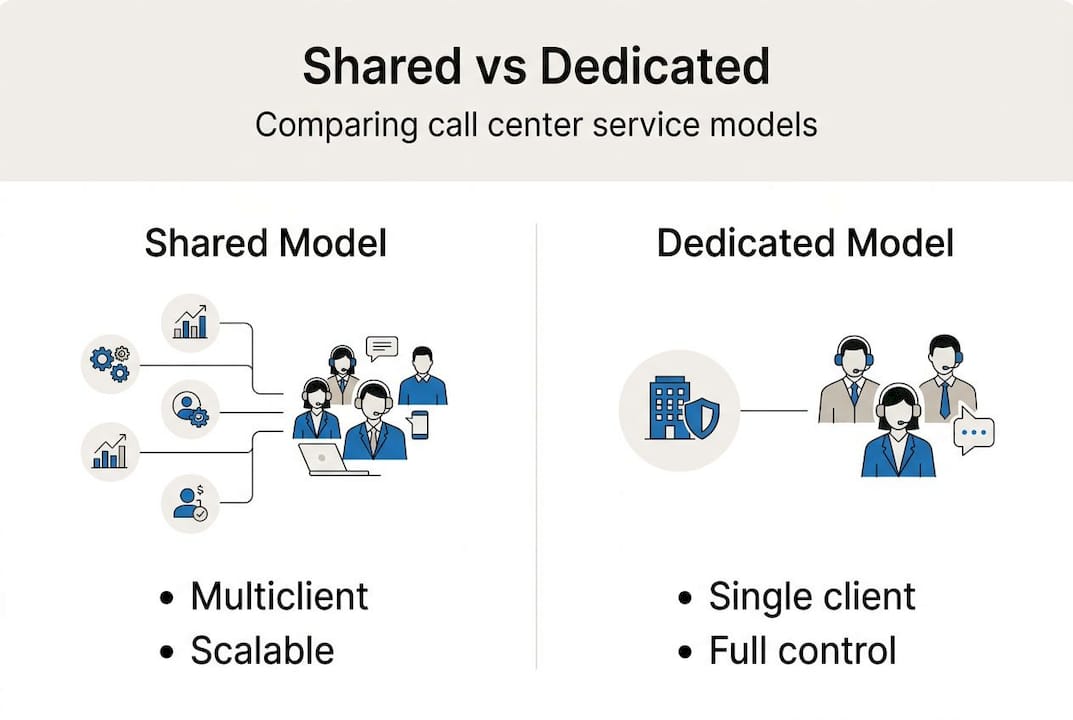
- Comparing shared and dedicated call center models
- How to successfully implement shared call center services
- Our perspective: Where most businesses get shared call center strategy wrong
- Elevate your customer support with CallTech's shared call center expertise
- Frequently asked questions
Key Takeaways
| Point | Details |
|---|---|
| Flexible, global support | Shared call centers power scalable, multilingual help desks across industries. |
| Significant cost reduction | Pooled resources enable up to 70% savings compared to dedicated services. |
| Right-fit decision making | Compare models side by side to match call center solutions to your needs. |
| Integration is vital | Successful implementation depends on seamless CRM and process integration. |
What are shared call center services?
A shared call center service is a model where a team of agents handles customer interactions for multiple client companies simultaneously. Unlike a dedicated model, where agents work exclusively for one brand, shared agents are trained across several accounts and shift between them based on real-time demand. This resource pooling is what makes the model both cost-effective and surprisingly flexible.
For telecom providers, SaaS platforms, and e-commerce businesses, this structure fits naturally. Demand spikes during product launches, billing cycles, or seasonal sales. A shared model absorbs those peaks without requiring you to hire and train a permanent team for a temporary surge. When volume drops, you're not paying for idle agents sitting at desks.
Here's what a modern shared call center typically includes:
- Multilingual agent pools covering 15 or more European languages
- Flexible scheduling with extended or 24/7 coverage options
- Cross-industry expertise spanning technical support, billing, and customer care
- VOIP infrastructure and CRM integrations for seamless data flow
- Real-time reporting dashboards accessible to client teams
The most persistent misconception about shared services is that they deliver lower quality. This idea is outdated. Modern shared contact centers operate with rigorous quality frameworks, dedicated account managers, and technology stacks that rival in-house setups. As one industry analysis notes, shared contact centers pool resources across clients, enabling flexibility, multilingual coverage, and significant cost efficiencies.
"The question is no longer whether shared services can match dedicated quality. It's whether your business can afford to ignore the cost and flexibility advantages they offer."
Shared models also integrate directly with your existing tools. Whether your team runs Salesforce, HubSpot, Zendesk, or a custom CRM, a well-structured shared provider connects those systems to deliver context-aware support. This is especially relevant for companies exploring outsourcing administrative services alongside customer-facing operations, where unified data access becomes a competitive advantage.
The shared model isn't a compromise. It's a deliberate architecture designed for businesses that need professional support without the overhead of a full-time, single-brand operation.
Key benefits of shared call center solutions
Once you understand how the model works, the advantages become concrete and measurable. Shared call center solutions deliver four core benefits that matter directly to enterprise decision-makers: cost predictability, scalability, language diversity, and operational speed.
Cost efficiency is the headline benefit. Businesses leveraging shared call centers can achieve up to 70% savings on multilingual support compared to building equivalent in-house capacity. You pay only for the time agents spend on your account, not for training, benefits, office space, or downtime between calls.

Scalability without overstaffing is the second major win. E-commerce companies running flash sales or telecom providers launching new markets don't need to hire 40 agents for a six-week campaign. Shared services scale up and down within days, not months.
Key benefits at a glance:
- Faster launch timelines: Go live in weeks, not quarters
- Language breadth: Access agents fluent in French, German, Dutch, Polish, Romanian, and more without separate hiring processes
- Reduced training burden: Providers manage onboarding and quality assurance
- Budget predictability: Usage-based pricing replaces fixed monthly headcount costs
- Hybrid model support: Combine AI-assisted chat and email handling with live voice for non-voice channels
For companies evaluating cost-effective outsourcing methods, the shared model often surfaces as the fastest path to international coverage without a proportional increase in operational complexity.
Pro Tip: Before committing to a shared model, map your monthly contact volume by channel and language. If you have more than three language requirements and volume that fluctuates by 30% or more month to month, shared services will almost certainly outperform a dedicated setup on both cost and flexibility.
The help desk outsourcing guide framework applies here too. Shared environments work best when you define clear escalation paths and SLA targets upfront, so agents across multiple accounts know exactly how to handle your most sensitive customer scenarios.
Comparing shared and dedicated call center models
Choosing between shared and dedicated isn't about which model is better in the abstract. It's about which fits your specific volume, complexity, and growth stage. Shared call centers offer higher flexibility and cost efficiency for variable demand, while dedicated centers provide exclusive agent focus for complex workflows.
| Feature | Shared model | Dedicated model |
|---|---|---|
| Cost structure | Pay per use | Fixed monthly cost |
| Scalability | High, adjusts quickly | Limited, requires ramp time |
| Language coverage | Broad, pooled | Narrow, team-specific |
| Agent exclusivity | Shared across clients | Exclusive to your brand |
| Setup speed | Fast (weeks) | Slower (months) |
| Best for | Variable demand, multilingual | Complex, high-volume, single brand |
Use this framework to assess your needs before speaking with any provider:
- Define your average and peak monthly contact volume across all channels
- List every language your customers require, including low-volume markets
- Identify your complexity level: Are most queries routine, or do they require deep product knowledge?
- Map your growth trajectory: Will volume double in 12 months, or stay flat?
- Assess your integration requirements: Do you need real-time CRM sync, or is batch reporting acceptable?
If steps 1 and 3 reveal high volume with complex, brand-specific workflows, dedicated may serve you better. If steps 2 and 4 show multilingual needs and rapid growth, shared wins. Many companies land in a hybrid position, using shared services for tier-1 support and dedicated agents for escalations.
Pro Tip: When evaluating providers, ask specifically how they handle account isolation within shared environments. A quality provider will demonstrate clear data segregation, separate call routing logic per client, and documented QA processes that prevent brand confusion between accounts. Review their call center pricing model comparison to understand exactly what you're paying for at each tier.
How to successfully implement shared call center services
Selecting the right model is only half the work. Implementation quality determines whether you see the promised savings and performance gains or spend months fixing avoidable problems.
Start with a structured onboarding checklist:
- Define SLAs and KPIs before signing any contract
- Complete CRM integration and test data flows before go-live
- Deliver brand training materials including tone guides, escalation scripts, and product FAQs
- Run a pilot period with reduced volume to identify gaps
- Establish weekly reporting cadences with your provider's account manager
Integrating CRM systems with shared call centers is crucial for real-time insights and maximized savings. Without clean data integration, agents lack context, handle times increase, and customer satisfaction scores drop.
Here are the KPIs you should track from day one:
| KPI | Target benchmark | Why it matters |
|---|---|---|
| First contact resolution (FCR) | Above 75% | Measures issue resolution efficiency |
| Customer satisfaction (CSAT) | Above 85% | Tracks customer experience quality |
| Average handle time (AHT) | Varies by industry | Indicates agent efficiency |
| Service level (SL) | 80% of calls in 20 seconds | Measures responsiveness |
| Abandonment rate | Below 5% | Signals queue management health |
To optimize global contact center workflow, build feedback loops from the start. Weekly data reviews, monthly QA scoring sessions, and quarterly business reviews with your provider create the accountability structure that separates high-performing partnerships from mediocre ones.
Pro Tip: The most common implementation failure isn't technology. It's knowledge transfer. Invest heavily in your initial training package. Agents who deeply understand your product, tone, and customer expectations will outperform generic agents on any metric, even in a shared environment. Pair this with the right customer service outsourcing tools to automate routine tasks and free agents for higher-value interactions.
Our perspective: Where most businesses get shared call center strategy wrong
After nearly 20 years of running multilingual shared support operations, we've seen a consistent pattern in how enterprises approach this model. Most focus almost entirely on price. They compare per-minute rates, negotiate discounts, and sign contracts without ever asking the questions that actually determine outcomes: How are agents trained on our brand? How is quality measured weekly, not quarterly? What happens when a shared agent handles a frustrated customer in a language they're less fluent in?
Price is a starting point, not a strategy. The businesses that get the most from shared services treat their provider as a genuine partner, not a vendor. They share product roadmaps, involve agents in feedback loops, and align KPIs to business outcomes rather than call metrics alone.
The other underestimated factor is cultural fit. Customers' satisfaction hinges not only on coverage and speed, but on personalization and seamless integration with your existing systems. An agent who understands the cultural nuances of a Dutch telecom customer or a Polish SaaS user delivers a fundamentally different experience than one who simply speaks the language.
Shared can absolutely achieve top-tier customer experience. But only when it's built as a true partnership with clear expectations, ongoing measurement, and mutual investment in quality. Explore what that looks like with outsourcing providers for global support that prioritize long-term alignment over short-term cost wins.
Elevate your customer support with CallTech's shared call center expertise
If this article has clarified what shared call center services can realistically deliver, the next step is finding a partner with the infrastructure and experience to back it up. CallTech Outsourcing has been delivering multilingual shared and dedicated support since 2005, serving clients across Europe, the UK, the US, and MENA in more than 15 languages.

Our shared call center services are built for telecom, SaaS, and e-commerce companies that need flexible, scalable, and cost-effective support without the overhead of a dedicated team. From multilingual customer engagement to full CRM integration and real-time reporting, we handle the operational complexity so your team can focus on growth. Ready to streamline global support workflow and reduce costs? Contact us today to request a quote or schedule a consultation.
Frequently asked questions
What types of companies benefit most from shared call center services?
Enterprises with fluctuating support volumes, global reach, and multilingual requirements see the greatest returns. Shared call centers are ideal for companies needing scalability and diverse language support without fixed headcount costs.
How do shared call centers deliver significant cost savings?
By pooling agents across multiple clients, providers reduce idle time and overhead, passing those savings to you. Businesses switching to shared services report up to 70% lower support costs compared to in-house or dedicated outsourced teams.
Are there risks to using shared call center services?
The main risks are reduced personalization and data integration gaps, but both are manageable. Proper integration of shared resources combined with clear SLAs and regular QA reviews effectively minimizes these concerns.
What should I look for in a shared call center provider?
Prioritize multilingual capacity, scalable technology, CRM integration capabilities, and a documented quality assurance process. Top-performing providers offer robust tech and proven multilingual support across multiple industries and geographies.
How do you measure success in a shared call center environment?
Track first contact resolution, customer satisfaction scores, and average handle time through real-time reporting dashboards. Key metrics like FCR and CSAT are the most reliable indicators of shared call center performance quality.