

TL;DR:
- Effective remote support requires strong leadership, structured processes, and targeted automation.
- Success depends on agent autonomy, quality assurance, and measurable ROI rather than just technology.
- Proper onboarding, ongoing communication, and process reviews are crucial for sustained high performance.
Running a remote support team that genuinely delivers across languages, time zones, and customer expectations is one of the hardest operational challenges global companies face. Most teams assume the hardest part is hiring multilingual agents. It isn't. The real complexity lies in creating consistent quality, managing agent performance without being physically present, and preventing the same support issues from repeating across markets. This guide breaks down exactly how high-performing organizations structure, equip, and lead remote support teams to get real results, not just coverage.
Table of Contents
- What makes remote support teams different?
- The three pillars of effective remote support
- Solving the productivity puzzle: Tools and automations that work
- Onboarding and communication: Setting up remote teams for success
- Why most companies underestimate the complexity—and the upside—of remote support teams
- Upgrade your remote support with proven multilingual solutions
- Frequently asked questions
Key Takeaways
| Point | Details |
|---|---|
| Remote teams need structure | Success comes from clear frameworks and strong leadership, not just remote access. |
| Automation prevents repeat issues | Smart use of AI scripting and knowledge bases reduces recurring tickets and improves morale. |
| Multilingual support drives loyalty | Meeting customers in their native language dramatically increases satisfaction and conversion rates. |
| Effective onboarding is critical | A structured onboarding and communication plan ensures new hires ramp up fast and stay productive. |
What makes remote support teams different?
With a clear sense of the challenge, let's clarify how remote teams set themselves apart from traditional models and what that really means for your bottom line.
Remote support teams don't just work from different locations. They operate across different cultures, time zones, and communication styles simultaneously. That's a fundamentally different management problem than running an on-site floor where a supervisor can walk over to coach an agent in real time.
Location independence sounds like a simple logistical shift. But it changes nearly every operational assumption you have. Feedback loops slow down. Miscommunications compound. Cultural gaps in how agents interpret customer emotions or complaints go unnoticed for weeks. For companies building remote multilingual support teams, these blind spots are often where quality quietly erodes.
There are specific friction points that appear repeatedly:
- Asynchronous handoffs where tickets fall through the gaps between time zones
- Language consistency failures where tone or terminology differs wildly between agents
- Recurring issues that should have been automated or documented long ago
- Agent isolation that leads to disengagement and quiet quitting
Building strong remote team culture doesn't happen by accident. It requires deliberate processes that replace the organic learning that happens naturally in a shared physical space.
Research confirms that supportive leadership moderates conflict and well-being in remote teams, which directly affects performance metrics. Without that leadership structure in place, you'll see elevated conflict, burnout, and churn, all of which are far more expensive to fix after the fact.
| Feature | Remote teams | On-site teams |
|---|---|---|
| Coverage flexibility | High: 24/7 across time zones | Limited by location and shifts |
| Quality consistency | Harder without structured QA | Easier with direct supervision |
| Scalability | Fast and cost-effective | Slower, tied to office capacity |
| Cultural alignment | Risk if not actively managed | Easier in single-culture settings |
| Technology dependency | Very high | Moderate |
| Agent well-being oversight | Requires intentional systems | More visible and immediate |
Pro Tip: Invest early in scalable communication and workflow tools before you feel the growing pains. Adding integrations retroactively to a team already handling volume is significantly more disruptive and expensive than building the right foundation from day one.
The three pillars of effective remote support
Now that you understand what's unique about the remote support model, let's break down what the most successful organizations get right every time.
Across industries, from telecom to SaaS to e-commerce, the organizations with consistently excellent remote support share three operational priorities: agent autonomy, rigorous quality assurance, and ROI-focused measurement. Get all three right, and everything else follows. Miss even one, and performance degrades in ways that are hard to diagnose.
"Prioritize tooling such as Slack huddles and AI triage to close onsite gaps. Multishore support needs autonomy, quality, and ROI pillars for genuine collaboration at scale."
Autonomy doesn't mean letting agents do whatever they want. It means equipping them with enough context, training, and decision-making authority to resolve customer issues without waiting for approval. When agents trust their own judgment, resolution times drop and customer satisfaction scores rise. Explore global support efficiency strategies that show how autonomy scales across markets.
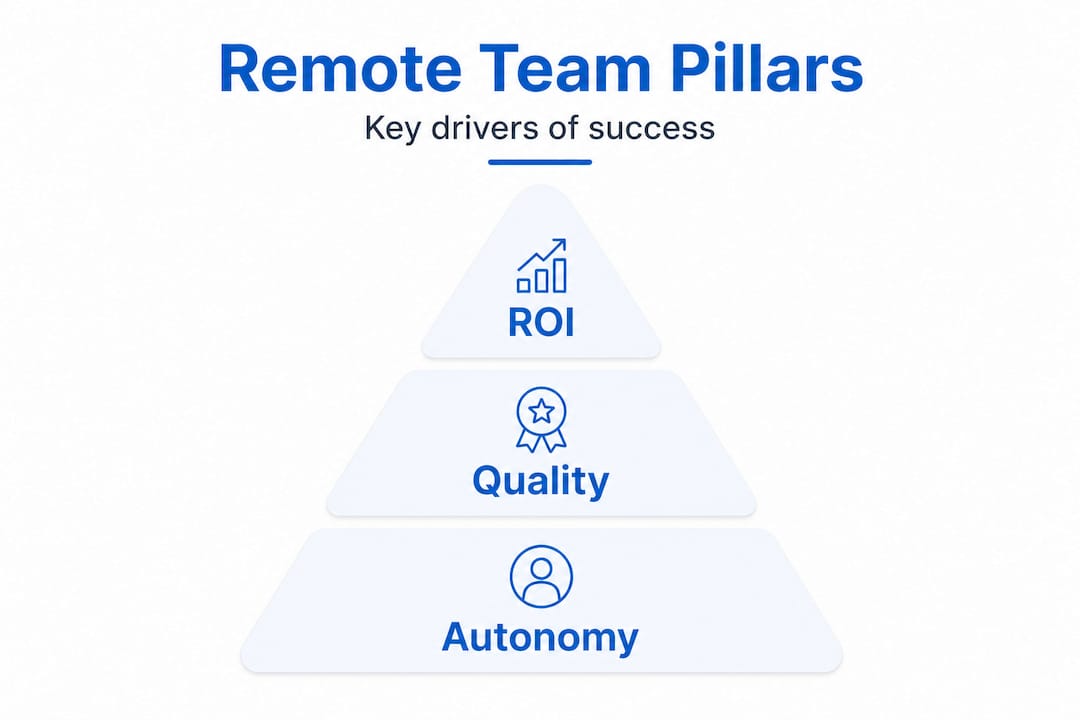
Quality assurance in a remote context means structured call and ticket reviews, calibration sessions across team leads in different regions, and scorecards built around outcomes rather than compliance theater. The teams that do this well don't just catch errors. They identify coaching opportunities before patterns become problems.
ROI measurement keeps the operation honest. Too many support organizations track volume metrics without connecting them to business outcomes. The clearest picture comes from cost per resolution, customer lifetime value impact, and churn reduction tied to support quality.
| Pillar | Key metric | Expected impact when optimized |
|---|---|---|
| Agent autonomy | Average handle time (AHT) | 15 to 25% reduction in AHT |
| Quality assurance | CSAT and FCR (first contact resolution) | 20 to 35% CSAT improvement |
| ROI measurement | Cost per case and churn correlation | 10 to 20% cost reduction |
Here are three practical steps to implement each pillar:
- Autonomy: Create tiered resolution authority so agents can resolve common issues immediately, escalate complex ones, and document edge cases for future training.
- Quality assurance: Schedule bi-weekly calibration sessions where team leads score the same interaction and compare results to align standards across regions.
- ROI measurement: Connect your helpdesk data to churn analytics monthly to identify whether support interactions correlate with customer retention or departure.
Flexible support services designed around these three pillars consistently outperform volume-first models in long-term customer retention.
Pro Tip: Quality monitoring and agent ownership work best together. When agents review their own scored calls before a coaching session, they identify their own gaps more honestly than when they're told about them. That self-awareness accelerates improvement faster than any top-down feedback cycle.
Solving the productivity puzzle: Tools and automations that work
Of course, even the best teams are only as good as the tools they use. Here's how technology supercharges remote support teams for today's global demands.

The gap between a good remote support team and a great one is often not the people. It's the tooling. Specifically, it's whether the tech stack actively reduces friction for agents or adds to it. Too many organizations layer tools without a clear workflow strategy, resulting in agents toggling between five platforms to resolve a single ticket.
The tools that actually move the needle in remote multilingual support environments include:
- AI-driven triage systems that automatically categorize and prioritize incoming tickets by language, urgency, and topic
- Slack huddles and async video tools that preserve human connection without requiring scheduled meetings
- Advanced helpdesk platforms like Zendesk or Freshdesk with multilingual templates and macro libraries
- Knowledge base systems that surface relevant articles to agents in real time based on ticket content
- CRM integrations that give agents full customer history before they type their first response
AI chatbots for customer support are particularly effective at handling tier-one queries, freeing human agents for escalated and emotionally complex interactions.
AI scripting and automations built from past support sessions can prevent entire categories of recurring IT tickets from reaching human agents at all. In practice, this means a team that previously spent 30% of their time on repetitive password resets and connectivity checks can redirect that capacity toward complex technical support or customer retention conversations.
A realistic scenario: a mid-size SaaS company supporting customers across six European markets introduces AI-driven triage with automated resolution scripts for their 15 most common ticket types. Within 90 days, those ticket types, previously representing about 20% of total volume, are resolved without agent involvement. Agent satisfaction goes up because the repetitive work disappears. Customer response times improve because the queue shrinks. Cost per case drops because the same headcount handles more complex, higher-value interactions.
To streamline global support workflows effectively, evaluate tools on three criteria: does it reduce agent clicks per resolution, does it improve response consistency across languages, and does it generate data you can actually act on?
Pro Tip: Automate the predictable so your agents can own the unpredictable. Customers remember how you handled their difficult moments, not their password resets. Use automations to create capacity for those high-stakes interactions.
Onboarding and communication: Setting up remote teams for success
With the right tech in place, initial onboarding and everyday communication become the backbone of truly great remote support teams.
The first 90 days for a remote support agent are the most fragile. Without structured onboarding, agents often build informal habits that are hard to correct later. They default to workarounds instead of documented processes. They hesitate to escalate because they don't know who to ask. They drift from brand voice because no one reinforced it early enough.
Here are five essential onboarding actions for remote support agents:
- Culture immersion in week one: Before any tool training, agents should understand the brand voice, customer personas, and the core promise behind the product they're supporting. This context shapes every future interaction.
- Tool certification by day 10: Agents should complete hands-on training for every tool in the stack, including mock ticket resolution sessions in the actual helpdesk environment.
- Playbook access with scenario drills: Provide resolution playbooks for the top 30 ticket types and run live scenario drills with team leads to build decision-making confidence before agents go live.
- Buddy system for the first 30 days: Pair each new agent with an experienced colleague in the same language group. This accelerates practical learning and reduces the isolation that often leads to early churn.
- Structured check-ins at days 30, 60, and 90: These aren't performance reviews. They're two-way conversations about what's working, what's confusing, and what support the agent needs to perform well.
"Research confirms that supportive leadership moderates both conflict and well-being in remote teams, making it one of the highest-leverage investments a support organization can make."
For ongoing communication, the channels matter less than the consistency. Weekly team syncs, async video updates from leadership, and clear escalation paths all contribute to an environment where agents feel informed and supported rather than isolated and guessing.
Language and culture barriers require specific attention. Remote team onboarding best practices for multilingual environments include language-specific onboarding tracks, cultural sensitivity briefings for agents supporting markets outside their own, and localized quality scorecards that account for regional communication norms. These aren't optional extras. They're the difference between agents who technically speak the language and agents who genuinely connect with customers in it.
For structured guidance for remote team onboarding in hybrid and distributed environments, consider frameworks that address both the operational and the human dimensions of agent integration.
Why most companies underestimate the complexity—and the upside—of remote support teams
After nearly two decades of working with global support teams, we've noticed a pattern. Companies invest heavily in recruitment and technology, then wonder why performance plateaus. The answer is almost always the same: they treated remote support as a logistics problem when it's actually a leadership problem.
Adding agents without improving processes doesn't scale support quality. It scales existing weaknesses. If your quality assurance process is manual and inconsistent, doubling your team doubles the inconsistency. If your communication structure doesn't reach agents effectively at one location, it will fail catastrophically across five.
The counterintuitive insight from our experience is that a smaller team with excellent leadership, clear processes, and targeted automations consistently outperforms a larger team with weaker operational foundations. We've seen this directly. A carefully led team of 20 agents with strong playbooks and weekly calibration will produce better CSAT scores and lower cost per resolution than a team of 40 operating with ambiguous standards and reactive management.
The technology is important, but it's not the differentiator. Two teams with identical tech stacks will produce wildly different results based on how well their leaders coach, communicate, and create psychological safety for agents to make decisions and admit mistakes.
Another underestimated factor: the value of revisiting processes regularly. Most organizations design their support workflows during implementation and rarely look at them again until something breaks. The teams that consistently lead on efficiency and quality review their core processes quarterly, retire automations that no longer reflect current ticket patterns, and update playbooks when product changes create new support scenarios.
The upside of getting this right is significant. We've seen clients reviewing global support strategy lessons cut cost per case by 25%, improve CSAT by 30 points, and reduce agent churn by nearly half, all from structural changes rather than headcount additions.
Pro Tip: Start any remote support expansion with a pilot program covering one language market and one ticket category. Measure everything. Scale what demonstrably works. Premature broad rollout without pilot data is the most common and most expensive mistake in remote support scaling.
Upgrade your remote support with proven multilingual solutions
Understanding what great remote support looks like is the first step. Building it efficiently and at scale is where the real competitive advantage lies.

CallTech Outsourcing has spent nearly 20 years helping telecom, SaaS, and e-commerce companies build exactly this kind of support operation. With coverage across more than 15 European languages, structured remote onboarding, and integrated quality frameworks, we give your customers consistent, high-quality support in their language without the overhead of building it in-house. Explore our outsourcing multilingual call center services or learn how to enhance customer engagement with multilingual support across your key markets. If you're ready to build or scale, our remote multilingual team strategies guide is a strong next step.
Frequently asked questions
How do remote support teams handle multiple languages efficiently?
They combine multilingual agents, AI-powered translations, and localized workflows to resolve queries quickly and accurately. Multishore support frameworks that prioritize tooling and structured collaboration are the key enabling factor.
What leadership qualities are essential for remote support teams?
Supportive leadership that prioritizes conflict management and agent well-being is the most critical factor in remote team performance. Research shows this directly moderates both conflict levels and overall well-being in distributed teams.
How does AI prevent recurring issues in remote support?
AI automates common fixes and provides agents with relevant past case solutions, preventing repetitive tickets from consuming human capacity. AI scripting built from past sessions is especially effective in IT and technical support environments.
What are the first steps to onboarding remote support staff?
Share clear processes and brand context before tool training, then provide structured check-ins at 30, 60, and 90 days to catch gaps early. Supportive leadership structures during the onboarding window significantly reduce early attrition and performance issues.