

TL;DR:
- Cost reduction is possible through measurement, outsourcing, and automation without sacrificing customer satisfaction.
- Effective support requires continuous monitoring of key metrics like cost per contact, CSAT, FCR, and AHT.
- Successful strategies focus on process improvements, smart outsourcing models, and AI automation with strong quality oversight.
Cutting customer support costs while keeping satisfaction scores high sounds like a contradiction. It isn't. Companies like Hugo reduced headcount by 71%, slashed total costs by 42%, and still improved CSAT scores by 12 points. The secret wasn't a single dramatic move. It was a disciplined combination of measurement, outsourcing, and smart automation. This guide walks you through the exact steps to assess your current setup, choose the right outsourcing model, deploy automation effectively, and protect service quality throughout the process.
Table of Contents
- Assessing your current support structure
- Embracing outsourcing: Strategic partnerships
- Leveraging automation and digital tools
- Ensuring service quality during cost reduction
- The uncomfortable truth: You can't cut what you can't measure
- Ready to reduce your support costs without losing quality?
- Frequently asked questions
Key Takeaways
| Point | Details |
|---|---|
| Baseline analysis is crucial | Carefully assess your current support structure to expose inefficiencies before making any changes. |
| Outsourcing accelerates savings | Well-chosen outsourcing models can lower costs dramatically without harming customer experience. |
| Automation drives sustainable cuts | AI and digital tools reduce costs while enhancing satisfaction, especially when piloted carefully. |
| Quality must be measured | Tracking CSAT, NPS, and FCR ensures service quality stays high throughout cost optimization. |
| Continuous improvement wins | Monthly reviews and adjustments, not annual, are critical for lasting results. |
Assessing your current support structure
Before you can reduce costs, you need to know where the money is actually going. Most support leaders have a rough sense of their biggest expense lines, but the real inefficiencies hide in the details: redundant contact channels, undertrained agents handling complex issues, and workflows that haven't been reviewed in years.
Start by pulling your core metrics. These are the numbers that tell you both what things cost and how well they're working:
- Cost per contact: The total cost of running your support operation divided by total contacts handled
- First contact resolution (FCR): The percentage of issues resolved on the first interaction
- Average handling time (AHT): How long agents spend per interaction, including wrap-up
- CSAT score: Direct customer satisfaction after an interaction
- Agent utilization rate: The percentage of time agents spend on productive work vs. idle time
| Metric | Typical baseline | Strong benchmark |
|---|---|---|
| Cost per contact | $8–$15 | Below $5 |
| FCR rate | 65–70% | Above 80% |
| AHT (minutes) | 6–9 | Below 5 |
| CSAT score | 72–78% | Above 85% |
| Agent utilization | 55–65% | 75–85% |
Once you have your baseline, look for the common culprits. Overstaffing during low-volume windows is a major cost driver. So is routing complexity: if customers bounce between departments before reaching someone who can actually help, your AHT climbs and your FCR drops. Both hurt your cost structure and your satisfaction scores simultaneously.
Process inefficiencies are often invisible until you map them out. Support workflow optimization typically reveals that 20 to 30% of agent time goes to manual tasks that could be automated or eliminated entirely. Vodafone and Klarna achieved a 70% reduction in cost per chat largely by fixing these kinds of process gaps before adding any new technology.
Pro Tip: Before you redesign anything, hold structured interviews with your frontline agents. They know exactly where the friction is. A 30-minute session per team can surface bottlenecks that months of data analysis might miss.
Embracing outsourcing: Strategic partnerships
Once your baseline and pain points are clear, your next lever is external expertise. Outsourcing isn't a cost-cutting shortcut. Done well, it's a strategic decision that gives you access to specialized talent, flexible capacity, and significant savings without the overhead of full-time headcount.
There are three main models to consider:
| Model | Cost | Quality control | Scalability | Best for |
|---|---|---|---|---|
| Onshore | High | High | Moderate | Complex, regulated support |
| Offshore | Low | Moderate | High | High-volume, lower-complexity |
| Hybrid | Medium | High | High | Multilingual, 24/7 coverage |
The hybrid model is increasingly the preferred choice for mid to large technology companies. It lets you keep sensitive or high-complexity interactions onshore while routing routine queries to lower-cost offshore teams. Hugo cut costs by 42% and improved customer satisfaction by combining outsourcing with process automation, a result that's hard to achieve with headcount cuts alone.
"Outsourcing can slash costs, but only when SLA and CX targets are baked into contracts."
Vendor selection is where most companies stumble. Cost-effective outsourcing requires more than finding the lowest hourly rate. You need to evaluate language capabilities, industry experience, technology infrastructure, and cultural fit. For companies serving European markets, multilingual support outsourcing is a non-negotiable capability, not a nice-to-have.
Watch for hidden costs that erode your savings:
- Transition and onboarding time (typically 4 to 12 weeks)
- Quality monitoring overhead you'll need to manage internally
- Technology integration fees not included in base pricing
- Contract penalties for volume changes
- Training materials and knowledge base development
The admin service outsourcing savings often extend beyond the support function itself. Back-office tasks like ticket categorization, data entry, and reporting can also be outsourced, freeing your internal team to focus on higher-value work.
Leveraging automation and digital tools
After outsourcing, harnessing technology is the next major step to efficiency. AI, chatbots, and CRM integration aren't replacements for human agents. They're force multipliers that let your team handle more volume at lower cost while maintaining response quality.

The business case is compelling. AI and RAG chatbots enabled companies to reduce support costs by millions while simultaneously improving CSAT scores. Vodafone's 70% cost-per-chat reduction came directly from deploying AI on high-frequency, low-complexity queries.
Here's what automation delivers when implemented correctly:
- 24/7 availability without overtime or shift premiums
- Instant response times on common queries, improving first-response metrics
- Consistent answers that eliminate variation between agents
- Scalability during volume spikes without emergency staffing
- Agent deflection on repetitive issues, freeing humans for complex cases
The right customer service outsourcing tools integrate with your existing CRM to give both bots and agents full context on every interaction. This reduces AHT and prevents the frustrating experience of customers repeating themselves. Support platforms for SaaS companies in particular benefit from tight CRM integration because product usage data can inform support responses in real time.
Cloud-based contact centers also eliminate significant infrastructure costs compared to on-premise setups. You pay for what you use, scale up during peak periods, and avoid capital expenditure on hardware.
Pro Tip: Don't automate everything at once. Start with your top 5 most frequent, lowest-complexity request types. Measure deflection rates and CSAT on those interactions for 60 days before expanding. This approach lets you build confidence in the system and catch escalation gaps before they affect your broader customer base.
The biggest pitfall in automation is poor escalation design. If a customer can't reach a human when the bot fails, frustration compounds fast. Build clear, low-friction escalation paths into every automated flow. Your contact center workflow optimization strategy should treat automation and human agents as a single integrated system, not separate channels.
Ensuring service quality during cost reduction
Technology and outsourcing help, but preserving and enhancing customer experience is the real test. Cost reduction initiatives fail when quality monitoring is treated as an afterthought rather than a parallel workstream.
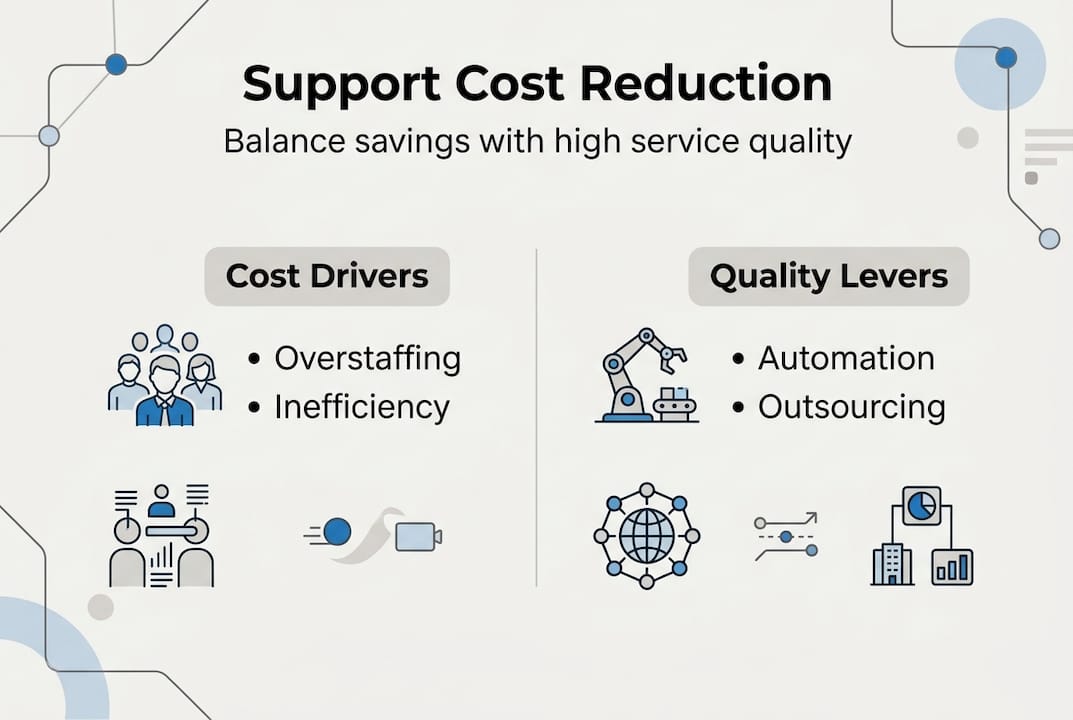
Hugo's experience is instructive: they improved CSAT by 12 points during aggressive cost reductions by maintaining rigorous quality oversight throughout the transition. That result doesn't happen by accident.
Here are the steps that make the difference:
- Define quality standards before you start. Document what good looks like: tone, resolution rate, escalation criteria, and response time targets. Ambiguity kills quality in transitions.
- Implement QA playbooks for outsourced teams. Score a sample of interactions weekly. Share results with your vendor and require improvement plans for underperforming areas.
- Set up real-time dashboards. Track CSAT, FCR, and AHT in near real time so you catch degradation early, not at the end of the month.
- Create feedback loops. Route low-CSAT interactions back to team leads for review. Use patterns in negative feedback to update training materials and bot scripts.
- Run monthly calibration sessions. Align internal QA teams with outsourced teams on scoring standards to prevent drift.
"Quality is not negotiable. Implement continuous monitoring early."
For practical tips on balancing cost and quality, the consistent theme across high-performing organizations is that measurement cadence matters as much as the metrics themselves. Monthly reviews catch problems that quarterly reviews miss entirely.
| Action | Cost impact | Quality impact |
|---|---|---|
| Automate tier-1 queries | High savings | Neutral to positive |
| Outsource overflow volume | Medium savings | Neutral with good SLAs |
| Optimize routing logic | Medium savings | Positive |
| Implement QA playbooks | Low cost | Strongly positive |
| Real-time analytics dashboards | Low cost | Strongly positive |
The best call center services in 2026 all share one characteristic: they treat quality assurance as a continuous process, not a periodic audit.
The uncomfortable truth: You can't cut what you can't measure
Here's what most cost-reduction initiatives get wrong. Leaders focus on the most visible cost, which is usually headcount, and assume that reducing it will solve the problem. It often makes things worse. Fewer agents handling the same volume means longer queues, higher AHT, and lower CSAT. You've cut the budget line while increasing the cost per contact.
The companies that actually win, like Hugo, don't start with cuts. They start with workflow measurement insights that reveal where time and money are actually going. Hugo's improvements came from identifying specific process bottlenecks, not from broad headcount reductions.
The contrarian truth is that investing in measurement infrastructure often delivers a better return than any single cost-cutting initiative. When you know your exact cost per contact by channel, by query type, and by team, you can make surgical decisions instead of blunt ones. Smarter measurement strategies consistently outperform gut-feel cost cutting.
Pro Tip: Switch from annual to monthly target reviews for your core metrics. Annual reviews tell you what happened. Monthly reviews let you course-correct before a trend becomes a crisis.
The leaders who sustain both cost efficiency and quality over time are the ones who treat measurement as an ongoing discipline, not a one-time project.
Ready to reduce your support costs without losing quality?
If the frameworks above resonate, the next step is finding the right partner to execute them. CallTech Outsourcing has been helping technology companies do exactly this since 2005, with multilingual outsourcing call center services across more than 15 European languages.

Our flexible models start from €6.5/hour for standard outsourced support and €4.5/hour for AI-assisted agents, giving you scalable options at every stage of your cost optimization journey. We handle contact center workflow optimization, CRM integration, and quality assurance so your internal team can focus on strategy. Whether you need 24/7 multilingual coverage or targeted overflow capacity, our VoIP outsourcing cost cuts and modern infrastructure mean you get enterprise-grade support without enterprise-grade overhead. Reach out to discuss a model that fits your volume, languages, and quality targets.
Frequently asked questions
What are the fastest ways to reduce customer support costs?
Outsourcing, automation, and process optimization are the fastest proven methods. Hugo, Vodafone, and Klarna all achieved rapid cost reduction by combining these three approaches rather than relying on any single lever.
How do I maintain customer satisfaction while cutting costs?
Monitor quality metrics closely, deploy automation on low-touch cases first, and require outsourcing partners to meet defined SLA and CSAT targets. Hugo improved CSAT by 12 points while aggressively reducing costs by keeping quality oversight in place throughout.
Can automation really improve both cost and quality?
Yes. AI and chatbot deployments at scale have consistently shown lower costs and higher satisfaction scores when escalation paths are well designed and automation is limited to appropriate query types.
What metrics should I track to verify impact?
Track cost per contact, CSAT, FCR, and agent productivity on a monthly basis. Cost per chat and CSAT are the two most reliable indicators of whether your changes are working or creating new problems.