

TL;DR:
- Outsourced appointment setting handles lead qualification and booking, saving sales reps time.
- It often results in 30-60% cost savings and faster, higher-quality pipeline growth.
- Successful partnerships require industry expertise, CRM integration, transparency, and collaboration.
Your sales reps are your most expensive asset, yet most of them spend a significant chunk of their week on tasks that have nothing to do with closing deals. Qualifying cold leads, chasing unresponsive prospects, and scheduling meetings eat up hours that should go toward revenue-generating conversations. Many sales leaders assume this is just the cost of doing business, but that assumption is costing real growth. Outsourcing appointment setting flips that equation. This guide breaks down exactly how these services work in 2026, what they cost, and how SaaS and telecom teams can use them to fill pipelines with meetings that actually convert.
Table of Contents
- What are outsourced appointment setting services?
- In-house vs. outsourced appointment setting: Which is better?
- How outsourced appointment setting improves sales efficiency
- Choosing the right partner: What sales leaders should look for
- A smarter way to empower your sales team
- Ready to drive more qualified sales meetings?
- Frequently asked questions
Key Takeaways
| Point | Details |
|---|---|
| Save time and costs | Outsourcing appointment setting lets your sales team focus on selling and delivers significant cost savings. |
| Boost lead quality | Specialized teams improve lead qualification and increase conversion rates for SaaS and telecom companies. |
| Choose partners wisely | The right provider fits your industry, tech stack, and values transparency and success metrics. |
| Strategic transformation | Treating outsourcing as a partnership, not a transaction, unlocks the greatest efficiency gains. |
What are outsourced appointment setting services?
At its core, outsourced appointment setting means hiring an external team to handle the top of your sales funnel. That team takes responsibility for identifying prospects, conducting outreach, qualifying leads based on your criteria, and booking confirmed meetings directly onto your reps' calendars. Your closers never touch a lead until it is warm, verified, and ready.
For SaaS companies, this usually means targeting specific decision-maker titles, such as VP of Sales or Head of Operations, at companies within a defined size range and vertical. For telecom, it often involves high-volume outbound campaigns targeting businesses ready to renegotiate contracts or upgrade infrastructure. In both cases, the outsourced team acts as a precision filter between raw prospect data and your quota-carrying reps.
Here is what a typical workflow looks like:
- Prospect list build: The provider sources or receives a list of target accounts based on your ideal customer profile (ICP).
- Cold outreach: Outbound calls, emails, or a combination are used to initiate contact.
- Lead qualification: Prospects are screened using your qualification criteria, such as budget, authority, need, and timeline.
- Handoff: Qualified leads are booked as confirmed calendar meetings for your sales team.
- Follow-up: No-shows and soft rejections are nurtured for future attempts.
It is important to distinguish outsourced appointment setting from general telemarketing. Telemarketing often aims at direct sales or brand awareness. Appointment setting is laser-focused on one outcome: getting a qualified prospect in front of your rep. Outsourced appointment setters handle lead qualification, outreach, and booking as a structured, repeatable process, which is why companies using this model consistently see stronger pipeline quality than those relying on reps to self-source.
Industries that benefit most include SaaS, telecom, healthcare, legal services, and local B2B services. Any business with a complex enough sale to warrant a discovery meeting before closing is a strong fit.
Pro Tip: Before handing off to any provider, document your ICP in detail. Include industry, company size, revenue range, tech stack, and the specific pain points your product solves. The more specific you are, the better the quality of meetings you will receive.
In-house vs. outsourced appointment setting: Which is better?
This is the question most sales leaders wrestle with, and the honest answer depends on your stage and goals. Let's put the key differences side by side.
| Factor | In-house | Outsourced |
|---|---|---|
| Startup cost | High (hiring, training, tools) | Low (service contract) |
| Scalability | Slow | Fast |
| Time zone coverage | Limited | Global |
| Industry expertise | Varies | Specialized providers available |
| Control over messaging | Full | Shared |
| Speed to launch | Weeks to months | Days to weeks |
Outsourcing appointment setting can deliver 30-60% cost savings compared to building and maintaining in-house teams once you factor in salaries, benefits, management overhead, and technology costs. For most SaaS and telecom companies operating lean sales organizations, that gap is hard to ignore.
That said, in-house appointment setting makes sense in certain situations:
- Your product requires a highly technical explanation during the first contact.
- Your brand voice is extremely sensitive and difficult to transfer.
- You are selling to a very small, well-known market where personal relationships matter from the first touch.
- You have the budget and runway to build a team properly over six or more months.
The brand misalignment risk is real but manageable. The best providers offer onboarding sessions, script co-development, and regular call reviews to keep messaging consistent. Treat it like an extension of your team, not a black box.

One significant advantage that gets overlooked is time zone coverage. An outsourced team can operate across multiple time zones simultaneously, meaning a prospect who fills out a form at 7 AM or 9 PM still gets a call within minutes. You can explore scalable outsourcing methods that use this follow-the-sun model to maximize contact rates across regions.
Pro Tip: If you are in telecom and selling across European markets, outsourced teams with native-language speakers in each region will dramatically outperform a centralized in-house English-only team on connection and conversion rates.
How outsourced appointment setting improves sales efficiency
The efficiency gains from outsourcing are not theoretical. Here is how the numbers typically shake out when comparing outsourced and in-house performance across key metrics.
| Metric | In-house | Outsourced |
|---|---|---|
| Qualified appointments per rep/month | 8 to 12 | 18 to 28 |
| Average time to first appointment | 5 to 7 days | 2 to 4 days |
| Rep time spent on prospecting | 40 to 50% | Under 10% |
| Lead-to-meeting conversion rate | 5 to 8% | 10 to 15% |
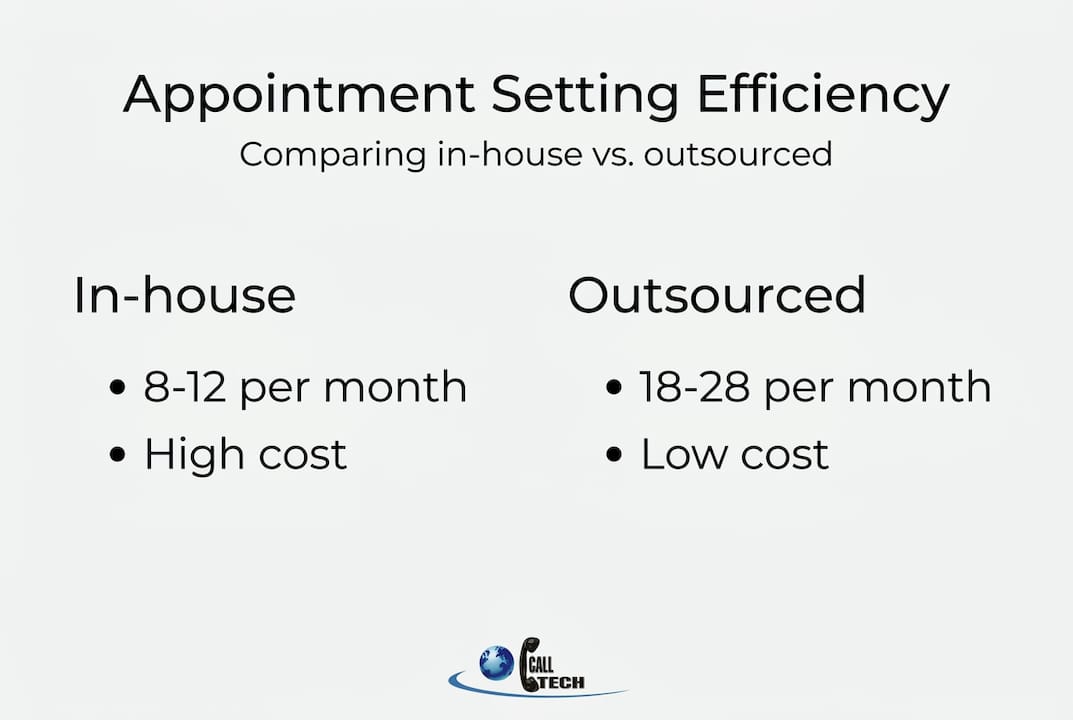
Outsourced teams can increase qualified appointments by up to 50% for SaaS companies, primarily because dedicated appointment setters are focused on one task all day, every day. They are not splitting attention between prospecting, demos, and account management.
The cycle from outsourcing to closed revenue follows a clear pattern:
- Outsourced team qualifies and books: Reps receive calendar invites with notes on the prospect's situation, pain points, and qualification status.
- Rep runs a focused discovery call: With context already in hand, the rep can skip basic qualification and move straight to value demonstration.
- Faster close: Deals that start with pre-qualified meetings close faster and at higher rates because time is not wasted on prospects who were never a fit.
"Reps who spend less than 20% of their time on prospecting consistently outperform those who spend more than 40% on it. The difference is not talent. It is focus."
This is where CRM-powered outsourcing becomes a serious competitive advantage. When your outsourced team writes notes, updates deal stages, and logs calls directly into your CRM, your internal reps walk into every meeting fully informed. There is no friction, no data gaps, and no lost context between handoff and close.
For telecom companies managing high-volume pipelines, following contact center best practices around call scripting and lead disposition coding ensures the outsourced team feeds data back in a format your sales managers can actually act on.
Choosing the right partner: What sales leaders should look for
Not all outsourced appointment setting providers are built the same. A provider with strong retail experience may struggle with a B2B SaaS sale. Due diligence involves assessing industry fit, tech stack compatibility, and transparency before you sign anything.
Here are the top selection criteria to prioritize:
- Proven SaaS or telecom experience: Ask for case studies and references from companies in your vertical.
- CRM integration capability: The team should be able to log activity directly into Salesforce, HubSpot, or whatever platform you use.
- Transparent reporting: You should receive daily or weekly dashboards showing dials, contacts, qualification rates, and bookings.
- Data security compliance: Especially important for telecom and SaaS companies handling customer data under GDPR or similar frameworks.
- Flexible pricing models: Look for options that include hourly, per-appointment, or hybrid structures depending on your volume.
Before signing, ask these three questions:
- How do you handle leads that do not convert on the first contact? A strong provider has a defined nurture process, not a discard pile.
- Who writes the scripts and how often are they tested and updated? Generic scripts are a red flag. You want collaborative script development with regular A/B testing.
- What does the onboarding process look like and how long before we see qualified meetings? Realistic timelines matter. Be cautious of anyone promising results within 48 hours.
Warning signs to watch for include vague SLAs with no measurable outcomes, providers who push a one-size-fits-all script, and teams that resist giving you direct access to call recordings. Transparency is non-negotiable.
For context on how a well-run outsourced operation should function, the help desk outsourcing guide covers service level expectations that apply equally to appointment setting environments. And when evaluating any outsourcing provider partnership, look for evidence of long-term client relationships, not a revolving door of short engagements.
Get your internal sales team involved early. When reps feel like outsourcing is being done to them rather than for them, adoption suffers. Frame it as giving them better leads, not replacing their role.
A smarter way to empower your sales team
Most companies that try outsourced appointment setting and walk away disappointed made the same mistake. They treated the provider like a vending machine. Put in a prospect list, get out meetings. That is not how it works.
The companies that see transformational results treat their outsourced team as a genuine extension of their sales organization. They share product updates, run monthly feedback sessions, and adjust targeting based on what is actually converting downstream. They measure the outsourced team on meeting quality, not just meeting volume.
Here is the contrarian view worth considering: the real value of outsourcing appointment setting is not the cost savings, even though those are significant. It is the strategic clarity it forces on your organization. When you have to define your ICP, write qualification criteria, and build a scalable handoff process, you are building the infrastructure for repeatable growth. The outsourced team just runs it.
Most sales leaders underinvest in efficiency in outsourcing because they think the ROI is about headcount reduction. It is actually about leverage. One great rep with 25 pre-qualified meetings a month will always outperform three average reps each spending half their time cold calling.
Pro Tip: Run a 60-day pilot with a narrow segment of your ICP before committing to a full rollout. Use that window to stress-test the script, refine qualification criteria, and confirm the provider can represent your brand the way you need.
Ready to drive more qualified sales meetings?
If your sales team is spending more time prospecting than closing, the math is working against you. The good news is that fixing it does not require a full restructure.

CallTech Outsourcing has been helping SaaS and telecom companies build reliable, multilingual appointment setting operations since 2005. With nearly 20 years of experience, coverage across more than 15 European languages, and full CRM integration capabilities, we build outbound programs that put qualified meetings on your reps' calendars at scale. Explore our outsourced appointment setting services to see how we structure campaigns for your industry, or review our call center service options to find the model that fits your team's size and goals.
Frequently asked questions
How does outsourced appointment setting work for SaaS companies?
A specialized team qualifies leads and schedules meetings directly onto your reps' calendars using your ICP, qualification criteria, and approved scripts. Your internal team only engages once a prospect is confirmed and ready for a discovery call.
How much can my company save by outsourcing appointment setting?
Outsourcing delivers 30-60% cost savings compared to building an in-house team when you account for salaries, training, management, and tooling costs. Most companies see the gap widen further as they scale volume.
What should I look for in an outsourced appointment setting provider?
Prioritize industry fit and CRM integration alongside transparent reporting and clearly defined SLAs. A provider who resists sharing call recordings or performance data is not a provider worth trusting.
Is outsourced appointment setting only for large enterprises?
Scalable outsourcing methods are available for companies of all sizes, from early-stage SaaS startups to global telecom operators. Many providers structure pricing to match your current volume with the flexibility to grow as your pipeline expands.