

TL;DR:
- Most subscription customer churn is due to operational failures like failed payments and process breakdowns, not agent empathy. Effective multilingual support focuses on measurable outcomes, proactive engagement, and seamless recovery to improve retention. Treating localization as an operational program rather than a translation project is essential for sustained success.
Most subscription teams spend heavily on agent training and help desk tools, then wonder why churn numbers barely move. The problem is often not the agents. A material share of churn is involuntary and linked to failed payments, language barriers, and process breakdowns that no amount of empathy coaching can fix. This guide walks through the operational and multilingual support strategies that actually drive measurable retention improvements, from recovering failed payments to designing localized support programs that produce real business outcomes.
Table of Contents
- Why subscription customer service is unique
- Operational churn: Tackling failed payments and recovery
- Designing multilingual support for measurable retention
- Proactive support: Predicting and preventing churn before it happens
- Perspective: Why most multilingual retention efforts fall short
- Scale your subscription customer service with expert multilingual support
- Frequently asked questions
Key Takeaways
| Point | Details |
|---|---|
| Involuntary churn is preventable | Failed payments cause 20–40% of churn but can be reduced with proactive support and smart billing practices. |
| Measure support by outcomes | Track self-serve rate, FCR, and cancellation saves by language and intent to prove real multilingual impact. |
| AI enables scalable engagement | Deploy multilingual AI support to deflect tickets and reduce churn while covering all markets. |
| Proactive action prevents churn | Use predictive analytics and omnichannel support to address risks before customers leave. |
| Annual billing requires support touchpoints | Retention hinges on how support handles renewal and cancellation calls, even with annual contracts. |
Why subscription customer service is unique
To address the real churn risks in subscription models, it's important to first understand what sets subscription customer service apart from other support types.
Subscription support is not a one-time transaction. Every interaction either strengthens or weakens a relationship that directly affects lifetime value (LTV). When a customer contacts support about a billing error in month three, that moment carries far more weight than a post-purchase question for a physical product. The stakes are compounded month after month, renewal after renewal.
Most leaders inherit a support model built for transactional businesses and try to adapt it. That's where the trouble starts. Subscription support must align with specific customer lifecycle moments: onboarding, mid-cycle usage questions, pre-renewal communication, and payment events. Each stage requires a different type of support response, a different tone, and often a different channel.
Here's what drives churn in subscription businesses, and it's not what most teams expect:
- Failed payments and billing friction are structural problems, not service failures
- Poor onboarding support leads to low feature adoption and early cancellations
- Inconsistent service quality across languages drives silent churn in international markets
- Missed renewal communication leaves customers confused and at risk
- Long resolution times at critical moments like cancellation intent convert fence-sitters into churners
"A large portion of churn is structurally driven by failures and friction, not solely by agent empathy or ticket resolution." (Customer Retention Strategies)
The data backs this up. Annual customers churn 3 to 7 times less than monthly customers, but even annual plans carry serious risk at renewal and cancellation points. Annual billing buys time. It doesn't buy loyalty on its own.
The support teams that win at retention understand this distinction. They build workflows around moments of truth, not just ticket volume. A strong customer retention guide for subscription businesses always starts with mapping these moments and designing support responses for each one.
Operational churn: Tackling failed payments and recovery
Once the distinct dynamics of subscription support are clear, the next priority is to focus on the largest and least-appreciated cause of churn: operational failures, starting with payment problems.
Involuntary churn from failed payments accounts for 20 to 40 percent of all churn. That number stops most operators cold the first time they hear it. Nearly half of all lost customers may never have intended to leave. They simply got caught in a payment failure with no recovery path.
The good news is this type of churn is almost entirely preventable with the right combination of technical and support measures.
| Recovery method | Impact level | Support team involvement |
|---|---|---|
| Smart retry logic (ML-powered) | High | Low (automated) |
| Card expiration alerts | High | Medium (outbound follow-up) |
| Dunning email sequences | Medium | Low to medium |
| Live agent outreach for VIP accounts | Very high | High |
| Self-serve payment update portals | Medium | Low |
Smart retry logic and card expiration reminders sit at the technical end of the recovery stack. Platforms like Stripe use machine learning to optimize the timing and frequency of payment retries, recovering a significant share of initially failed transactions without any customer contact. But technology alone doesn't cover the full picture.
Here's a practical recovery workflow that combines technical and human support:
- Detect the failure immediately. Configure your billing platform to flag failed payments in real time and trigger both an automated retry and a customer notification simultaneously.
- Send a clear, branded notification. Avoid threatening language. Frame it as a quick fix, not a warning. Localize this message for every language market you serve.
- Allow self-serve payment updates. Many customers will resolve the issue themselves if given a frictionless path. A clear link to a payment update page removes the need for agent contact.
- Trigger an agent outreach for high-value accounts. For accounts above a defined revenue threshold, a proactive outbound call or chat within 24 hours of a failed payment dramatically improves recovery rates.
- Track dunning recovery rates. Measure how many failed accounts are recovered within 7, 14, and 30 days. Compare results across channels and languages to identify gaps.
- Close the loop with sentiment tracking. After a successful recovery, a brief customer effort score (CES) survey reveals how the experience felt and whether the customer's trust was maintained.
Pro Tip: Coordinate your billing team and support team around a shared alert system. When agents know a customer calling about a billing error also had a failed payment last week, they can address both issues proactively rather than reacting to one at a time. This kind of coordination is central to any solid process improvement guide for subscription operations.
The businesses that reduce involuntary churn the fastest are not always the ones with the best retry logic. They're the ones where billing and support share data, communicate fast, and treat payment recovery as a customer experience moment rather than a backend process.

Designing multilingual support for measurable retention
Preventing churn isn't just about recovering lost revenue. It's also about delivering proactive, targeted support to every customer, in the language they speak and in the channel they prefer. This is where multilingual operations can truly move the needle.
Many subscription businesses launch multilingual support by translating their top 10 help articles and calling it done. That approach generates almost no measurable impact on churn. The need for multilingual support goes far deeper than content translation.
Effective multilingual support is designed around outcomes, tracked by language, intent, and customer segment. That means measuring the following metrics for every language you serve:
- Self-serve resolution rate: How often do customers find answers without contacting an agent?
- Ticket deflection rate: What share of potential contacts are resolved through automated or self-serve channels?
- First contact resolution (FCR): Are agents resolving issues completely on the first interaction?
- Reopen rate: How often do customers come back with the same problem?
- Cancellation save rate: When a customer signals intent to cancel, how often does a support interaction change that outcome?
The goal is to design multilingual support around measurable outcomes by language, such as self-serve resolution, first-contact resolution, and cancellation intercept rates. Tracking these numbers by language reveals which markets are underserved and where localization investment will produce the highest return.
| Support approach | Ticket deflection | FCR rate | Churn reduction potential |
|---|---|---|---|
| English-only help center | Low | Medium | Minimal for non-English markets |
| Translated help articles only | Low to medium | Medium | Marginal |
| Multilingual AI chat plus articles | High | High | Significant |
| Multilingual AI plus human agents | Very high | Very high | Maximum |
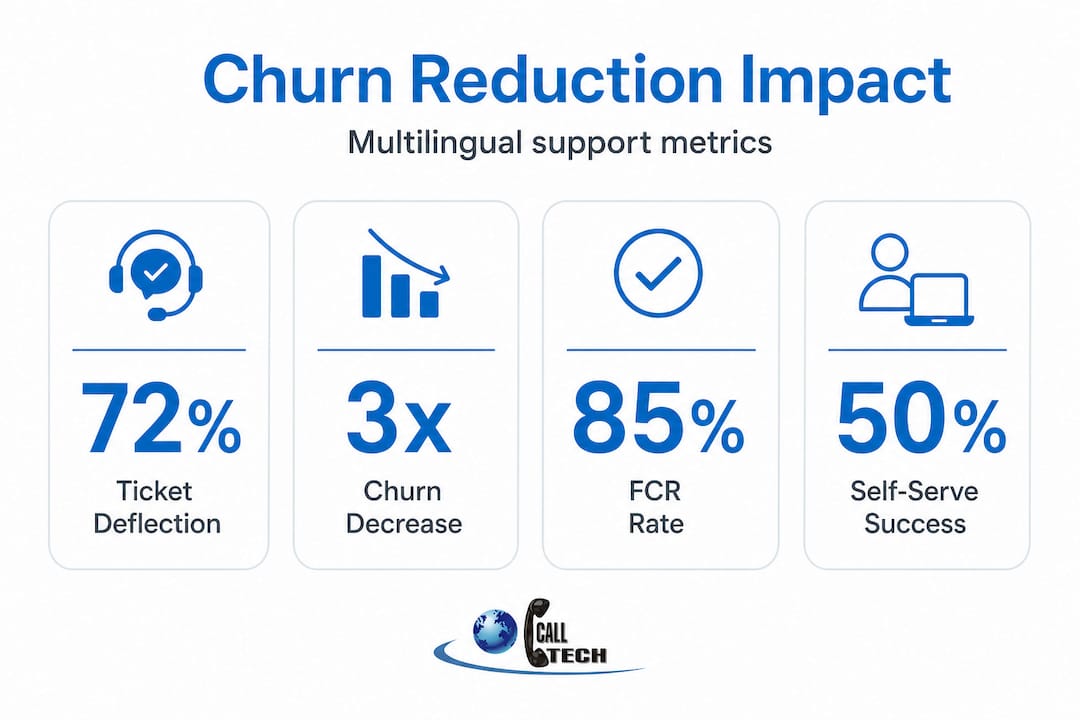
Multilingual AI chat achieved 72% ticket deflection and reduced churn for a SaaS subscription platform. That's not a marginal improvement. A 72 percent ticket deflection rate means the vast majority of customer questions are resolved instantly, without waiting for an agent, and without the frustration that drives cancellation decisions.
AI-powered multilingual support works best when it's layered with human agents who handle complex issues and cancellation conversations. AI covers volume and speed. Agents cover nuance and relationship recovery.
Pro Tip: Don't limit localization to your help center. In-app prompts triggered at key moments (after a failed action, during a free trial expiration, or at the renewal gate) in a customer's native language can reduce support tickets and cancellations at the same time. Multilingual engagement strategies that embed localization into the product experience consistently outperform those limited to support channels alone.
Localization also applies to agent scripts. When a German-speaking customer calls with a billing complaint, they expect more than a translated version of your English script. Regional communication norms, formality levels, and even the pacing of a support conversation differ by culture. Training agents to match those expectations is what separates functional multilingual support from genuinely effective multilingual support.
Proactive support: Predicting and preventing churn before it happens
Structured, measurable multilingual support solves much of the churn problem, but proactive engagement and early warning systems unlock even higher retention rates.
The traditional support model is reactive. A customer has a problem, contacts support, and gets help. In subscription businesses, this model is far too slow. By the time a customer reaches out about a frustration they've been experiencing for two weeks, the cancellation decision may already be forming.
Subscription-centric support flips this model. Customer support should be subscription-centric, with agents alerted to churn-risk accounts using usage and engagement metrics. That means building a system where low login frequency, declining feature usage, or missed onboarding milestones automatically flag an account for proactive outreach.
Here's how to structure a proactive churn prevention system:
- Define risk signals for your product. Common indicators include a drop in weekly active usage, skipped renewal reminders, multiple failed login attempts, or a spike in support tickets related to a single feature.
- Connect your product analytics to your CRM. When risk signals appear, they should automatically create a task or alert in your support team's queue, not sit in a product dashboard nobody checks.
- Create tiered intervention scripts. A customer who has reduced usage by 30 percent needs a different conversation than one who just submitted a cancellation form. Train agents for each scenario.
- Use omnichannel touchpoints strategically. Churn risk from negative service interactions can be preempted with real-time monitoring and omnichannel support. Email, in-app messaging, and phone all serve different purposes in a proactive outreach strategy.
- Measure intervention outcomes. Track what percentage of at-risk accounts that received proactive contact stayed subscribed versus those that did not. This data justifies continued investment in proactive programs.
"Customers who receive proactive support before a problem escalates are significantly more likely to remain subscribers than those who only receive reactive assistance."
Additional tactics that reduce voluntary cancellations include:
- Renewal education campaigns sent 30, 14, and 7 days before a billing date, in the customer's language
- Usage milestone messages celebrating customer success and reinforcing value
- Personalized check-in calls for enterprise or high-value accounts at the midpoint of their subscription year
- Self-service pause options as an alternative to cancellation, promoted proactively by agents handling cancellation calls
Combining multilingual support conversions data with behavioral signals creates a powerful retention engine. When you know that French-speaking customers in a specific usage segment churn at twice the rate of their English-speaking counterparts, you can target that exact cohort with a localized, proactive campaign. That's the level of precision that moves retention metrics at scale.
Dedicated multilingual support agents who specialize in cancellation prevention and renewal support consistently outperform generalist teams on save rates. Specialization matters when the conversation is high-stakes.
Perspective: Why most multilingual retention efforts fall short
After nearly 20 years of working with subscription businesses across telecom, SaaS, and digital services, one pattern stands out above all others: most multilingual retention programs fail not because of poor translation quality, but because they're treated as content projects rather than operational programs.
The trap is easy to fall into. A company expands into three new European markets, commissions translation of its help center, hires a few bilingual agents, and declares the multilingual program live. Six months later, churn in those markets is nearly the same as before. The conclusion many teams reach is that multilingual support doesn't move the needle. The real conclusion should be that the program was never measured properly.
Multilingual support often fails when treated as a translation project; it should be governed as an operational measurement program by language and intent. That means assigning a business owner to each language market, setting specific FCR and deflection targets by locale, reviewing those numbers monthly, and iterating based on what the data shows.
The teams that get this right treat localization the same way they treat product development: hypothesis, build, measure, improve. They tie every localization investment to a specific support outcome or retention metric. If a new German help article doesn't reduce German-speaking ticket volume by a measurable amount within 60 days, it gets revised.
The uncomfortable truth is that most customer service leaders don't have this level of rigor around their multilingual programs. Translation gets done, agents get hired, and results get assumed rather than measured. Building effective remote multilingual teams requires the same operational discipline as building any high-performing team: clear goals, regular measurement, and fast iteration.
The shift from translation project to retention program is a mindset change, not a technology purchase. It costs nothing to start measuring FCR by language this quarter. It costs a great deal to keep investing in multilingual support for another year without knowing whether it's working.
Scale your subscription customer service with expert multilingual support
The blueprint above works. But executing it across multiple languages, time zones, and customer segments requires either a very large internal team or the right external partner.

CallTech Outsourcing has been helping subscription businesses in SaaS, telecom, and digital services reduce churn through operationally measured multilingual support since 2005. Our teams combine dedicated native-language agents with AI-powered frameworks to deliver fast, scalable support across more than 15 European languages. We measure outcomes, not just activity: FCR, ticket deflection, cancellation save rates, and dunning recovery. If you're ready to turn your multilingual support into a real retention engine, explore our outsourcing call center services or learn how we enhance multilingual customer engagement for subscription brands like yours.
Frequently asked questions
What is the most common cause of churn in subscription businesses?
Failed payments such as expired cards or banking issues are a leading cause of involuntary churn. Involuntary churn from payments accounts for 20 to 40 percent of all subscription churn.
How does multilingual support reduce churn?
Multilingual support boosts self-serve resolution, reduces ticket reopen rates, and improves retention in international markets. The key is to design multilingual support around measurable operational outcomes rather than content volume.
Which metrics should we track to measure multilingual support success?
Track self-serve rate, ticket deflection, first-contact resolution, reopen rate, and cancellation save outcomes by language. Track self-serve rate by language and first-contact resolution alongside cancellation intercept data for the clearest picture.
What role does AI play in multilingual subscription support?
AI enables scalable, always-on support across multiple languages, deflects a large share of tickets, and lowers churn by resolving issues instantly. Multilingual AI chat achieved 72% ticket deflection and reduced churn for a subscription platform in a documented case study.
Does annual billing always reduce churn in subscription services?
Annual customers typically churn far less than monthly, but support quality at renewal moments still determines outcomes. Annual customers churn 3 to 7 times less than monthly customers, though proactive renewal support remains essential.