

TL;DR:
- Multilingual support significantly boosts international ecommerce conversions and revenue.
- Outsourcing support with the right technology enhances scalability and operational efficiency.
- Support builds trust, loyalty, and brand reputation in global markets.
Most ecommerce leaders assume product quality and price are the primary drivers of international sales. The data says otherwise. A Shopify store that added five languages to its customer support operation saw international conversion jump 600%, moving from a 0.4% to a 2.8% conversion rate, with revenue climbing 312%. That is not a marketing win. That is a support win. This article covers why multilingual support is a genuine growth lever, how to build the right operational foundation, which strategies and technologies scale results, and where the industry is heading next.
Table of Contents
- Why customer support is critical for global ecommerce growth
- Building blocks: Core components of effective ecommerce support
- Key strategies to deliver top-tier multilingual support
- Technology and outsourcing: Tools that enable scalable support
- A new reality: Why support is your brand's global differentiator
- Scale your global support with expert partners
- Frequently asked questions
Key Takeaways
| Point | Details |
|---|---|
| Multilingual support drives sales | Offering support in more languages can multiply international sales and revenue. |
| Outsourcing enables rapid scaling | Expert partners and tech platforms make it much easier to support diverse global customers. |
| Core strategies boost CX | Effective recruitment, training, and tools are key to delivering world-class customer experiences. |
| Support shapes brand loyalty | Top brands invest in support as a long-term differentiator, not just a cost center. |
Why customer support is critical for global ecommerce growth
When shoppers land on your store from Germany, Poland, or Spain, their first question is not "Is this product good?" It is "Will someone help me if something goes wrong?" That question is answered before they ever contact you, by the language options you offer and how quickly you respond in those languages. Support shapes trust, and trust drives purchases.
The numbers back this up clearly. One Shopify merchant recorded a 600% conversion increase after adding multilingual support across five languages. The revenue impact was 312% growth. These are not incremental gains. They represent what happens when international shoppers finally feel confident enough to buy.
Here is what separates multilingual ecommerce operations from monolingual ones:
- Language coverage: Shoppers can get help in their native tongue, reducing confusion and cart abandonment
- Cultural fluency: Agents understand local norms, making interactions feel natural rather than robotic
- Faster resolution: Agents who speak the customer's language resolve issues in fewer exchanges
- Higher loyalty: Customers who receive native-language support are far more likely to return and refer others
- Broader reach: You can realistically enter new markets without restructuring your entire operation
"Customers are four times more likely to purchase from a brand that communicates in their native language, and that preference becomes even stronger when something goes wrong." This dynamic makes support the trust engine behind repeat purchases in international markets.
The multilingual engagement benefits extend beyond first-time conversions. When a shopper has a smooth return experience in their own language, you have earned their loyalty. That loyalty compounds. Repeat customers spend more, complain less, and bring others with them. Building customer loyalty through language-native support is one of the highest-return investments an ecommerce business can make.

Understanding global support needs means recognizing that language is not just a feature. It is a signal of respect. And in ecommerce, respect translates directly into revenue.
Building blocks: Core components of effective ecommerce support
Knowing that multilingual support matters is one thing. Building it correctly is another. Many companies make the mistake of adding a language option without building the operational infrastructure to support it. The result is a frustrating experience that damages the brand more than no support at all.
Start with this comparison of support models:
| Model | Best for | Strengths | Weaknesses |
|---|---|---|---|
| In-house | Small teams, 1-2 languages | Full control, brand alignment | High cost, hard to scale |
| Outsourced | 3+ languages, rapid growth | Speed, expertise, cost efficiency | Requires strong onboarding |
| Hybrid | Mid-size brands with complex needs | Flexibility, layered coverage | Management complexity |
For most growing ecommerce businesses, outsourcing multilingual support is the fastest path to covering multiple markets without overextending internal resources.
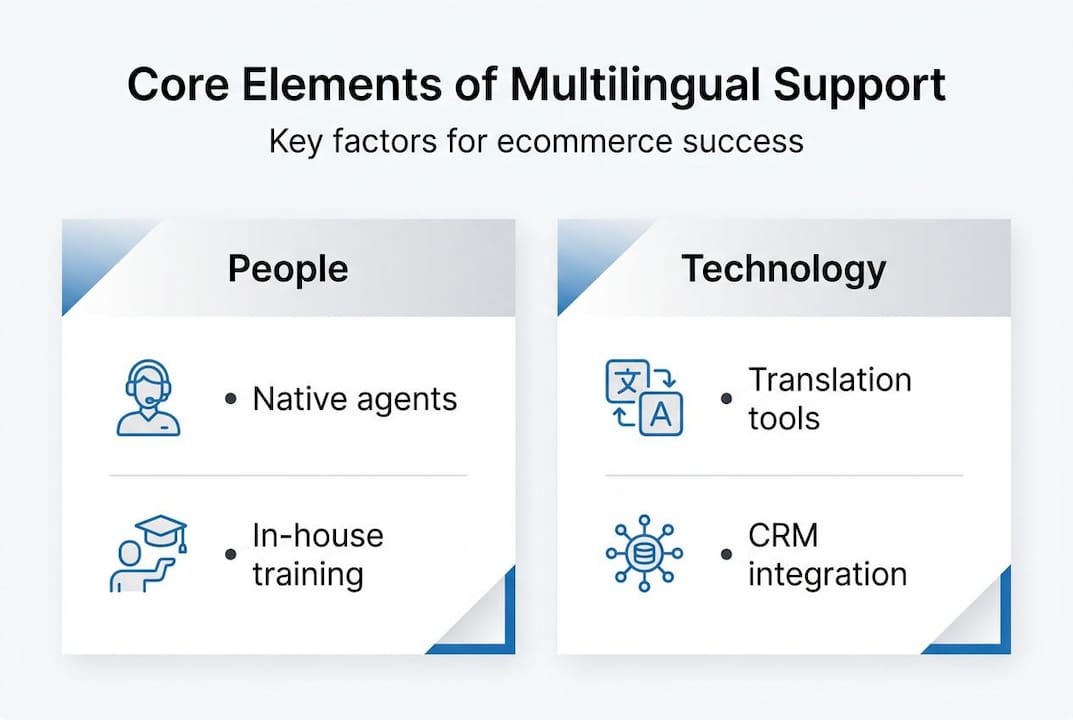
Once you have chosen your model, build on these five foundational pillars:
- Language coverage: Define which markets you serve and ensure native-level agents cover each one
- Omnichannel capability: Customers reach you by chat, email, phone, and social. Be present on all of them
- Response speed: International shoppers have the same expectations as local ones. Slow responses kill confidence
- Knowledge base: A well-maintained, multilingual FAQ and internal knowledge base cuts handle time and improves consistency
- Cultural fluency: Scripts should adapt tone by market. What feels friendly in the Netherlands may feel cold in Spain
Pro Tip: Avoid launching a language with a single agent and no backup coverage. Thin support creates bottlenecks during peak periods and trains customers to expect delays. Build redundancy from day one.
Training matters enormously here. Agents need product knowledge, escalation paths, and market-specific tone guides. Collect customer feedback by language and region to continuously refine scripts. Avoid the common outsourcing mistakes that stem from insufficient onboarding or unclear performance benchmarks. The case for investing properly is clear: language-driven conversion gains are only possible when support quality is consistent across every market you operate in.
Key strategies to deliver top-tier multilingual support
Building the infrastructure is just the foundation. Scaling it effectively requires deliberate strategy at every layer, from hiring to automation to channel management.
When it comes to recruiting and managing multilingual agents, these practices separate high-performing teams from average ones:
- Hire for cultural fluency, not just language fluency. A native speaker who does not understand the market's customer expectations creates friction
- Use shadowing programs where new multilingual agents train alongside experienced ones before going live
- Set language-specific KPIs (key performance indicators). Resolution time and satisfaction scores can vary by market, so measure accordingly
- Rotate agents across channels to prevent burnout and build versatility
- Incentivize quality, not just speed. Fast but inaccurate support costs more in the long run
Here is how top-performing ecommerce companies typically structure their support coverage:
| Language tier | Channels supported | Avg. response time |
|---|---|---|
| Core (English, German, French) | Phone, chat, email | Under 2 minutes |
| Secondary (Spanish, Italian, Dutch) | Chat, email | Under 4 minutes |
| Emerging (Polish, Czech, Romanian) | Email, async chat | Under 8 hours |
Pro Tip: Resist the urge to fully automate tier-one support in new markets. Chatbots trained on English data perform poorly in languages with complex grammar or regional dialects. Start with human agents, then introduce automation once you have enough real conversation data to train your tools effectively.
Your support workflow at scale must also account for tone adaptability. A pre-sale inquiry from a shopper in France requires a different register than a billing dispute from a customer in Poland. Rigid scripts fail here. Use modular script blocks that agents can combine based on context and market. The connection between adding more language options and higher global conversion rates is real, and efficient support strategies are what make that connection sustainable. Studying retail growth examples across industries confirms that operational depth behind the customer experience is what separates scalable brands from those stuck in one market.
Technology and outsourcing: Tools that enable scalable support
Even the best agents need the right tools. The technology stack you choose determines how efficiently your team operates and how quickly you can add new languages or channels.
The essentials for any multilingual ecommerce support operation include:
- CRM systems: Centralize customer history across languages and channels so agents have full context before responding
- AI-enabled helpdesks: Route tickets intelligently by language, topic, and urgency without manual triage
- Live translation integrations: Allow agents to handle unexpected languages without dropping quality, useful as a bridge while you scale native coverage
- Real-time analytics dashboards: Track resolution rates, satisfaction scores, and response times by language and channel
- Workflow automation tools: Handle repetitive tasks like order confirmations and tracking updates so agents focus on complex issues
AI and chatbot tools play a growing role, but their value is in handling volume on well-understood queries, not in replacing judgment on nuanced issues. A chatbot that misunderstands a complaint in Czech does more damage than a 30-minute wait for a native-speaking agent.
Pro Tip: When evaluating outsourcing partners, ask specifically about their CRM integrations and translation stack. A partner with no CRM compatibility will create data silos that slow your team down and make quality measurement nearly impossible.
The business case for CRM-powered outsourcing is strong. Outsourced partners with established technology infrastructure eliminate the capital cost of building your own stack. Cost-effective outsourcing models let you pay for what you use and scale up or down as demand shifts. Stores that leverage technology and outsourcing together for multichannel, multilingual support consistently report exceptional financial gains, precisely because both sides of the equation reinforce each other. Smart selection of retail supplier strategies in adjacent industries shows the same pattern: operational efficiency compounds when technology and human expertise are aligned.
A new reality: Why support is your brand's global differentiator
For years, the dominant logic in ecommerce was simple: build a great product, price it competitively, and growth will follow. Support was seen as a cost to minimize, a department to offshore to the cheapest possible option, a problem to solve only after something broke. That logic is no longer defensible.
The brands winning in international markets today are not just outspending competitors on ads. They are outperforming them on trust. Support is the moment where trust is either built or destroyed. It is almost always invisible when it works and devastatingly loud when it fails.
The most successful ecommerce companies we work with treat support as a continuous feedback loop. Every resolved issue, handled in the customer's native language, adds to that shopper's lifetime value. Every frustrated ticket that bounced between untrained agents, or worse, never got answered, chips away at it. The math is not complicated.
In global commerce, support is not just a cost. It is the trust engine that drives repeat purchase, referrals, and long-term brand equity. Companies that invest proactively in outsourcing for support success understand this. Those that wait until support becomes a crisis are already paying the hidden cost of lost customers they never knew they had.
Scale your global support with expert partners
If this guide has made one thing clear, it is that multilingual support is not a side project. It is a core growth function. The question is not whether to invest in it, but how to do it efficiently.

CallTech Outsourcing has been helping ecommerce businesses scale their multilingual support outsourcing operations since 2005, covering more than 15 European languages with agents trained in both CX and cultural fluency. Our solutions are built specifically for businesses like yours, with flexible models that grow as your markets grow. Explore how engagement-boosting support and a streamlined global support workflow can turn your support operation into a genuine competitive advantage.
Frequently asked questions
How does multilingual support impact ecommerce sales?
Adding native-language support can dramatically lift international conversion rates. One documented case shows a 600% conversion increase after a store added five languages, with revenue growing 312%.
What are the most cost-effective ways to provide support in multiple languages?
Outsourcing to specialized providers combined with a strong technology stack delivers the best balance of quality, speed, and cost. Multilingual outsourcing consistently outperforms building fully in-house for most ecommerce businesses.
When should ecommerce stores outsource customer support?
Outsource when you lack native-language agents in-house, when your support volume is growing faster than your team, or when entering a new market where building internal expertise would take too long.
Which technologies are essential for scalable support?
Prioritize CRM systems, AI-enabled helpdesks, live translation tools, and real-time analytics platforms. These four categories cover routing, context, language access, and performance measurement across all your markets.