

TL;DR:
- Effective market research integrates culturally relevant, language-segmented data with AI-driven analytics to inform operational improvements. It identifies specific regional customer pain points, enhances support strategies, and facilitates targeted product localization across global markets. Choosing a partner with deep multilingual expertise and actionable insight delivery is crucial for driving tangible business growth.
Language fluency is not enough to win international markets. Companies in telecom, SaaS, and e-commerce often invest heavily in translating their customer support without first understanding what their customers in each region actually need, expect, or resent. The result is polished communication built on shaky assumptions. Targeted market research services are what separate global brands that grow from those that merely operate in multiple languages. This guide breaks down the methodologies, impact metrics, and selection criteria that corporate decision-makers need to make research work at real scale.
Table of Contents
- What are market research services and why do they matter?
- Leading methodologies in telecom, SaaS, and e-commerce
- How multilingual research drives customer support and efficiency
- Selecting and evaluating a market research partner
- The uncomfortable truth most market research clients overlook
- Looking for multilingual market research that drives true global efficiency?
- Frequently asked questions
Key Takeaways
| Point | Details |
|---|---|
| Multilingual research boosts efficiency | Using multilingual market research leads to faster insights and better customer support globally. |
| Combine qualitative and AI methods | Blending traditional research with AI-driven analytics yields the most actionable results. |
| Select partners by outcomes | Choose vendors who demonstrate real improvements, not just large data samples. |
| Tailor approaches by industry | Telecom, SaaS, and e-commerce each require specialized research strategies for maximum impact. |
What are market research services and why do they matter?
Market research services are structured programs that gather, analyze, and translate customer and market data into decisions your business can act on. For global operations, they split into two broad types. Primary research pulls directly from your audience through surveys, interviews, and focus groups. Secondary research draws on existing sources like industry reports, competitive data, and behavioral analytics platforms.
Both categories also break down by approach. Quantitative research gives you numbers: response rates, churn percentages, satisfaction scores. Qualitative research gives you context: why customers are churning, what friction points frustrate them in specific markets, and what language actually resonates.
For companies operating in telecom, SaaS, and e-commerce, this combination is not optional. These industries move fast, operate across dozens of markets, and carry complex customer journeys. A telecom provider expanding into Central Europe faces different support expectations than one already embedded in Western Europe. A SaaS platform entering B2B markets in Scandinavia encounters purchase decision logic that rarely appears in standard industry templates.
The efficiency and customer experience improvements that research can drive are well documented, but only when the methodology actually fits the market. This is where many organizations fall short. They run global surveys in one language or rely on industry-wide reports that mask the nuances that matter most at the local level.
AI-driven global market insights are rapidly changing the speed and predictive accuracy of this process. AI tools can now analyze open-ended survey responses across multiple languages simultaneously, flag emerging trends before they reach critical mass, and build predictive models that anticipate where churn risk is climbing before your support team sees the volume spike. This makes research faster and more actionable, but it does not replace the need for culturally diverse panels and methodologically sound question design.
"Market research services for telecom, SaaS, and e-commerce typically employ a mix of primary and secondary methodologies, with AI integration for predictive insights and real-time analysis."
Key strategic applications of market research in global operations include:
- Identifying support pain points that are unique to specific language markets
- Mapping customer journeys to expose handoff failures between channels
- Building a baseline for measuring the impact of operational changes over time
- Informing product localization with actual user feedback rather than assumptions
- Prioritizing which markets deserve deeper investment based on satisfaction and loyalty trends
When research is embedded in business process outsourcing, it becomes a continuous feedback loop rather than a one-time exercise.
Pro Tip: Never apply a single survey instrument across all markets without localization review. A question that feels neutral in German can carry a very different emotional tone in Polish or Romanian, and that changes what respondents tell you.
Leading methodologies in telecom, SaaS, and e-commerce
The most effective market research programs are not one-size-fits-all. Each vertical has evolved specific methodologies that match how its customers make decisions and where they are most likely to share honest feedback.
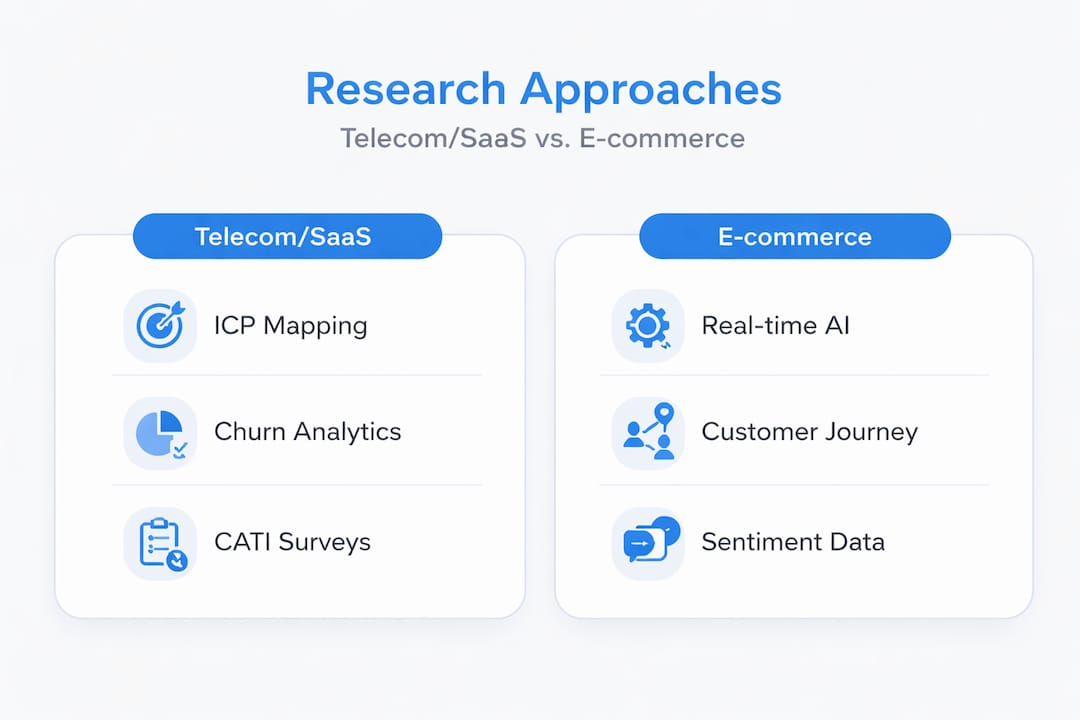
| Vertical | Primary methods | AI-enhanced tools | Key output |
|---|---|---|---|
| Telecom | ICP definition, churn surveys, NPS | Churn prediction models, WOA | Retention strategy |
| SaaS | Customer journey mapping, win/loss interviews | Predictive churn, synthetic personas | Product and support alignment |
| E-commerce | Post-purchase panels, sentiment analysis | Real-time trend detection | Conversion and loyalty lift |
ICP definition (Ideal Customer Profile) goes well beyond company size or revenue band. In B2B telecom and SaaS environments, a nuanced ICP captures the emotional and organizational triggers that drive switching decisions. A procurement lead at a mid-size logistics firm in the Netherlands has fundamentally different switching logic than one at a retail chain in Romania. Treating those as equivalent is a costly error.
Customer journey mapping in SaaS is particularly powerful when it incorporates multilingual support touchpoints. Where do customers in French-speaking markets drop off compared to English-speaking markets? Are there specific onboarding steps where non-native speakers disengage? These are questions that mapping can answer when it is built on language-segmented data.
Churn analytics performance research has demonstrated that machine learning models like the Whale Optimization Algorithm (WOA) outperform traditional statistical methods in predicting which customers are about to leave. WOA-based models identify complex, non-linear patterns in usage data that simpler regression models miss entirely. For telecom operators managing millions of subscribers, that difference translates directly into revenue saved.
CATI survey methods (Computer-Assisted Telephone Interviewing) remain highly effective in markets where response rates to digital surveys are low, particularly in Southern and Eastern Europe. They allow for real-time probing when an answer demands follow-up, which digital surveys cannot replicate.
Synthetic panels and AI-generated personas are emerging as a way to scale global research without the cost and timeline of recruiting diverse respondents across 15 or more markets. While they work best as a complement to real panel data, they allow organizations to stress-test assumptions before running expensive primary research campaigns.
Here is a step-by-step approach to designing a methodology stack for global markets:
- Define your research objective with precision. "Understand churn" is too broad. "Identify the top three support friction points driving churn among mid-market SaaS clients in DACH markets" is actionable.
- Select primary and secondary methods based on market accessibility and data availability.
- Build language-segmented survey instruments with local cultural review before deployment.
- Layer AI analytics on top of collected data for pattern detection and predictive scoring.
- Validate quantitative findings with qualitative interviews in the highest-priority markets.
- Feed results directly into support operations planning, not just executive presentations.
B2B research strategies in telecom and SaaS specifically benefit from this layered approach because purchase decisions at the organizational level involve multiple stakeholders, longer sales cycles, and higher switching costs. Surface-level surveys rarely surface the real decision logic. SaaS support platforms that integrate research data directly into their workflows see faster iteration on pain points than those that treat research as a separate function.
Pro Tip: Using synthetic panels to model low-volume markets before investing in full primary research can save significant budget while still surfacing directionally accurate insights.
How multilingual research drives customer support and efficiency
Multilingual market research is not just a translation exercise. It is the mechanism that reveals why customer behavior differs across markets and what operational adjustments will actually move the needle.

Consider a telecom operator running support across eight European markets. A single-language survey program will tell you your average CSAT score. A multilingual, culturally segmented program will tell you that your German-speaking customers are highly satisfied with resolution time but frustrated by billing transparency, while your Spanish-speaking customers have the opposite problem. Those are different operational fixes requiring different investments.
The impact data from multilingual research programs consistently shows measurable improvements when insights are properly applied:
| Metric | Before multilingual research | After implementation |
|---|---|---|
| Average first-call resolution | 61% | 78% |
| Customer churn rate (quarterly) | 8.4% | 5.1% |
| CSAT score (10-point scale) | 6.8 | 8.3 |
| Average handle time | 7.2 minutes | 5.6 minutes |
These are representative outcomes based on typical program results. The improvements are not automatic. They depend on research quality, how well insights are translated into operational changes, and whether support teams are briefed and equipped to act on the findings.
"Research using AI integration for predictive insights and real-time analysis allows businesses to detect emerging support issues across language markets before they escalate."
Key efficiencies that multilingual research typically unlocks include:
- Faster identification of language-specific FAQ clusters that reduce call volume when addressed in self-service
- Support script optimization tailored to regional communication styles
- Smarter staffing decisions based on volume and issue type patterns by language market
- Reduced escalations through better first-touch training informed by real customer language data
- More accurate SLA (service level agreement) benchmarking for each regional market
Market research tools in e-commerce show that real-time AI monitoring of customer feedback across languages lets brands catch product complaints and support failures in hours rather than weeks. For e-commerce companies managing peak seasons across multiple European markets, that speed is a genuine competitive advantage.
One common pitfall is assuming that a survey translated accurately is a survey that performs equally. Word-for-word translation preserves grammar but often loses meaning, emotional register, and cultural resonance. A question about "customer satisfaction" translates cleanly in text but may evoke different response thresholds depending on national norms around expressing complaints or praise. Call centers for global research with native-speaking interviewers consistently produce more reliable qualitative data for this reason.
When you connect multilingual research to boosting sales capacity, the downstream effect becomes even clearer. Understanding why customers in specific markets hesitate before upgrading or why they churn at specific subscription milestones allows sales teams to intervene with targeted, culturally informed messaging rather than generic upsell scripts.
Selecting and evaluating a market research partner
Choosing the right research partner for global multilingual work is one of the highest-leverage decisions you will make. A weak partner with large datasets produces confident-sounding reports that lead to bad decisions. A strong partner with precise methodology and diverse panel access produces insights that you can actually build strategy around.
Here is how to evaluate prospective partners systematically:
- Assess language and panel coverage. A partner claiming "global reach" should be able to specify exactly which language markets they can serve with native-speaking interviewers or culturally validated digital instruments, not just automated translation.
- Examine AI capability in depth. Ask how AI is used in their workflow: for survey deployment, for data analysis, for predictive modeling, or all three? A partner using AI only for survey distribution is not an AI-powered research firm.
- Request industry-specific case studies. General market research competency does not automatically transfer to telecom churn modeling or SaaS customer journey analysis. You want evidence of vertical expertise.
- Probe their ICP methodology. As B2B telecom and SaaS research shows, ICP definition requires nuanced qualitative input and emotional switching logic analysis. Partners who build ICPs from firmographic data alone will miss the insights that matter most.
- Evaluate how they translate insights into operations. The deliverable is not a slide deck. It is a set of actionable recommendations that your support operations team can actually implement. Ask to see examples.
- Check for red flags. Overpromising on sample size, underspecifying panel diversity, and offering off-the-shelf methodology for complex multilingual environments are all warning signs.
| Evaluation criterion | Red flag | Strong indicator |
|---|---|---|
| Language coverage | Automated translation only | Native-speaking panels per market |
| AI methodology | Vague references to "AI tools" | Specific model types and use cases |
| Industry expertise | Generic case studies | Telecom or SaaS-specific examples |
| Panel diversity | Large sample, single demographic | Varied segments across markets |
| Insight delivery | Summary reports only | Operational implementation roadmap |
Streamlining CX with operational services requires that research insights feed directly into contact center workflows, not sit in a strategy document. The best partners understand that distinction and design their reporting accordingly.
Outsourcing telecom support tips consistently point to vendor alignment on operational goals as the single most important factor in partnership success. Research partners are no different.
Pro Tip: Ask every prospective research partner to describe a project where their initial findings were wrong and how they corrected course. Partners who have never been wrong have never been rigorous.
The uncomfortable truth most market research clients overlook
After nearly two decades of working with global brands in telecom, SaaS, and e-commerce, we have seen the same pattern repeat. Companies invest in market research, receive substantial reports, and then wonder why operational performance does not improve significantly. The answer is almost never the data volume. It is the questions that were never asked.
Most organizations instinctively optimize for the appearance of rigor: large sample sizes, sophisticated-looking dashboards, branded deliverable decks. What they underweight is whether the research actually interrogates the right problems. A 10,000-respondent survey built around the wrong hypothesis produces confident misinformation at scale.
The research that drives real operational gains combines churn analytics with WOA and similar advanced models alongside culturally diverse, language-segmented panels. Neither element alone is sufficient. WOA-based churn modeling without cultural segmentation will identify which customers are leaving but not why they are leaving in ways that are actionable by market. Diverse panels without rigorous analytics produce rich anecdotes that are hard to prioritize.
We have seen organizations in SaaS spend significant budget on a research partner with impressive proprietary databases, only to receive insights that could not be distinguished from publicly available industry reports. The databases were real. The analysis was generic. The strategies for B2B global growth that followed were equally generic.
The antidote is simple but uncomfortable: insist on research that challenges your current assumptions, even when the findings look less polished. A shorter report that identifies three specific operational changes with measurable impact is worth more than a 60-page analysis that validates what you already believed. Finding the right services partner means finding one willing to tell you what you need to hear, not what you hoped to confirm.
Looking for multilingual market research that drives true global efficiency?
If this article has clarified where your current research program might be falling short, the next step is finding a partner with the right combination of multilingual depth, AI capability, and operational focus to close those gaps.

At CallTech Outsourcing, we have built our outsourcing multilingual market research capability over nearly 20 years, supporting telecom, SaaS, and e-commerce clients across more than 15 European languages. Our teams combine CATI interviewing, qualitative panel research, and AI-assisted analytics to deliver insights that translate directly into improved support operations. Whether you need customer journey mapping for a new market or ongoing churn analysis across your European subscriber base, our multilingual support for e-commerce and customer engagement solutions are built to drive measurable outcomes, not just deliverables.
Frequently asked questions
What are the most effective market research methods for telecom and SaaS?
The most effective methods combine ICP definition, qualitative pain point analysis, churn prediction models like the Whale Optimization Algorithm, and global panel research segmented by language market and organizational type.
How does multilingual market research improve operational efficiency?
It reveals market-specific friction points that generic research misses, enabling tailored support strategies that reduce handle time, improve first-call resolution, and lower churn across diverse regional markets.
What should I look for in a global market research partner?
Prioritize native-language panel coverage, demonstrated AI methodology, industry-specific expertise in telecom or SaaS, and a clear process for turning research into operational recommendations rather than just summary reports.
How is AI changing market research for e-commerce?
AI enables real-time trend analysis across multiple languages simultaneously, faster churn prediction, and synthetic persona modeling that allows brands to test assumptions before committing to expensive primary research campaigns.