

TL;DR:
- % of enterprise CX leaders prefer hybrid customer support models that combine AI automation with human intervention.
- This approach enhances efficiency, supports multilingual environments, and ensures high-quality escalation management across global time zones.
Across enterprise CX teams, 73% of CX leaders now prefer a hybrid customer support model over AI-only or human-only approaches. That number should matter to you if you're running support operations across multiple countries and languages. Telecom and SaaS companies face a specific version of this challenge: customers expect immediate answers in their native language, technical issues escalate fast, and a chatbot that misreads frustration can cost you a renewal. This article breaks down exactly how the hybrid model works, what it demands operationally, and how to implement it without the usual pitfalls.
Table of Contents
- Understanding the hybrid customer support model
- The role of AI and human agents in multilingual hybrid support
- Implementing the follow-the-sun staffing strategy in hybrid support
- Best practices for seamless AI-human handoffs in hybrid multilingual support
- Optimizing hybrid support for telecom and SaaS: strategies and challenges
- Rethinking the hybrid support model: beyond automation and cost-cutting
- Explore multilingual hybrid support solutions with CallTech
- Frequently asked questions
Key Takeaways
| Point | Details |
|---|---|
| Hybrid model preference | 73% of customer experience leaders prefer combining AI with human agents over AI-only or human-only support. |
| Human role expansion | Human agents are taking on higher-value tasks as AI automates routine work, improving customer engagement. |
| Follow-the-sun staffing | Global shift-based support ensures 24/7 coverage without burnout by handing off cases across time zones. |
| Seamless AI-human handoffs | Using confidence thresholds, sentiment detection, and structured context enables smooth transitions between AI and humans. |
| Telecom/SaaS optimization | Channel-agnostic AI and geo-redundancy in support hubs provide scalable, cost-efficient multilingual service. |
Understanding the hybrid customer support model
The hybrid customer support model is not a half-measure between full automation and a traditional call center. It's a deliberate architecture where AI handles what it does faster and cheaper, and humans handle what they do better. In telecom and SaaS specifically, this distinction matters more than in most industries. A billing dispute on a €200 monthly SaaS subscription and a network outage affecting 5,000 business customers are not problems you solve with a chatbot.
At its core, the model works like this:
- AI handles volume. Routine queries, password resets, account lookups, and FAQ deflection run through AI without human involvement. AI-assisted support technologies like natural language processing (NLP) detect language automatically and route tickets to the right queue before a human ever sees them.
- Humans handle judgment. Escalations involving churn risk, complex technical faults, regulatory complaints, or emotionally charged customers go straight to trained agents. These are situations where multilingual support expertise in the customer's native language genuinely changes the outcome.
- The two layers are connected. AI pre-qualifies and tags every ticket. Humans receive structured context, not a blank case. This is the difference between a functional hybrid model and one that just adds friction.
Research confirms that AI improves speed and efficiency while humans provide the empathy and judgment needed in high-stakes interactions. In practice, this means human roles shift from answering repetitive questions toward complex problem-solving, account management, and escalation resolution. That's a better use of skilled agents and a better experience for customers who actually need a person.
Understanding the full customer support process before retrofitting AI into it is the starting point for any successful implementation.
The role of AI and human agents in multilingual hybrid support
Once you've defined the model, the operational question becomes: how do AI and human agents actually divide the work across multiple languages and channels?
For multilingual environments, AI carries heavy lifting on the front end. It detects the customer's language instantly, selects the appropriate response template or knowledge base article, and handles the interaction end to end if the query is straightforward. Platforms like Zendesk now support hundreds of languages with automatic detection and smooth escalation to human agents, enabling 24/7 automation coverage without requiring fully staffed overnight shifts in every language.
Here's how a well-designed workflow typically flows:
- Language detection and intake. AI identifies the customer's language from the first message and assigns the ticket to the correct language queue.
- Tier 1 resolution attempt. The AI attempts to resolve the query using pre-approved responses and knowledge base content. If it resolves successfully, it logs the interaction and closes the ticket.
- Confidence threshold check. If the AI's confidence drops below a set threshold (more on this in Section 5), or if sentiment turns negative, it flags the ticket for human review.
- Structured handoff. The human agent receives the ticket with language tag, issue category, sentiment score, and a short "Next Action" note, not a 10-minute transcript to read.
- Human resolution and feedback loop. The agent resolves the issue and tags the outcome. This data feeds back into AI training to improve future routing accuracy.
Pro Tip: Train your agents specifically on reading handoff summaries, not full conversation logs. The "Next Action" note should tell them exactly what the customer needs and what the AI already tried. This cuts average handle time (AHT) on escalated tickets significantly.
The workforce implication here is significant. 85% of service leaders are actively expanding human agent responsibilities as AI absorbs simple, repetitive work. Agents in a mature hybrid model are closer to support specialists than frontline responders, which improves retention and raises the quality ceiling on complex multilingual support operations.
Getting this division right also depends on team structure. Understanding best practices for multinational teams helps you avoid the common mistake of building a hybrid model around your largest language market and under-resourcing everything else. If your remote support teams aren't set up with the right tooling and language coverage, no amount of AI automation will compensate.
Implementing the follow-the-sun staffing strategy in hybrid support
Multilingual hybrid support without 24/7 coverage is a half-built system. For telecom and SaaS companies serving international markets, customers in Germany, Brazil, and Japan are not going to wait until your Amsterdam office opens. This is where the follow-the-sun staffing model becomes essential.

The concept is straightforward: follow-the-sun staffing shifts open cases between regional teams across time zones during standard business hours. Instead of one team working nights to cover global demand, teams in Asia-Pacific, Europe, and the Americas each pick up the queue during their day. No overtime. No burnout. No customers waiting six hours for a reply.
What makes it work in practice:
- Overlapping shifts between handoff regions. A 30-minute overlap between the APAC team ending and the EMEA team starting is enough to brief live on priority cases without losing context.
- Documented next steps on every open ticket. An agent finishing their shift in Warsaw needs to leave a clear note for the agent starting in Bogotá. This is not optional.
- Shared cloud-based platforms. Unified cloud software gives every team real-time access to the same customer history, case status, and language context. Without this, follow-the-sun creates more confusion than it solves.
- Language routing rules that follow the sun. Your AI intake layer needs to know which language queues are active at any given hour and route accordingly.
| Factor | Follow-the-sun model | Traditional staffing |
|---|---|---|
| Coverage hours | 24/7 without night shifts | Requires overnight staffing |
| Agent burnout risk | Low | High for overnight staff |
| Response time | Consistent across time zones | Slower outside core hours |
| Cost | Lower per-hour labor costs | Higher overtime and night shift premiums |
| Multilingual flexibility | High, via regional team specialization | Limited to one team's language range |
For global customer support at scale, follow-the-sun is not a luxury. It's how you avoid a situation where your German enterprise customer's critical outage ticket sits unread for eight hours because it arrived at 11 PM Central European Time. Applying this alongside contact center best practices on quality monitoring and SLA (service level agreement) management is what turns the model from theory into a system that actually holds.
Best practices for seamless AI-human handoffs in hybrid multilingual support
The handoff is where most hybrid support implementations break down. Everything before it can work perfectly and a bad escalation still destroys the customer experience. This section is about making sure that doesn't happen.
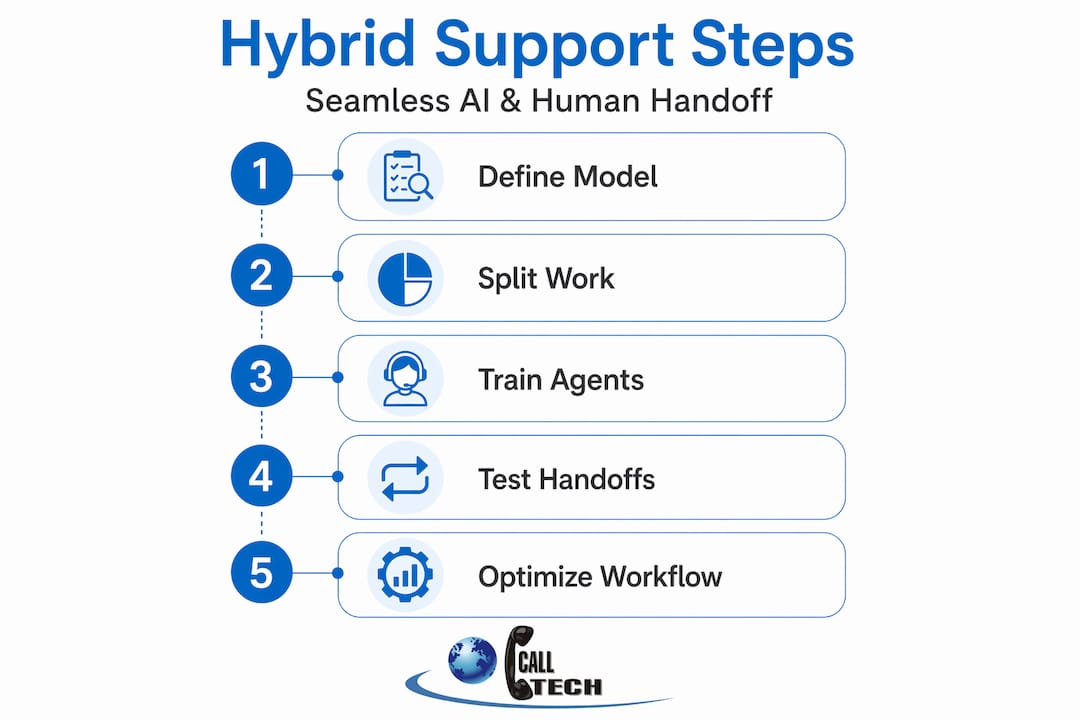
Effective AI-to-human escalations use confidence thresholds of 80 to 85%, combined with sentiment detection and structured context payloads. In practice, that means:
- Set your confidence threshold at 80 to 85%. If the AI's confidence in its response falls below that point, escalate. In regulated telecom environments or when handling SaaS data security questions, push that threshold to 90%.
- Add sentiment triggers. Confidence alone isn't enough. A customer who is technically in an easy-to-resolve scenario but is expressing anger or frustration needs a human, regardless of confidence score.
- Add loop detection. If the same customer has contacted support three times in 48 hours on the same issue, that's a signal. Don't let AI cycle them through the same resolution path a fourth time.
- Transfer structured context, not transcripts. The human agent needs the issue category, language, sentiment score, what the AI already attempted, and a "Next Action" note. That's it.
- Audit escalation flows regularly. A common failure pattern is the "solved to closed" ticket gap where AI marks a case as resolved before the human agent has actually confirmed the issue is closed, leaving customers confused when they follow up.
Pro Tip: Run monthly tests on your handoff paths from at least three different languages and two different channels (chat and email, for example). What works in English on live chat often breaks in French via email due to character encoding, template formatting, or language detection errors. Testing multi-channel and multilingual paths together reveals failure points that single-language testing misses entirely.
Improving your support process around handoffs is ongoing work, not a one-time setup. The best practices for multinational teams include regular calibration sessions between AI operations teams and frontline agents to keep escalation logic current with real customer behavior.
Optimizing hybrid support for telecom and SaaS: strategies and challenges
Telecom and SaaS companies have characteristics that stress-test hybrid support models in ways that simpler businesses don't. High technical complexity, regulatory requirements across multiple jurisdictions, tiered customer segments (free users versus enterprise accounts), and multi-channel customer behavior all create optimization challenges that generic blended support models aren't built for.
The core optimization principle for this sector is channel-agnostic AI with geo-redundancy. That means your AI layer handles tickets consistently whether they arrive via chat, email, in-app support, or phone, and your human hubs are distributed across regions so that no single location becomes a bottleneck.
In practice, this often means:
- Two or more regional human hubs. A common setup pairs a volume hub in the Philippines or India (for English, Spanish, or general European language overflow) with a complexity hub in Eastern Europe or LatAm that specializes in nuanced European languages like Polish, Czech, Romanian, or German.
- Geo-redundancy as a risk management tool. If one hub faces a local disruption, the other absorbs the load without a coverage gap.
- AI training that reflects your actual customer base. A SaaS company serving Nordic markets needs AI trained on Swedish and Finnish support tickets, not just English examples.
| Feature | Channel-agnostic AI | Traditional single-channel AI | Benefit for telecom/SaaS |
|---|---|---|---|
| Ticket intake | All channels unified | One channel at a time | No coverage gaps across touchpoints |
| Language detection | Real-time across channels | Often English-first | Accurate multilingual routing |
| Context continuity | Full across handoffs | Often reset per channel | Customers don't repeat themselves |
| Scalability | Scales with volume | Requires per-channel scaling | Lower cost to expand |
Challenges don't disappear once you've built this architecture. Quality drift is real: AI models need retraining when product features change, and that's constant in SaaS. Ticket resolution gaps persist if AI and human workflows aren't tightly connected. And maintaining language quality across 10 or more European languages requires dedicated quality assurance (QA) processes per language, not just per team.
Scaling your global support workflow requires treating language coverage as an infrastructure decision, not a staffing afterthought. Reviewing global customer support strategies that have worked at scale gives you a clearer sense of what to build toward. And ensuring your remote support teams have the tooling, access, and training to operate within this architecture closes the gap between design and execution.
Rethinking the hybrid support model: beyond automation and cost-cutting
Here's the uncomfortable truth about how most companies approach hybrid support: they frame it as a cost reduction project and then wonder why customer satisfaction doesn't improve.
The cost argument is real. AI does reduce the volume of tickets requiring human handling, and that has a direct impact on labor costs. But if cost is the only lens, you end up automating everything you can automate and hollowing out the human layer to the minimum viable headcount. That's a mistake, and it shows up in your churn numbers before it shows up in your dashboards.
The smarter frame is role reinvention. As AI automates simple work, the organizations winning at hybrid support are the ones redeploying humans to positions where they genuinely cannot be replaced: handling complex technical escalations in a customer's native language, managing high-value account relationships, and making judgment calls that require emotional intelligence. These are exactly the situations where a SaaS customer decides whether to renew or leave.
This requires investment in people, not just technology. Technology and people must evolve together to hit both experience and efficiency goals. That means training agents on AI supervision, on reading and acting on sentiment signals, and on the kind of empathy-driven communication that actually de-escalates a frustrated enterprise customer. As Gartner analyst Eric Keller put it, "Organizations that only use AI to reduce costs risk missing a strategic opportunity."
Pro Tip: Build a dedicated upskilling track for agents who handle AI-escalated tickets. These agents need a different skill set than traditional frontline staff. Partner with workforce development specialists who understand the intersection of AI operations and human performance if you don't have that capability in-house.
The contact center practices that produce the best long-term results treat human agents as the quality ceiling of the entire operation, not as the fallback for when AI fails. That mindset shift is what separates companies building lasting customer loyalty from those just managing costs.
Explore multilingual hybrid support solutions with CallTech
Putting a hybrid customer support model into practice across multiple languages and time zones takes more than a technology choice. It takes the right people, the right processes, and a partner who understands both.

CallTech Outsourcing has been helping telecom and SaaS companies build exactly this kind of operation since 2005. With coverage across more than 15 European languages and nearly two decades of multilingual contact center experience, we provide the outsourcing services that make hybrid support work at scale: follow-the-sun staffing, AI-human handoff workflows, and dedicated agents who handle complex escalations in your customers' native languages. If you want to enhance multilingual customer engagement without rebuilding your internal team from scratch, or need to build effective remote multilingual teams that integrate with your existing tools, we can help you get there faster and with fewer operational surprises.
Frequently asked questions
What is a hybrid customer support model?
It combines AI automation with human agents to handle customer service efficiently, using AI for routine tasks and humans for complex or emotional interactions. 73% of enterprise CX leaders now prefer this approach over AI-only or human-only models.
How does the follow-the-sun model improve hybrid support?
It shifts support across global teams by time zone, providing 24/7 coverage without night shifts and ensuring smooth ticket handoffs with shared customer context. This directly reduces agent burnout and improves response times for international customers.
What are best practices for AI-to-human handoffs?
Set clear escalation triggers using confidence thresholds at 80 to 85% combined with sentiment analysis, transfer structured context like issue tags and next steps, and audit escalation flows regularly to prevent customer confusion and ticket resolution gaps.
Why is human involvement still critical in hybrid support?
Human agents are expanded to roles requiring empathy, judgment, and trust-building in complex or high-risk situations that AI cannot handle, which is what builds customer loyalty over time.
How can telecom and SaaS companies scale multilingual support efficiently?
By using channel-agnostic AI with geo-redundancy across global hubs, companies balance routine query automation in many languages with human-handled complex cases, achieving both cost efficiency and consistent quality at scale.