

TL;DR:
- The help desk outsourcing market is projected to grow past 16 billion dollars by 2032.
- Effective outsourcing improves resolution times, language coverage, and scalability beyond cost savings.
- Choosing the right model requires balancing automation, control, and industry-specific KPIs for long-term success.
The global help desk outsourcing market sits at roughly $9.7 billion in 2024, with projections pushing it past $16 billion by 2032. Yet most decision-makers still treat outsourcing as a cost-cutting lever rather than a strategic growth tool. That framing costs them. Companies in telecom, SaaS, and e-commerce that get outsourcing right don't just reduce overhead. They improve resolution times, expand language coverage, and build support operations that scale without breaking. This guide walks you through the real scope of help desk outsourcing, the metrics that matter, how to choose the right model, and how to implement it across multiple geographies without losing quality or control.
Table of Contents
- Understanding help desk outsourcing: Scope, scale, and market trends
- Benchmarks and quality metrics: What decision-makers must track
- Choosing the right model: Outsourced vs. in-house, and automation trends
- Practical steps: Implementing scalable help desk outsourcing across geographies
- Our take: Why most help desk outsourcing misses the mark—and what truly matters
- Take action: Your next step to reliable help desk outsourcing
- Frequently asked questions
Key Takeaways
| Point | Details |
|---|---|
| Market is rapidly growing | Help desk outsourcing is expanding globally, offering major scalability for telecom, SaaS, and e-commerce sectors. |
| Success hinges on quality metrics | KPIs such as FCR, CSAT, and user effort scores are essential for evaluating outsourcing provider performance. |
| AI and automation reshape support | Emerging technology is shifting benchmarks from speed-focused metrics to user experience and productivity indicators. |
| Scalability needs strategic execution | Effective implementation across regions depends on clear SLAs, integrated workflows, and trusted partners. |
Understanding help desk outsourcing: Scope, scale, and market trends
Help desk outsourcing means contracting an external provider to handle customer and technical support functions on your behalf. This ranges from basic tier-one ticket resolution to complex multilingual support across time zones. It's not just about answering phones. It includes email support, live chat, CRM management, escalation handling, and back-office functions tied to customer experience.
The market is growing fast. IT help desk outsourcing is expanding at a CAGR between 6.5% and 9%, driven by demand from telecom, SaaS, and e-commerce sectors that need flexible, multilingual support without the overhead of building internal teams. These industries share a common challenge: their customer bases grow faster than their support infrastructure.
Here's a snapshot of what's driving that growth by sector:
- Telecom: High call volumes, complex billing queries, and multilingual subscriber bases make outsourcing a practical necessity.
- SaaS: Subscription models require continuous onboarding support and technical troubleshooting across global markets.
- E-commerce: Seasonal spikes, return management, and cross-border logistics create unpredictable demand that in-house teams struggle to absorb.
The strategic benefits go beyond headcount reduction. Companies that invest in administrative outsourcing report improved response times and better resource allocation. When you pair that with scalable outsourcing methods, you get a model that adjusts to demand without the lag of hiring cycles.

| Sector | Primary outsourcing driver | Key support need |
|---|---|---|
| Telecom | Volume and language coverage | Billing, technical, retention |
| SaaS | Scalability and onboarding | Technical support, subscription help |
| E-commerce | Seasonal flexibility | Returns, order tracking, complaints |
One often-overlooked advantage is CRM integration. CRM-powered outsourced support enables seamless data flow between your internal systems and external agents, maintaining context across every customer interaction. Without it, outsourced teams operate in silos and quality suffers. With it, the handoff becomes invisible to the customer.
The bottom line: help desk outsourcing is not a commodity purchase. It's a structural decision that affects your customer experience, your operational efficiency, and your ability to expand into new markets.
Benchmarks and quality metrics: What decision-makers must track
Choosing a provider without tracking the right metrics is like hiring a sales team without measuring revenue. The numbers tell you whether your outsourcing investment is actually working. Here are the five core KPIs every decision-maker should monitor.
- First Contact Resolution (FCR): The percentage of issues resolved on the first interaction. Industry benchmark sits at 72%, meaning nearly three in ten contacts require a follow-up. Anything below 65% signals a training or process problem.
- Customer Satisfaction Score (CSAT): Typically measured on a 1-5 scale, with a strong benchmark around 4.2/5. Low CSAT scores from an outsourced team often point to poor knowledge base quality or insufficient product training.
- Average Handle Time (AHT): Measures efficiency, but don't optimize for speed alone. A fast interaction that doesn't resolve the issue costs more in the long run.
- SLA Compliance: The percentage of tickets resolved within agreed timeframes. SLA compliance benchmarks hover around 85%. Anything below 80% consistently should trigger a contract review.
- Self-Service Deflection Rate: The share of issues resolved without agent involvement. Higher deflection reduces cost, but only if the self-service tools are actually solving problems and not just frustrating customers.
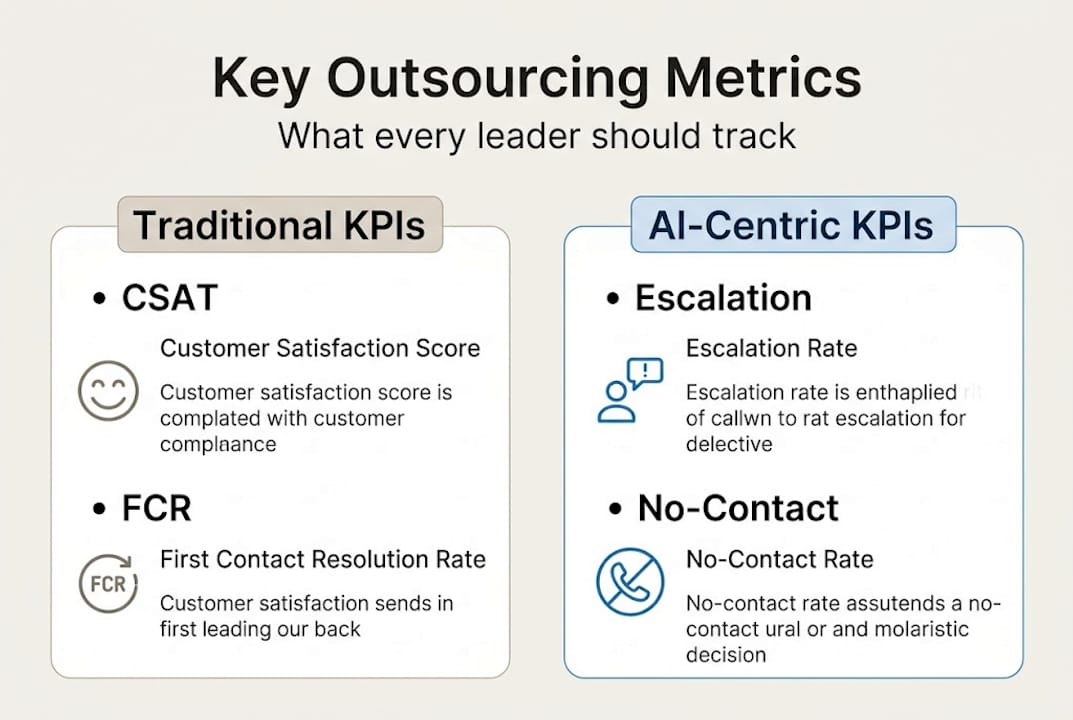
Beyond traditional KPIs, AI-driven support environments are introducing a new layer of measurement. Escalation accuracy (how often AI correctly routes issues), user effort score (how hard customers have to work to get help), and sentiment analysis are becoming reliable predictors of long-term customer retention.
Pro Tip: Don't let speed dominate your provider evaluation. A low AHT paired with poor FCR means customers are calling back. That doubles your cost while damaging satisfaction. Balance speed with resolution quality.
When reducing support costs is the goal, these metrics help you cut in the right places. Providers who can't report on FCR and CSAT with transparency are a red flag. Review the most common outsourcing mistakes before signing any contract, and use telecom-specific outsourcing benchmarks to set realistic SLA targets for your sector.
Choosing the right model: Outsourced vs. in-house, and automation trends
Not every company should outsource everything. The right model depends on your volume, your product complexity, and how much direct control you need over customer interactions.
| Model | Cost | Control | Scalability | Risk |
|---|---|---|---|---|
| In-house | High | Full | Low | Low |
| Outsourced | Medium | Partial | High | Medium |
| Automated/AI | Low | Full | Very high | Medium |
Outsourcing offers clear advantages in cost savings and scalability, but it does introduce visibility tradeoffs. You're trusting an external team to represent your brand, often in languages your internal managers can't monitor directly. That's a real risk if SLAs and reporting structures aren't airtight.
AI and automation are reshaping this decision. Self-service portals, chatbots, and AI-assisted ticket routing can deflect a significant share of tier-one contacts before they ever reach a human agent. For some SaaS companies, this means outsourcing only the complex or high-value interactions while automating the routine ones.
The smartest support operations in 2026 aren't choosing between outsourcing and automation. They're layering both, using automation to handle volume and outsourced experts to handle nuance.
Key factors to evaluate before committing to a model:
- Contact complexity: Simple, repetitive queries suit automation. Billing disputes, technical escalations, and retention conversations need human judgment.
- Language requirements: Automation tools have language limitations. Multilingual support at scale still requires human agents.
- Brand sensitivity: High-touch customer relationships may require in-house oversight even if execution is outsourced.
Pro Tip: Before defaulting to outsourcing, audit your ticket categories. If more than 40% of your volume is repetitive and low-complexity, automation may reduce cost faster with less risk.
For a detailed cost breakdown, the outsourced vs. in-house comparison is worth reviewing before you finalize your model. Pair that with contact center best practices to ensure whichever model you choose is set up for operational success.
Practical steps: Implementing scalable help desk outsourcing across geographies
Strategy without execution is just planning. Here's how to move from decision to deployment across multiple markets.
- Define your scope before selecting a provider. List every support channel, language, and ticket type you need covered. Vague scopes lead to vague SLAs and expensive scope creep.
- Evaluate providers on language depth, not just language count. A provider claiming 15 languages means little if their agents are non-native speakers with limited product knowledge.
- Build SLAs around outcomes, not activity. Measure resolution rates and CSAT, not just ticket volume or response speed. Outcome-based SLAs align provider incentives with your goals.
- Integrate outsourced teams into your CRM and knowledge base from day one. Agents working without access to customer history or product documentation will underperform regardless of their skill level.
- Pilot in a single region before scaling. Test your SLA framework, escalation paths, and quality monitoring in one market. Fix the gaps before expanding to five more.
The IT help desk outsourcing subset is growing specifically because telecom, SaaS, and e-commerce companies need rapid scalability without proportional cost increases. That scalability only materializes when implementation is structured correctly from the start.
Key operational checkpoints during rollout:
- Weekly quality reviews during the first 90 days
- Escalation path testing before go-live
- Agent product training tied to your actual ticket categories
- Shared dashboards for real-time SLA visibility
Pro Tip: Pilot with your second-largest market, not your biggest. If something goes wrong during the pilot, the impact is contained. Your primary market gets a refined, tested model.
Building global outsourcing partnerships that last requires treating your provider as an extension of your team, not a vendor you manage at arm's length. The companies that get the most from outsourcing invest in onboarding, communication, and shared performance goals.
Our take: Why most help desk outsourcing misses the mark—and what truly matters
After nearly 20 years of building multilingual support operations, we've seen the same pattern repeat: companies evaluate outsourcing partners almost entirely on price and response speed, then wonder why customer satisfaction plateaus or declines after six months.
The uncomfortable truth is that speed and cost are the easiest metrics to fake. A provider can hit AHT targets by cutting conversations short. They can hit ticket volume numbers by closing unresolved issues. Neither metric tells you whether customers are actually getting help.
The shift that matters is moving toward AI-centric KPIs: no-contact resolution rates, AI escalation accuracy, user effort scores, and sentiment analysis. These metrics are harder to game and far more predictive of long-term retention and brand loyalty.
What most experts miss about multinational scaling is the cultural dimension. A support interaction that feels efficient in one market can feel cold or dismissive in another. Language fluency is table stakes. Cultural fluency is what separates good outsourcing from great outsourcing. Pair that with CX best practices and you have a framework that actually holds up at scale.
Take action: Your next step to reliable help desk outsourcing
If you've made it this far, you're serious about building a support operation that actually performs across markets and languages. The next step is connecting with a provider who has the infrastructure, the language depth, and the operational track record to deliver.

At CallTech Outsourcing, we've been helping telecom, SaaS, and e-commerce companies scale their support since 2005. Whether you're evaluating outsourcing multilingual contact center services for the first time or optimizing an existing setup, we can help. Explore our global support strategies for real-world examples, or review our approach to scalable support workflow to see how we structure operations for long-term growth.
Frequently asked questions
What is the average cost savings from help desk outsourcing?
Companies can achieve up to 60% cost savings by outsourcing help desk operations, depending on provider choice, geography, and how well processes are optimized before handoff.
Which KPIs should telecom and SaaS companies track when outsourcing support?
Prioritize FCR, CSAT, and SLA compliance benchmarks alongside newer AI-centric success metrics like escalation accuracy and user effort score for a complete picture of provider performance.
How does outsourcing affect control and visibility of customer support?
Outsourcing introduces visibility and control tradeoffs, but these risks are manageable with strong SLAs, shared dashboards, and regular performance reviews built into the contract from day one.
Can help desk outsourcing scale effectively across multiple countries?
Yes, provided SLAs are outcome-based and CRM integration is in place from the start. Scalability in IT outsourcing is one of the primary reasons telecom and SaaS companies choose external providers over expanding in-house teams.
What are emerging automation trends in help desk outsourcing?
AI escalation and self-service deflection are reducing tier-one contact volumes, while sentiment analysis and new KPIs are replacing traditional speed metrics as the primary indicators of support quality.