
TL;DR:
- Many business leaders wrongly assume outsourced customer support pricing is simple based on region and rate. The actual cost includes factors like agent wages, technology, training, quality control, and overhead, which vary significantly and impact pricing beyond initial quotes. Multilingual support premiums of 20 to 40% reflect market scarcity and training investments, essential for entering new markets or handling sector-specific complexities effectively.
Many business leaders assume that outsourced customer support pricing works like a simple calculator: pick a region, get a rate, done. The reality is far more layered. Language requirements alone can push your hourly costs up by as much as 40% above base rates, and that's before you factor in sector specialization, 24/7 coverage, or quality control overhead. For telecom and SaaS companies expanding into international markets, understanding exactly what drives per-hour pricing isn't a nice-to-have. It's the foundation of a smarter outsourcing strategy.
Table of Contents
- Understanding the true cost of customer support per hour
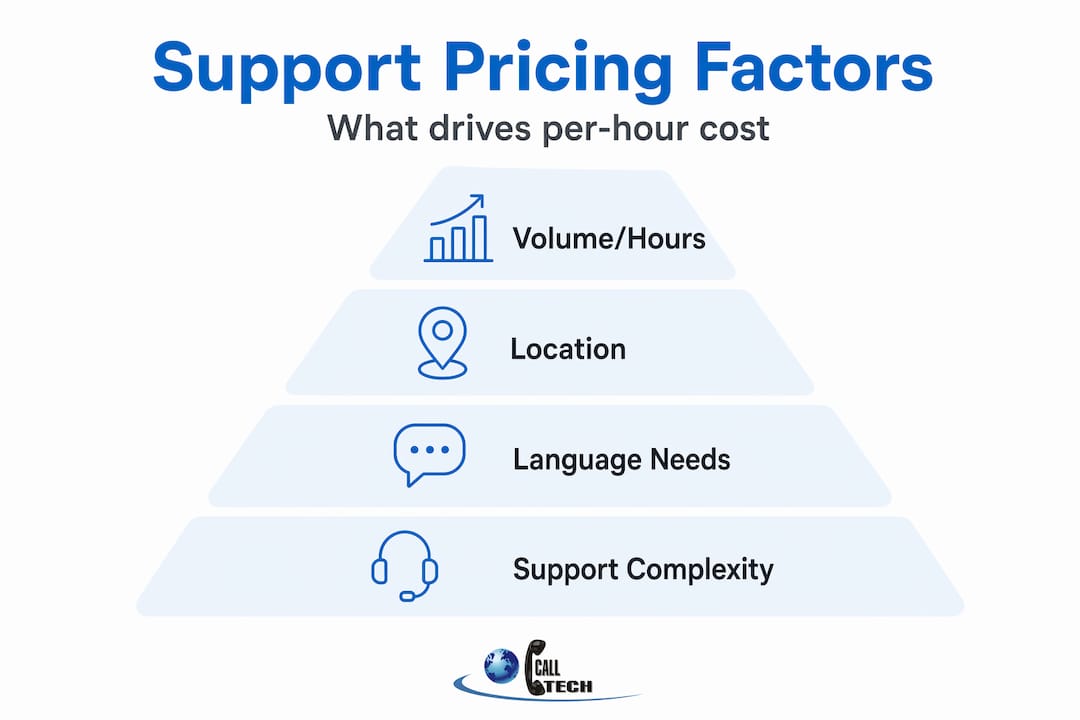
- Key factors that influence customer support pricing
- How multilingual support impacts hourly customer service rates
- Choosing the right pricing model for your global business
- What most businesses overlook about hourly support pricing
- Scale smarter: find your best-fit outsourced support solution
- Frequently asked questions
Key Takeaways
| Point | Details |
|---|---|
| Hourly pricing structure | Customer support per hour includes labor, training, language skills, and operational overhead. |
| Multilingual premium | Expect a 20–40% cost increase for multilingual agents compared to single-language support. |
| Sector-specific costs | Telecom and SaaS require advanced expertise, pushing hourly rates higher than generic support. |
| Optimizing spend | Align support model, language needs, and business goals to get the best value per hour. |
| Strategic investment | Focusing solely on low hourly rates risks quality; balanced investment yields higher customer satisfaction. |
Understanding the true cost of customer support per hour
While surface-level rates can look straightforward on a vendor proposal, the actual hourly price you pay reflects a bundle of operational costs that most vendors don't spell out upfront. Before you compare quotes, you need to know what's inside each number.
What goes into an hourly rate?
The components that make up a typical outsourced support hourly rate include:
- Agent labor costs: This is the largest single factor, covering wages, social contributions, and benefits tied to the agent's location.
- Technology and infrastructure: VOIP systems, CRM licenses, ticketing tools, and secure communication platforms all carry per-seat costs that get baked into your rate.
- Training and onboarding: Initial ramp-up for a new program, product knowledge sessions, and ongoing refresher training are real costs. Some vendors absorb these, others add them to your rate.
- Quality control and supervision: Team leaders, QA analysts, and call monitoring systems are behind-the-scenes costs that responsible providers don't skip.
- Overhead and margin: Office facilities, IT maintenance, HR, and the vendor's profit margin complete the picture.
Understanding this structure helps you evaluate proposals more critically. A rate that looks cheap may have stripped out quality oversight or is routing your calls through infrastructure that lacks redundancy.
| Region | Typical hourly rate range | Language tier |
|---|---|---|
| Eastern Europe | $12 to $20 | Major European languages |
| Southeast Asia | $8 to $14 | English, some European |
| Latin America | $10 to $18 | Spanish, Portuguese |
| Western Europe | $22 to $40+ | Premium multilingual |
| North Africa | $9 to $15 | French, Arabic, some European |
"Multilingual proficiency is not a small premium. It changes the talent pool, the training investment, and the retention cost for every agent on your program."
Multilingual proficiency can add 20 to 40% to your outsourcing price compared to single-language operations. This isn't a vendor markup. It reflects a genuine market reality: agents who can fluently handle German escalations or navigate a French billing dispute are rarer and command higher wages.
If you're weighing the full financial picture, it also helps to look at outsourced vs in-house support costs before committing to either direction. The hidden costs of building internal multilingual teams often dwarf what a well-structured outsourcing contract costs over the same period.
Pro Tip: Ask every vendor to provide a line-item breakdown of what's included in their hourly rate. Any vendor unwilling to do this is either hiding inefficiency or plans to invoice you separately for items you expected to be covered.
Key factors that influence customer support pricing
After grasping the basic cost structure, readers need to know what actually shifts pricing for their specific business needs. For telecom and SaaS companies in particular, several levers move the needle significantly.
Sector specialization and technical complexity
Telecom support often involves network troubleshooting, device configuration, and billing dispute resolution, all of which require agents with above-average technical knowledge. SaaS support frequently demands familiarity with APIs, user dashboards, and subscription management workflows. This level of technical aptitude commands higher hourly rates than general customer service because the talent pool is smaller and training cycles are longer.
When you require agents who can handle escalations involving SIM activation errors or walk enterprise users through software integrations, you are not buying commodity support. The hourly rate reflects the intellectual complexity of what you're asking agents to do.
Language requirements and geographic reach
Multilingual proficiency adds 20 to 40% to your base hourly cost. But the exact premium varies depending on how rare the language is. Supporting German-speaking customers from a Central European hub is more affordable than sourcing native Romanian or Czech speakers from a location without a strong talent base for those languages. The more obscure or less commonly outsourced the language, the higher the premium.
Understanding why multilingual support matters is the first step. The pricing implication follows directly: every language you add to your support scope is a talent and training investment, not just a routing decision.
Volume, operating hours, and shift structure
Higher call volumes generally create economies of scale that reduce your effective per-hour cost. Vendors can staff more efficiently, reduce idle time, and negotiate better on infrastructure when programs are large enough. Conversely, 24/7 coverage adds night-shift differentials and weekend premiums. If your global customer base requires around-the-clock availability, factor that into your hourly cost modeling before you sign.

Onshore vs. nearshore vs. offshore delivery
Location still matters significantly. Offshore operations in Southeast Asia or North Africa carry lower labor costs but may introduce time zone complexity and language quality variations. Nearshore delivery from Eastern or Central Europe balances cost control with stronger European language coverage and closer cultural alignment for European markets.
Reviewing the full range of call center pricing models alongside a call center cost per hour breakdown gives you the framework to compare vendors on equal footing rather than just surface rate.
Pro Tip: When evaluating language coverage, test the actual quality, not just the claimed capability. Request sample interactions or conduct mock calls in the target language before finalizing a contract. Agent fluency gaps become visible almost immediately under real product scenarios.
How multilingual support impacts hourly customer service rates
Building on the understanding that language drives cost, this section gets specific about the financial impact of multilingual support and when the premium genuinely pays off.
How the language premium is calculated
The 20 to 40% premium for multilingual agent pricing isn't arbitrary. It reflects a combination of higher agent wages due to scarcity, additional training time to reach consistent quality across languages, and higher retention costs because multilingual agents have more options in the labor market. In practical terms, if your base rate for English-only support is $14 per hour, multilingual coverage could push that to $17 to $20 per hour per agent, before volume discounts.
| Support type | Typical hourly rate | Estimated monthly cost (1 FTE) |
|---|---|---|
| Single-language (English) | $12 to $16 | $1,920 to $2,560 |
| Bilingual (English + one European language) | $16 to $22 | $2,560 to $3,520 |
| Multilingual (3+ European languages) | $20 to $28 | $3,200 to $4,480 |
These figures assume a standard 160-hour month and vary based on region and complexity. The gap between single-language and full multilingual coverage is real, but it's also predictable and plannable.
When paying more for multilingual support is the right call
Paying a premium for multilingual agents is strategic in the following scenarios:
- You are entering a new European market where customer trust depends heavily on native-language support during the first 12 months of market entry.
- Your product has complex technical flows that increase the risk of miscommunication when agents work in a second language.
- Your churn data shows higher attrition in specific language markets, which often signals that customers aren't getting the support quality they need.
- Your contract base includes enterprise clients who have language-specific SLA requirements (service-level agreements) baked into their vendor relationships.
- Regulatory or compliance requirements in the target market mandate documentation and communication in the local language.
The international customer service guide outlines how language quality shapes first-contact resolution rates and customer satisfaction scores across European markets. For telecom companies managing large subscriber bases across multiple countries, even a 5% improvement in first-contact resolution (meaning the issue is resolved without a callback) has measurable impact on cost-per-interaction.
"Customers who receive support in their native language report significantly higher satisfaction and are meaningfully less likely to churn within the following six months."
Multilingual support also directly accelerates international expansion. When you can guarantee consistent, native-quality support from day one of entering a new market, you remove one of the biggest adoption barriers for enterprise buyers in markets like Germany, France, or the Netherlands. Explore how support for multinational teams and dedicated multilingual support structures can make that expansion more operationally sound.
Choosing the right pricing model for your global business
With insight into hourly and language-related factors, it's time to zoom out and look at the broader pricing model landscape. Matching the right model to your operational needs is often where companies leave the most money on the table.
Common call center pricing models
- Per-hour (time-based): You pay for agent time regardless of volume. Works well for consistent, predictable interaction loads and complex technical support where handle time varies widely.
- Per-ticket or per-contact: You pay a flat fee per resolved interaction. Better for simpler, transactional support where volume is predictable but hourly utilization fluctuates.
- Hybrid models: A base retainer plus per-ticket fees for overflow. This is increasingly popular with SaaS companies that experience seasonal spikes or product launch surges.
- Shared agent models: Your interactions are handled by agents who also support other client programs, lowering cost but reducing control over specialization and availability.
- Dedicated agent models: Agents work exclusively on your program. Higher hourly cost, but better product knowledge, faster ramp, and more consistent customer experience.
How to assess which model fits your business
- Map your monthly interaction volume and check whether it's consistent or seasonal.
- Identify your average handle time. If it varies widely, per-hour is safer than per-ticket.
- Assess how much product knowledge depth agents need. High complexity favors dedicated models.
- Evaluate your language mix. Shared agent pools rarely cover 3+ languages with consistent quality.
- Check whether your contract requires performance-based SLAs. These are easier to enforce under dedicated or hybrid arrangements.
Reviewing cost-effective outsourcing tips gives you a solid framework for structuring vendor relationships that scale without generating surprise invoices.
Multilingual proficiency premiums of 20 to 40% can apply to any pricing model. Make sure you negotiate this explicitly, whether you're on a per-hour or hybrid arrangement, so you're not absorbing undisclosed rate differences mid-contract.
Pro Tip: Always insist on a written service-level agreement that defines response time, language quality standards, QA scoring benchmarks, and escalation paths. Vague contracts are where hidden costs appear, usually during your busiest quarter.
What most businesses overlook about hourly support pricing
We've spent nearly two decades watching companies approach outsourced support pricing the same way. They get multiple quotes, sort them lowest to highest, and start negotiating from the bottom. It feels logical. It often backfires.
The fixation on the lowest per-hour rate consistently underestimates what we'd call the true cost of poor support. A vendor charging $10 per hour with 35% annual agent turnover is not actually cheap. You absorb the hidden costs through longer handle times as new agents learn your product, more escalations as undertrained staff escalate issues they should resolve, and, ultimately, customer churn in markets where language quality and resolution speed drive loyalty decisions.
We've also seen companies treat multilingual coverage as a line item to trim rather than a strategic capability. When a telecom company manages 50,000 subscribers across Germany, Poland, and the Netherlands, native-quality support in those languages is not a premium. It's the basic cost of operating credibly in those markets. Cutting that cost by moving to lower-quality bilingual agents at a reduced rate typically generates more complaints, more callbacks, and more churn than the per-hour savings justify.
The same logic applies to sector specialization for SaaS businesses. An agent who genuinely understands subscription billing logic, API terminology, and user tier differences handles calls faster and with fewer errors than a general support agent reading from a script. The hourly rate is higher. The cost per successfully resolved interaction is lower.
The smarter question is not "what's the lowest hourly rate I can negotiate?" It's "what's the fully loaded cost of the support quality this vendor delivers?" Decisions made through that lens tend to produce better customer satisfaction scores, lower churn, and stronger long-term ROI from outsourcing partnerships.
If you're still evaluating whether outsourcing makes sense at all for your specific situation, the comparison covered in outsourcing vs in-house fit walks through the decision criteria in a way that applies directly to telecom and SaaS contexts.
Scale smarter: find your best-fit outsourced support solution
The pricing dynamics covered in this guide, language premiums, model selection, hidden costs, and sector-specific complexity, are exactly what CallTech Outsourcing has been helping telecom and SaaS companies navigate since 2005. With more than 15 European languages covered and nearly 20 years of operational experience, we build support programs around what your customers actually need, not what's easiest to staff.

Whether you're exploring multilingual support outsourcing for the first time or refining an existing program, our team works as a genuine extension of your business. For deeper reading on where to go next, our global support strategies resource covers proven approaches for international markets, and our business process outsourcing guide gives you the full picture of how BPO partnerships work in practice. Let's build something that scales.
Frequently asked questions
What is the typical hourly rate for outsourced customer support?
Outsourced customer support generally ranges from $8 to $25 per hour depending on location, language requirements, and technical complexity, with multilingual proficiency adding 20 to 40% above base rates.
How much more does multilingual customer support cost?
Multilingual skills add 20 to 40% to base hourly pricing, reflecting higher agent wages, longer training cycles, and increased retention costs compared to single-language support programs.
Are there hidden costs in hourly pricing for support services?
Yes. Training, technology licensing, quality control, and after-hours shift premiums are frequently not itemized in initial quotes, so always request a full cost breakdown before signing a contract.
Which pricing model is best for SaaS or telecom companies?
Hourly rates work well for complex, variable-volume programs, but hybrid models that combine a base retainer with per-ticket overflow fees often deliver better cost control for SaaS companies with fluctuating interaction volumes.
Is offshore support always cheaper per hour?
Offshore rates are typically lower, but language and technical requirements can significantly reduce those savings, particularly when high-quality European language coverage or sector-specific technical knowledge is required.