

TL;DR:
- Customer retention is a revenue-focused strategy that relies on omnichannel coverage, integrated workflows, proactive risk detection, and strict quality standards. Outsourcing multilingual support enhances these pillars by offering scalable, data-driven, and seamless customer engagement across global markets. Proper implementation emphasizes system integration, continuous review, and alignment of KPIs to drive long-term loyalty and retention success.
Retention is not a customer service metric. It's a revenue strategy. Most support leaders assume that faster response times and polite agents are all it takes to keep customers from leaving, but that belief leaves serious money on the table. The mechanics of top-performing retention in telecom, SaaS, and e-commerce consistently follow four pillars: omnichannel coverage, integrated workflows, proactive churn risk detection, and strict SLA and QA discipline. This guide breaks down each one and shows you how outsourced multilingual support turns those pillars into a scalable retention engine.
Table of Contents
- What are customer retention support services?
- Key components of effective retention support
- Outsourcing multilingual retention support: Why and when it matters
- How to implement and optimize customer retention support
- The real secret to retention: It's not just what you do, but how you integrate
- Ready to scale up your retention support?
- Frequently asked questions
Key Takeaways
| Point | Details |
|---|---|
| Integrated support is critical | Retention is only as strong as your omnichannel, multilingual, and CRM-enabled support network. |
| Proactive risk detection reduces churn | Identifying at-risk customers early enables targeted interventions and measurable revenue benefits. |
| Outsourcing boosts efficiency and reach | Specialized multilingual partners help you scale faster and cover global customer needs efficiently. |
| Relentless QA drives results | Ongoing quality control and SLA rigor are essential to continuously improve retention outcomes. |
What are customer retention support services?
Customer retention support services are the structured programs, processes, and teams that help your business keep existing customers engaged, satisfied, and subscribed. They go well beyond answering tickets. They combine reactive issue resolution with proactive outreach, behavioral data analysis, and system-level integration to catch problems before customers decide to leave.
For telecom providers, this might mean a specialized win-back team that contacts subscribers flagged as flight risks before contract renewal. For SaaS companies, it often includes customer success touchpoints triggered by low product usage scores. For e-commerce brands, it can look like personalized post-purchase follow-ups and loyalty program support. The specifics change per industry, but the underlying structure stays the same.
Effective retention support typically includes:
- Omnichannel accessibility so customers can reach you via phone, live chat, email, social media, or in-app messaging without repeating their history
- Multilingual coverage to serve customers in their native language across every market you operate in
- Proactive churn detection using behavioral signals and support data to identify at-risk accounts early
- CRM and helpdesk integration so agents have full customer context from the moment a conversation starts
- Defined SLAs and QA frameworks that set and measure consistent service standards across all channels
"The pattern is clear across telecom and e-commerce: omnichannel coverage, integrated workflows, proactive risk detection, and SLA/QA rigor consistently define the top-performing retention operations."
Retention and support are not separate functions. They work together. A customer who gets fast, personalized, context-aware service in their language is far less likely to churn than one who has to repeat their problem three times to three different agents. If you want to strengthen your internal processes, a structured support process improvement approach gives you a solid starting point. For companies moving into new markets, a multilingual support guide covers the operational essentials.
Key components of effective retention support
With the basics in place, let's break down what distinguishes truly effective retention support from the rest. Understanding each component individually helps you identify where your current operation has gaps and where outsourcing can fill them most efficiently.
-
Omnichannel engagement. Customers do not think in channels. They switch between your app, your website, your phone line, and your social pages depending on what's convenient at the moment. Effective retention support meets them at each of those points without creating friction. A customer who starts a conversation on live chat should not need to re-explain their issue when they follow up by phone. Seamless channel continuity is what separates frustrating support from support that builds loyalty. Explore multilingual engagement strategies to see how this works in practice across international markets.
-
Integrated systems and context. An agent with access to a customer's full history, their plan details, their open tickets, their purchase record, and their past complaints, can resolve issues faster and more personally. This is only possible when your CRM, helpdesk, and communication platforms are connected. Siloed tools mean agents start every conversation blind. The omnichannel and integrated workflow pattern across telecom and e-commerce shows that context delivery to frontline agents is one of the single biggest drivers of retention outcomes.
-
Proactive churn risk detection. Waiting for a customer to call and cancel is too late. Leading retention teams use data signals, usage drops, missed payments, complaint volume, long silence periods, to score at-risk accounts and trigger outreach before the customer has decided to leave. This can be as simple as an automated flag in your CRM or as sophisticated as a machine learning model scoring renewal probability weekly.
-
SLA and QA rigor. SLAs (Service Level Agreements) define the standards your team commits to: first response time, resolution time, escalation protocols. QA (Quality Assurance) is how you verify those standards are actually being met. Without both in place, you have no reliable way to know if your retention programs are working or simply running. Reviewing best practices for multinational teams is a smart move for any operation managing agents across regions.
-
Multilingual capability. A customer who cannot communicate comfortably in their language will not stay loyal. This is especially critical in Europe, where a single product can serve customers across a dozen different languages and cultural expectations. Native-language support is not a nice-to-have in global markets. It is a core retention variable.
Pro Tip: Do not wait until churn spikes to audit your QA framework. Run a monthly review of resolution quality against retention outcomes. Teams that do this consistently catch systemic issues months before they show up in renewal numbers.
Outsourcing multilingual retention support: Why and when it matters
Now that we know what makes retention support truly effective, let's compare your operational options. The in-house versus outsourced debate is often framed as a cost question, but the more important comparison is capability coverage.
| Factor | In-house team | Outsourced provider |
|---|---|---|
| Language coverage | Limited to hired staff | 15+ European languages available |
| Scalability | Slow, HR-dependent | Fast, contract-based |
| CRM integration | Possible but resource-heavy | Pre-built for most major platforms |
| SLA enforcement | Self-monitored | Third-party accountability |
| QA consistency | Varies by manager | Standardized and auditable |
| Time zone coverage | Often gaps overnight | 24/7 structurally possible |
| Cost per agent | High fixed cost | Variable and optimized |
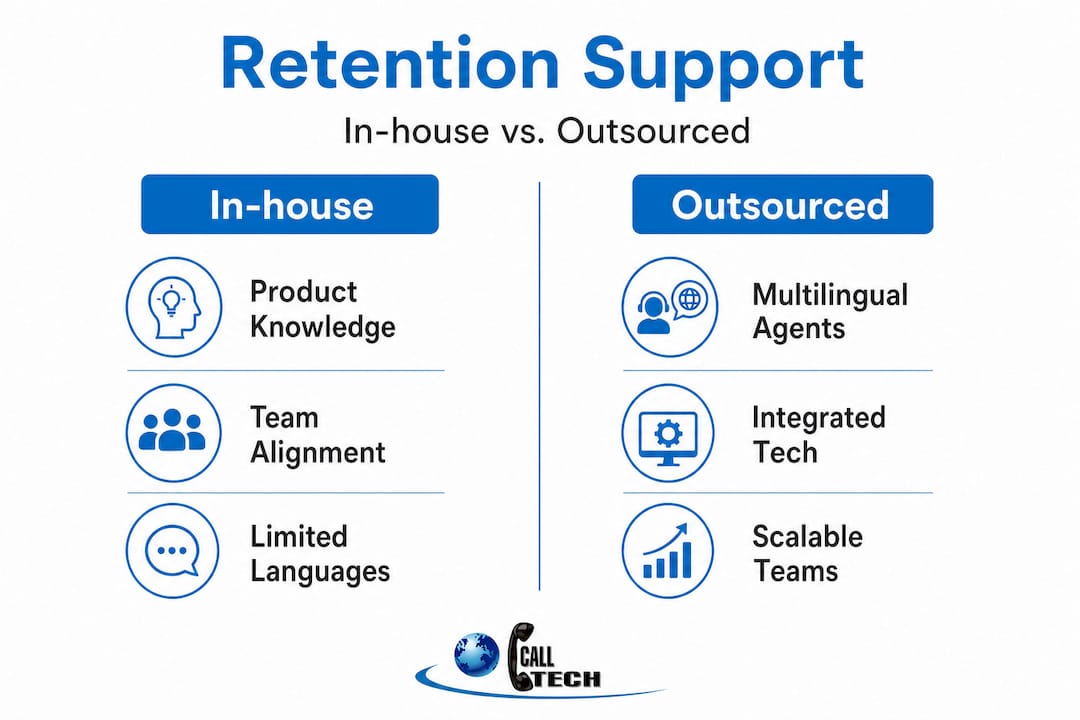
In-house teams have advantages: deep product knowledge, cultural alignment, and easier escalation paths. But they consistently struggle with language coverage gaps, overnight and weekend shifts, and scaling up during peak periods without over-hiring.

Outsourced providers that specialize in retention support bring fully trained multilingual teams, pre-integrated technology stacks, and measurable SLA commitments from day one. The pattern across telecom and e-commerce operations confirms that providers with robust CRM integration and strict QA discipline deliver faster resolution times and measurably better retention rates than in-house teams operating with fragmented tools.
One frequently underappreciated advantage of outsourcing is the data discipline it forces. A good provider delivers regular reporting on first response time, resolution rate, escalation volume, and CSAT scores. That accountability creates a feedback loop your internal team may lack the bandwidth to maintain consistently.
CRM-powered multilingual support eliminates the context problem almost immediately. Agents log in with your customer data already accessible, meaning no cold-start delay. For operations managing multiple markets, scalable support workflows built for global growth prevent the bottlenecks that kill retention programs during expansion.
Pro Tip: When evaluating outsourcing partners, ask specifically how they handle CRM handoff between channels. If the answer is vague, their omnichannel integration is probably surface-level. Real retention impact requires real data continuity at every customer touchpoint.
How to implement and optimize customer retention support
Once the decision to outsource is made, here's how telecom, SaaS, and e-commerce leaders can move from plan to execution for optimal retention gains. The implementation phase is where most programs either gain momentum or stall. Having a clear sequence matters.
-
Map the customer journey. Before you can fix retention, you need to know exactly where customers are leaving. Map every major touchpoint from onboarding through renewal, flag the stages with the highest drop-off rates, and assign clear ownership for each one. This map becomes the blueprint for your retention support program.
-
Define SLAs tied to retention KPIs. Generic SLAs like "respond within 24 hours" are not enough. Your SLAs need to connect directly to retention outcomes. For example, a SaaS business might set a target of resolving billing disputes within 4 hours, because billing frustration is one of the top three churn triggers. The SLA and QA rigor pattern shown in high-performing operations always ties service standards directly to business outcomes, not just internal process benchmarks.
-
Integrate your systems. Connect your CRM, helpdesk, and communication platforms so agents have full context on every interaction. This is non-negotiable for effective retention work. A disconnected stack means agents can't see past issues, subscription status, or behavioral flags that indicate churn risk.
-
Select your outsourcing scope. Decide which functions to outsource first based on your biggest gaps. Common starting points are overnight language coverage, specialist billing and renewal support, and win-back outreach campaigns. Use a structured support improvement guide to prioritize based on impact.
-
Build continuous review loops. Retention support does not improve passively. Set monthly reviews of your key metrics, listen to call recordings, read chat transcripts, and actively look for patterns that signal systematic issues. Review your inbound support best practices regularly to catch drift early.
Here's a quick reference for the metrics that matter most:
| KPI | What it measures | Target benchmark |
|---|---|---|
| First response time | Speed of initial agent reply | Under 2 minutes for live chat |
| Time to resolution | Total time to close a ticket | Under 24 hours for standard issues |
| Churn rate | Percentage of customers lost per period | Varies by industry; track trend over time |
| Customer LTV | Revenue per customer over full relationship | Track for improvement after support changes |
| CSAT score | Customer satisfaction per interaction | Above 85% consistently |
| Renewal rate | Percentage renewing subscriptions | Set targets by segment |
Key retention support tools worth integrating:
- CRM platforms (Salesforce, HubSpot, Zendesk) for customer history and behavioral data
- QA monitoring tools for call and chat scoring
- Churn prediction models built on usage and engagement signals
- Multilingual communication platforms with channel routing and translation support
The real secret to retention: It's not just what you do, but how you integrate
Here's what most customer support leaders get wrong: they treat retention as a staffing challenge. Hire better agents. Train them harder. Maybe add a new helpdesk tool. These changes help at the margins. But the operations that genuinely outperform their competitors on retention do something different. They treat integration as the core competency, not a technical afterthought.
We have seen this pattern clearly in nearly 20 years of working across telecom, SaaS, and e-commerce operations. An excellent agent with a fragmented toolset is less effective than a good agent with full customer context available instantly. When your CRM does not talk to your helpdesk, and your helpdesk does not talk to your communications platform, every customer who reaches support is essentially a stranger. The agent starts cold. The customer has to repeat themselves. Frustration builds. The churn risk goes up, not down.
The integrated workflow and QA pattern across high-performing operations is not a coincidence. It reflects a deliberate choice to invest in the connective tissue of support, not just the individual pieces. In our experience, more than 90% of failed retention interventions trace back to siloed tools or agents lacking actionable context at the moment of customer contact.
The other underrated factor is QA discipline. Most organizations run QA sporadically, or only when something goes visibly wrong. The operations that consistently win on retention treat QA as a weekly practice, not a quarterly audit. They score calls and chats, share findings with agents, track score trends over time, and connect quality data directly to retention outcomes. That discipline, run consistently at scale, is the unfair advantage that separates long-term retention champions from everyone else. Investing in support workflow integration is where this starts operationally.
Ready to scale up your retention support?
If the framework above describes where you want to be but not yet where you are, the gap is likely a combination of language coverage, system integration, and QA consistency. These are exactly the gaps CallTech Outsourcing is built to close.

CallTech has nearly 20 years of experience providing multilingual outsourcing call center services across telecom, SaaS, and e-commerce. Our teams operate in more than 15 European languages, with full CRM integration, omnichannel coverage, and strict SLA and QA monitoring built in from day one. Whether you need dedicated retention specialists, win-back campaign support, or around-the-clock multilingual support for e-commerce, we offer solutions that are measurable, scalable, and cost-efficient. Ready to engage customers globally with the operational rigor that drives real loyalty? Let's talk.
Frequently asked questions
What's the difference between regular customer support and retention support?
Retention support focuses specifically on keeping current customers engaged and loyal through proactive outreach, churn risk detection, and data-driven interventions, while regular support addresses individual issues as they arise without a structured focus on long-term loyalty outcomes.
How can multilingual support improve customer retention?
When customers can communicate in their native language, they experience less friction and more confidence in your brand, which directly reduces churn risk in multilingual markets where language barriers often accelerate disengagement.
What KPIs should I track to measure retention support success?
The most important KPIs are churn rate, customer lifetime value, renewal rate, first response time, time to resolution, and CSAT score, all tracked consistently over time to identify trends rather than one-off performance snapshots.
When should companies consider outsourcing their retention support?
Outsourcing makes the most strategic sense when your internal team lacks multilingual coverage, cannot maintain consistent SLA performance across time zones, or does not have the integrated tools needed to deliver context-aware retention support at scale.