

TL;DR:
- Back office outsourcing offers strategic scalability and reduces costs for telecom and SaaS companies.
- Successful outsourcing depends on strong governance, clear KPIs, and phased implementation.
- Properly managed outsourcing improves efficiency, multilingual support, and customer satisfaction.
Most telecom and SaaS leaders approach back office outsourcing as a cost-cutting lever. That framing is partially right but mostly incomplete. The real value is strategic: the ability to scale multilingual operations across markets without building expensive in-house infrastructure. Companies that recognize this distinction cut total cost of ownership by 37–38% compared to fully in-house models. This guide covers what back office outsourcing actually includes, the concrete benefits for telecom and SaaS firms, how to manage the risks, and a practical roadmap for implementation.
Table of Contents
- What is back office outsourcing?
- Core benefits: Why telecom and SaaS firms outsource
- Risks, pitfalls, and governance best practices
- How to evaluate and implement a back office outsourcing solution
- Real-world outcomes: Success stories and lessons learned
- The uncomfortable truth: Why most outsourcing projects fail (and how to get it right)
- Ready to scale with smarter back office outsourcing?
- Frequently asked questions
Key Takeaways
| Point | Details |
|---|---|
| Major cost savings | Back office outsourcing can save telecom and SaaS companies up to 38 percent in total cost of ownership. |
| Efficient global support | Outsourcing partners provide multilingual talent and 24/7 service, improving customer experience and scalability. |
| Governance is critical | Strong oversight, SLAs, and vendor alignment are essential to maximize value and minimize risks. |
| Scalable for growth | Phased outsourcing lets companies pilot and expand successful processes while avoiding disruption. |
What is back office outsourcing?
Back office outsourcing means delegating internal, process-driven functions to an external provider so your core team can focus on growth. These are not customer-facing roles. They are the engine that keeps operations running: data entry, billing, compliance reporting, CRM administration, HR processing, IT support, and multilingual documentation. Without these functions working smoothly, even the best customer-facing teams fail.
For telecom and SaaS firms, the distinction between front office and back office matters. Front office covers direct customer interactions such as sales calls, live chat, and technical support. Back office covers what happens before and after those interactions: account updates, invoice processing, ticketing workflows, and regulatory reporting. Both can be outsourced, but the back office is often where the most scalable gains exist.
Common back office functions outsourced by telecom and SaaS companies include:
- Billing and invoice management
- CRM data entry and administration
- Multilingual customer documentation and localization
- Compliance and regulatory reporting
- Subscription management and account changes
- IT helpdesk first-line processing
As one resource on business process outsourcing notes, the strongest case for outsourcing is when a function is repeatable, scalable, and non-core to your product strategy.
"Back office functions are critical for operational efficiency but can be efficiently outsourced for cost and scale advantages."
Key drivers pushing firms toward outsourcing include competitive pricing pressure, the need for 24/7 multilingual coverage, and the advantages of outsourcing specialized expertise that would take years to build internally. In short, back office outsourcing is not a shortcut. It is a deliberate structural choice.
Core benefits: Why telecom and SaaS firms outsource
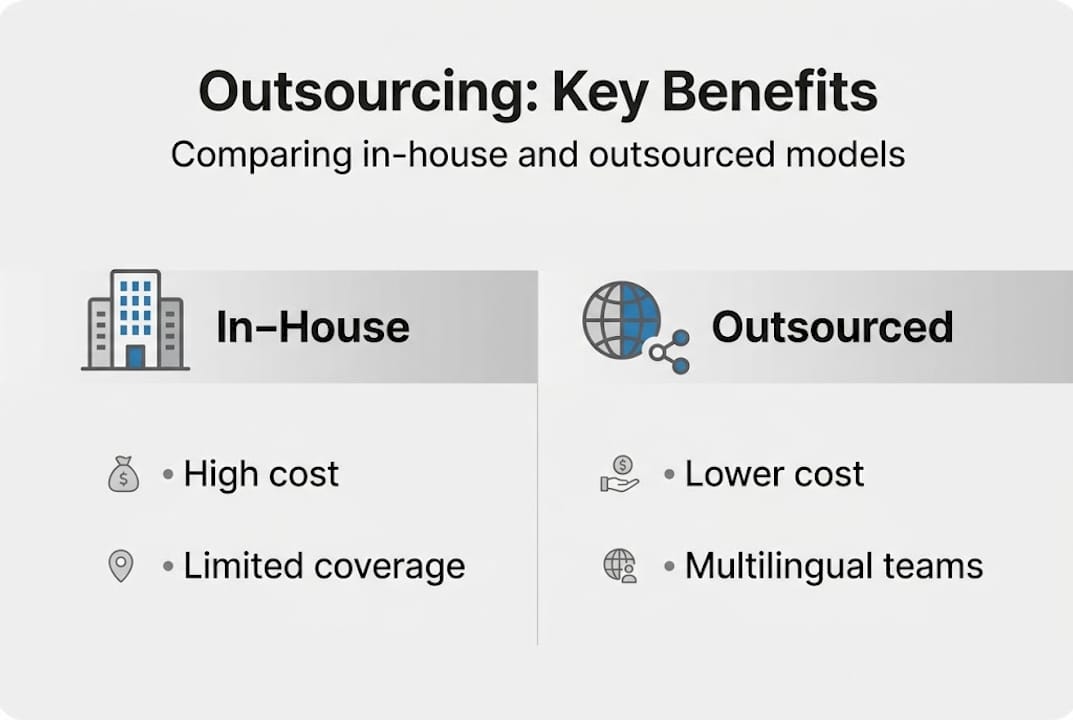
The benefits go well beyond the bottom line, though the bottom line is a strong starting point. Cost savings average 37–38% in total cost of ownership for telecoms that adopt strategic outsourcing. That number includes reductions in labor, office overhead, software licensing, training, and management time.

| Benefit area | In-house model | Outsourced model |
|---|---|---|
| Labor cost | High (local rates) | Lower (specialized providers) |
| Language coverage | Limited | 15+ European languages |
| Scaling speed | Slow (months) | Fast (weeks) |
| 24/7 availability | Expensive | Included in SLA |
| Tech integration | Custom build | Provider-managed |
Beyond cost, telecom and SaaS firms gain access to multilingual teams that can support customers across Europe without the complexity of hiring locally in each country. For a SaaS company launching in three new markets simultaneously, that is the difference between a smooth rollout and a support backlog that damages early retention.
Flexibility is another underrated benefit. Outsourced back office teams can scale up during product launches, billing cycles, or regulatory deadlines, then scale back without the pain of layoffs or idle headcount. The administrative outsourcing savings extend to technology too. Providers bring pre-built CRM systems for support that would cost significant time and budget to develop in-house.
Key benefits at a glance:
- Predictable monthly costs instead of variable overhead
- Rapid multilingual capacity without local hiring
- Access to specialist expertise in billing, compliance, and localization
- Faster response to demand spikes
Pro Tip: When evaluating cost savings, always calculate the fully loaded cost of your in-house team: salary, benefits, training, turnover, and technology. Most companies underestimate in-house costs by 20–30% because they exclude indirect expenses.
Risks, pitfalls, and governance best practices
The benefits are real but so are the risks. Over-reliance can cause disruption when governance is weak. Decision-makers who treat outsourcing as a set-and-forget move almost always regret it.
Common risks include:
- Vendor lock-in: Becoming dependent on one provider with no exit strategy creates leverage you do not want to hand over.
- Compliance gaps: In regulated industries like telecom, outsourced teams must operate within GDPR and sector-specific rules. A provider unfamiliar with your regulatory environment is a liability.
- Data privacy exposure: Sharing customer data with third parties requires airtight data processing agreements and regular security audits.
- Loss of visibility: Without structured reporting, you lose insight into how processes are performing until something breaks.
| Factor | In-house | Outsourced (with governance) |
|---|---|---|
| Process visibility | High | High (with KPI dashboards) |
| Flexibility | Low | High |
| Disruption risk | Low | Medium (manageable) |
| Cost efficiency | Low | High |
The fix is governance. A solid governance framework includes clear SLAs with defined response times, KPIs reviewed weekly, regular compliance audits, and a dual escalation path so issues never stall at one contact. Resources on outsourcing governance consistently show that firms with structured oversight outperform those without it. For further perspective on scalable outsourcing methods, a phased approach reduces exposure significantly.
If you want to understand what proper provider structure looks like from the inside, an outsourcing company setup guide offers useful context on what mature providers build into their operations.
Pro Tip: Never rely on a single vendor for all critical functions. Build at least one fallback option into your contract, and negotiate clear exit clauses from day one.
How to evaluate and implement a back office outsourcing solution
Once risks are understood, you need a structured process for evaluation and implementation. Rushing this stage is where most firms make costly mistakes.
Follow these steps:
- Identify the functions to outsource: Map your current back office processes. Rank them by volume, complexity, and strategic sensitivity.
- Create an RFP with clear requirements: Include language needs, tech stack compatibility, compliance requirements, and expected SLAs.
- Shortlist providers with sector experience: Prioritize vendors with a proven track record in telecom or SaaS, not just generic BPO.
- Run a pilot with one function: Test real performance before committing. A 60 to 90 day pilot reveals gaps that proposals never show.
- Scale with lessons learned: Use pilot data to refine processes, then expand scope gradually.
Evaluation criteria that matter most:
- Multilingual capacity (language breadth and native speaker quality)
- Technology integration capabilities with your existing CRM and ticketing tools
- Data security certifications and GDPR compliance
- Transparent pricing with no hidden scaling costs
Balancing cost savings with governance is what separates successful implementations from expensive lessons. For guidance on partnering for global support and sector-specific telecom outsourcing tips, the implementation groundwork matters as much as provider selection. If your primary need is technical resolution workflows, help desk outsourcing is worth evaluating as a standalone entry point.
Real-world outcomes: Success stories and lessons learned
Real outcomes ground this discussion in practical reality. Firms that have succeeded with back office outsourcing share consistent patterns.
A European SaaS firm expanding into five new language markets outsourced its multilingual ticketing and customer documentation to a specialized provider. Within three months, first-response times dropped by 40%, and customer satisfaction scores in the new markets matched those in the company's home market. The key: they ran a structured pilot and defined SLAs before full rollout.
A telecom provider centralizing its compliance reporting and billing administration with an outsourcing partner achieved measurable TCO reductions within the first year while freeing its in-house team to focus on network development. Case studies confirm operational gains and improved customer outcomes when proper oversight is in place.
Lessons from firms that struggled are equally instructive:
- Selecting a vendor based on price alone, without evaluating cultural fit or process maturity, led to SLA breaches and customer churn.
- Skipping the pilot phase and outsourcing entire departments in one move created integration chaos that took months to untangle.
- Ignoring staff retraining during transition resulted in internal resistance that slowed adoption and undermined results.
"The firms that succeed treat outsourcing as a partnership, not a transaction. Governance, communication, and shared accountability are what separate results from regrets."
The tools you use to manage outsourced teams matter too. Structured customer service outsourcing tools make performance visible and keep both teams accountable to the same standards.
The uncomfortable truth: Why most outsourcing projects fail (and how to get it right)
Here is what the industry rarely admits: most outsourcing failures are not caused by bad vendors. They are caused by bad briefs, unrealistic expectations, and a fundamental mismatch between what a company wants and what it is willing to manage.
Decision-makers chase the lowest price point, skip due diligence on vendor culture, and then blame the provider when results disappoint. The real issue is almost always internal: no one owned the relationship, KPIs were vague, and escalation paths were improvised.
From nearly 20 years of running multilingual back office operations, we have seen one truth hold consistently: the clients who succeed are the ones who treat the outsourcing partner as an extension of their team, not a vendor to be managed at arm's length.
Weak governance is the single biggest predictor of failure. Weekly check-ins, transparent KPI dashboards, and dual escalation paths are not bureaucratic overhead. They are the infrastructure that makes outsourcing actually work. Understanding common outsourcing mistakes before you sign a contract is the single best investment you can make in your program's success.
Start with one function. Prove the model. Then expand with confidence.
Ready to scale with smarter back office outsourcing?
The insights in this guide reflect the reality of what works and what does not in multilingual back office outsourcing for telecom and SaaS firms. The next step is finding a partner who brings both the operational depth and the language coverage your markets demand.

At CallTech Outsourcing, we have supported telecom and SaaS companies across Europe since 2005, providing multilingual call center services in more than 15 European languages. Whether you need to enhance customer engagement across new markets or explore outsourcing for cost savings that actually move the needle, our teams are built for exactly this challenge. Reach out to discuss a tailored approach for your operations.
Frequently asked questions
Which back office functions are best suited for outsourcing in telecom and SaaS?
Common candidates include billing, account management, CRM admin, compliance reporting, and multilingual customer documentation. These functions are commonly outsourced for scale because they are repeatable and high-volume.
How do I ensure data security and compliance with an outsourcing partner?
Choose providers with robust compliance policies, clear SLAs, regular audits, and proven industry credentials. Governance and oversight are critical for managing data risk in outsourced back office functions.
Does back office outsourcing actually improve customer satisfaction?
When implemented well, outsourcing can boost responsiveness and language coverage, positively affecting customer satisfaction scores. Operational gains and improved outcomes have been consistently reported with proper outsourcing oversight.
What is the typical cost savings range for telecom and SaaS firms outsourcing back office?
Expect a 37–38% TCO advantage when leveraging strategic outsourcing in telecom and SaaS, compared to fully in-house operational models.
How long does it take to implement a back office outsourcing partnership?
With proper planning, a phased rollout can take between 2 and 6 months depending on project scope, function complexity, and provider expertise.
Recommended
- Why outsource administrative services: 60% cost savings
- CRM systems power outsourced multilingual support: 70% savings
- Help desk outsourcing guide: Boost efficiency & CX
- Cost-effective outsourcing methods for scalable support
- Korp.ph | How to Incorporate a BPO or Outsourcing Company in the Philippines: Step-by-Step Guide